Telecom operators are expanding wholesale network services beyond traditional mobile roaming to generate revenue from fiber infrastructure, data-center connectivity, enterprise networks and mobile virtual network operator (MVNO) agreements.
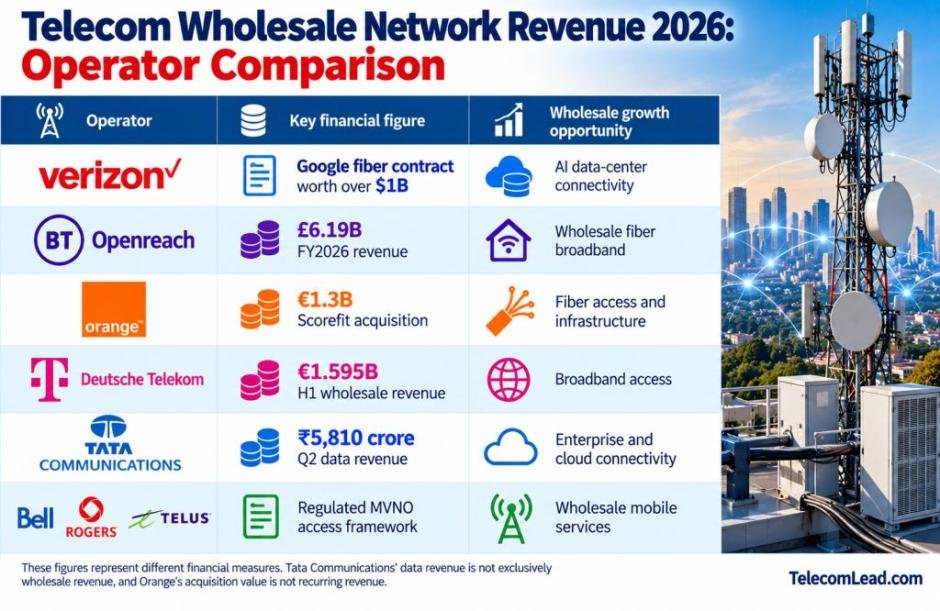
Verizon secured a dark-fiber agreement worth more than $1 billion with Google, BT Openreach generated £6.19 billion in annual revenue, and Tata Communications reported ₹5,810 crore in quarterly data revenue.
However, Deutsche Telekom’s 1.7 percent decline in German wholesale revenue demonstrates that network ownership does not automatically guarantee revenue growth.
As AI data centers and cloud infrastructure expand, telecom operators are targeting long-term network-access contracts that can generate recurring revenue without requiring direct relationships with every end customer.
Verizon: $1 Billion Google Deal Highlights AI Fiber Demand
Verizon signed a dark-fiber agreement worth more than $1 billion with Google in July 2026, highlighting growing demand for high-capacity connectivity between AI data centers.
Dark fiber allows enterprise customers to use dedicated optical fiber infrastructure while managing their own transmission equipment.
The arrangement provides Google with network capacity for cloud and AI workloads while allowing Verizon to monetize its fiber infrastructure through a long-term commercial agreement.
Verizon CEO Dan Schulman indicated that additional contracts could generate several billion dollars in revenue over multiple years.
What Could Large Fiber Contracts Generate?
A hypothetical $1 billion contract recognized evenly over 10 years would represent approximately $100 million in annual revenue.
A $3 billion portfolio of similar contracts would represent $300 million annually under the same assumption.
These are illustrative calculations, not Verizon’s disclosed contract duration or revenue recognition schedule.
The financial opportunity depends on contract terms, construction commitments, network availability and ongoing maintenance costs.
For telecom operators, AI data-center connectivity creates opportunities to monetize long-haul fiber routes, metropolitan networks and dedicated enterprise infrastructure.
BT Openreach: £6.19 Billion Wholesale Revenue From Fiber
BT Group’s Openreach business provides a major example of wholesale broadband monetization.
Openreach generated £6.19 billion in revenue during FY2026, increasing 1 percent year over year.
Its full-fiber network covered more than 22.9 million premises, with 8.8 million connected customers after adding a record 2.2 million connections.
Fiber take-up exceeded 38 percent, while broadband ARPU increased 4 percent to £16.70.
Openreach invested £3.171 billion in capex, increasing 12 percent, as it expanded fiber coverage.
The company targeted 25 million premises passed by December 2026.
Why Fiber Take-Up Matters
Building fiber networks creates substantial upfront costs, but wholesale revenue depends on the number of customers using those networks.
For example, a network passing one million premises with 30 percent take-up serves 300,000 connections.
Increasing take-up to 40 percent would add 100,000 connections without requiring another one million premises to be passed.
At an illustrative wholesale revenue of £15 per connection monthly, those additional customers would generate £18 million in annual revenue.
The example excludes connection costs, service expenses and wholesale pricing differences.
BT’s FY2026 annual report provides further information about Openreach’s financial performance.
Orange: €1.3 Billion Fiber Acquisition Reshapes Wholesale Economics
Orange reported H1 2026 revenue of €20.9 billion, increasing 3.5 percent.
Non-recurring wholesale contributions in France supported reported growth. Excluding these contributions, revenue growth would have been approximately 3 percent.
Orange also completed its €1.3 billion acquisition of Scorefit in July 2026.
Scorefit holds fiber access purchased on the wholesale market in France for Orange.
The transaction simplifies Orange’s fiber access arrangements as the company transitions from copper infrastructure to fiber broadband.
The acquisition illustrates an important wholesale strategy: operators can choose between purchasing long-term access rights and controlling infrastructure assets through ownership.
However, the €1.3 billion transaction value represents an acquisition investment, not additional wholesale revenue.
The financial implications include access costs, capital requirements and long-term network control.
Deutsche Telekom: Wholesale Revenue Falls Despite Fiber Expansion
Deutsche Telekom reported €1.595 billion in German wholesale revenue during H1 2026, declining 1.7 percent year over year.
Second-quarter wholesale revenue fell 4.5 percent to €790 million.
Wholesale broadband lines declined from 8.479 million to 8.426 million over 12 months, representing a reduction of approximately 53,000 lines.
Fiber-optic lines accounted for 7.574 million wholesale broadband connections.
The company attributed part of the revenue decline to the expiration of contractually agreed price increases under its commitment model.
The results demonstrate that wholesale performance depends on both network utilization and pricing.
Even when fiber infrastructure remains widely used, revenue can decline if contract prices change or wholesale customer volumes weaken.
The figures are detailed in Deutsche Telekom’s H1 2026 Germany segment report.
Tata Communications: ₹5,810 Crore Data Revenue and 18.6% Digital Growth
Tata Communications reported Q2 FY2027 gross revenue of ₹6,688 crore, increasing 9.6 percent year over year.
Data revenue increased 12.2 percent to ₹5,810 crore, while digital portfolio revenue rose 18.6 percent to ₹3,016 crore.
Data revenue represented approximately 86.9 percent of reported gross revenue.
The company identified data-center-to-data-center connectivity as a structural growth opportunity.
Its international network supports enterprise connectivity, cloud access, managed services and digital platforms.
Unlike conventional wholesale broadband businesses, Tata Communications combines underlying network transport with higher-value enterprise solutions.
This approach can create additional revenue from cloud connectivity, security and managed digital infrastructure.
However, its data revenue includes services beyond wholesale access and should not be compared directly with Deutsche Telekom’s wholesale revenue.
See Tata Communications’ Q2 FY2027 financial results.
MVNO Agreements: Wholesale Mobile Revenue Without Retail Customers
MVNO agreements allow companies to sell mobile services under their own brands while purchasing network access from established mobile operators.
For network owners, MVNO partnerships can generate wholesale revenue from spare network capacity and improve infrastructure utilization.
Canada provides an example of regulated wholesale mobile access.
In July 2026, the Canadian Radio-television and Telecommunications Commission reaffirmed its framework for mandated facilities-based MVNO access.
The framework applies to eligible regional wireless carriers under specified conditions involving Bell, Rogers, TELUS and Saskatchewan Telecommunications.
Eligibility includes spectrum licensing, carrier registration, an operating home network and active retail services.
Illustrative MVNO Revenue Economics
Consider an operator hosting one million MVNO subscribers.
| Monthly wholesale revenue per subscriber | Annual revenue |
| $3 | $36 million |
| $5 | $60 million |
| $8 | $96 million |
| $10 | $120 million |
These are illustrative gross revenue scenarios, not actual Canadian MVNO tariffs.
Profitability depends on network traffic, interconnection expenses, customer usage and contractual pricing.
AI Data Centers Create Another Wholesale Fiber Opportunity
AI infrastructure is increasing demand for dedicated connectivity between data centers, cloud regions and enterprise facilities.
For example, a cloud company connecting 20 data centers may require multiple high-capacity fiber routes, redundant paths and service-level guarantees.
Telecom operators can monetize these requirements through dark fiber, wavelength services, Ethernet connectivity and managed network agreements.
Unlike consumer broadband, enterprise connectivity contracts may include long-term capacity commitments and customized infrastructure.
However, dedicated fiber contracts can also require significant upfront construction expenditure, making return on invested capital an important measure.
Which Wholesale Business Models Offer Growth Opportunities?
The 2026 financial results reveal four different approaches.
Dark fiber and AI connectivity: Verizon’s Google agreement demonstrates demand for dedicated data-center networks.
Wholesale broadband: BT Openreach generates recurring access revenue by supplying fiber infrastructure to retail service providers.
Fiber access restructuring: Orange is changing its infrastructure ownership arrangements, while Deutsche Telekom’s revenue decline highlights wholesale pricing pressure.
Enterprise and digital connectivity: Tata Communications is expanding data and digital services beyond conventional network transport.
MVNO agreements provide another opportunity for operators to generate revenue from mobile infrastructure without directly acquiring every retail customer.
For telecom CFOs and wholesale executives, the most important indicators are revenue per wholesale connection, fiber take-up, contract duration, network utilization, capex intensity and operating margin.
As AI data centers and enterprise cloud demand expand, wholesale network access could become an important revenue source for telecom operators with extensive fiber and mobile infrastructure.
FASNA SHABEER