
Global telecom capital expenditure increased 5 percent in the first half of 2026, driven by investments in 5G networks, fiber broadband, artificial intelligence (AI), cloud computing and data centers.
According to Dell’Oro Group’s telecom capex assessment, global telecom equipment revenue also increased approximately 5 percent.
MTN Consulting reported that 145 telecom operators invested $72.9 billion in Q2 2026, representing 7.2 percent annual growth. Annualized capital expenditure reached $304.5 billion.
The investment cycle is divided between traditional connectivity infrastructure and computing platforms supporting AI applications, enterprise cloud services and data-intensive workloads.
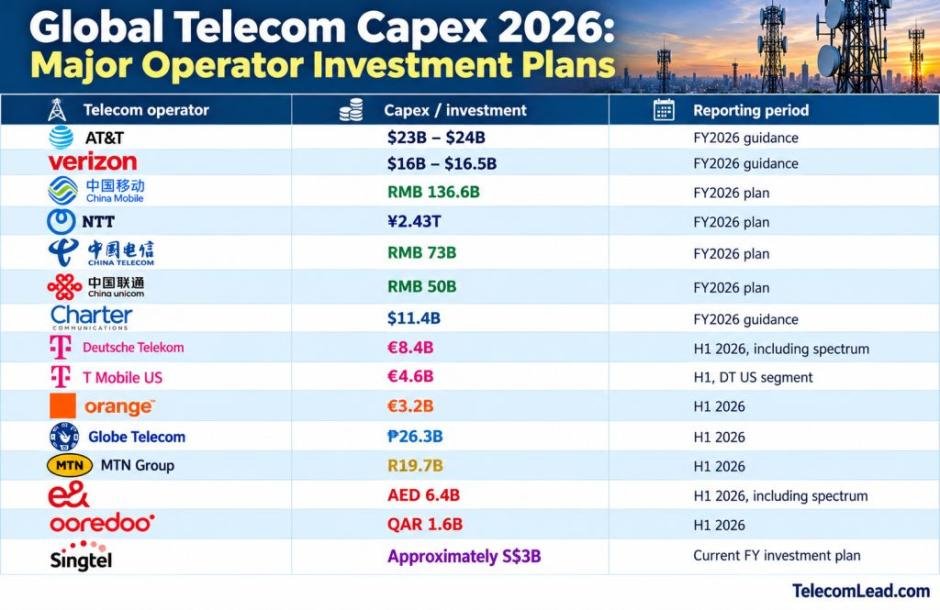
These are selected figures, not a currency-converted spending ranking. Capital investment, cash capex and spectrum-inclusive measures differ. T-Mobile US is included within Deutsche Telekom’s consolidated results.
AT&T: $24 Billion Investment Plan for Fiber and 5G
AT&T remains one of the largest telecom infrastructure investors, targeting $23 billion–$24 billion in capital investment during 2026.
Its latest Q3 2026 results show capital expenditure of $5.1 billion and capital investment of $5.6 billion.
AT&T reported 13.31 million fiber connections, up 23.4 percent year over year, and 2.94 million fixed wireless connections, up 65.4 percent.
The company’s fiber network reached more than 39 million consumer and business locations, with a target of over 40 million by year-end and more than 60 million by 2030.
AT&T expects annual capital investment of $22 billion–$23 billion during 2027–2028, indicating a gradual moderation in spending while expanding broadband coverage.
Verizon: $16.5 Billion Capex Supports Wireless and Broadband
Verizon invested $8.2 billion during H1 2026, with annual capital expenditure guidance of $16 billion–$16.5 billion.
Operating cash flow increased 9.9 percent to $18.4 billion, while free cash flow reached $10.2 billion.
Its investment priorities include 5G capacity expansion, network modernization, fiber infrastructure and broadband customer growth.
Verizon’s first-half free cash flow exceeded its capex expenditure by approximately $2 billion, although free cash flow is already calculated after relevant capital spending and should not be interpreted as an additional capex budget.
China Mobile, China Telecom and China Unicom: AI Computing Becomes a Major Priority
Chinese operators are directing capital expenditure toward AI computing and intelligent networks.
| Operator | 2026 capex plan | H1 2026 investment | AI / computing focus |
| China Mobile | RMB 136.6B | RMB 61B | RMB 15.6B computing-network investment |
| China Telecom | RMB 73B | RMB 32.4B | Cloud and AI computing |
| China Unicom | RMB 50B | RMB 24.1B | Over 35% of planned capex for computing |
China Mobile’s computing-network investment represented approximately 25.6 percent of its H1 capital expenditure.
China Telecom reported cloud revenue of RMB 61.8 billion, demonstrating the commercial importance of cloud infrastructure alongside network investment.
China Unicom’s allocation of more than 35 percent of planned capex to computing represents over RMB 17.5 billion, based on its RMB 50 billion annual plan.
These figures indicate a shift from predominantly connectivity-focused investment toward integrated telecom, cloud and AI infrastructure.
NTT and Deutsche Telekom: Large-Scale Network Modernization
NTT plans approximately ¥2.43 trillion in fiscal 2026 capital investment, covering NTT DOCOMO mobile infrastructure, fixed broadband, enterprise ICT and data centers.
First-quarter investment reached approximately ¥511.8 billion.
Deutsche Telekom reported €8.4 billion H1 2026 cash capex including spectrum, with €7.8 billion excluding spectrum.
Its US segment, T-Mobile US, accounted for approximately €4.6 billion in cash capex before spectrum.
Germany’s fiber expansion and US wireless network modernization remain major priorities.
For additional financial details, see Deutsche Telekom’s H1 2026 report.
Charter, Orange, Telefónica, Vodafone and BT: Fiber Investment Continues
Charter Communications invested $5.73 billion in H1 2026, compared with $5.27 billion a year earlier.
Network upgrades and rebuilds accounted for $1.33 billion, while line extensions represented $1.54 billion. Charter expects approximately $11.4 billion full-year capex, excluding Cox transaction effects.
Orange invested €3.2 billion in H1, up 2.7 percent, with capital intensity of 15.2 percent.
Telefónica targets a capex-to-revenue ratio of approximately 12 percent in 2026. Its 5G network reached 83 percent population coverage across four core markets.
Vodafone recorded 22.7 percent growth in annualized capex in MTN Consulting’s Q2 assessment, reflecting network investment activity.
BT Group expects £4.2 billion–£4.3 billion in FY2027 capex, supporting Openreach fiber deployment and EE network modernization.
Bharti Airtel and Reliance Jio: Different Capex Trends in India
Bharti Airtel recorded 21 percent growth in annualized capex, according to MTN Consulting’s September 2026 assessment.
Its spending priorities include 5G capacity, fiber broadband, enterprise connectivity and network expansion across India and Africa.
Reliance Jio recorded an 8.8 percent decline in annualized capex, suggesting a different phase of its investment cycle.
Jio’s priorities include additional 5G capacity, fixed wireless access, fiber broadband and digital platforms.
Reliance Industries reported FY2026 group capex of ₹144,271 crore, but this includes non-telecom businesses and should not be presented as Jio-specific investment.
The contrasting trends highlight how Indian operators are balancing network expansion with capital efficiency.
Globe, MTN, e& and Ooredoo: Emerging-Market Network Investment
Globe Telecom invested ₱26.3 billion during H1 2026, increasing 39 percent.
Approximately 91 percent of spending supported data and digital infrastructure, including 878 new 5G sites and 80,052 fiber-to-the-home lines.
MTN Group invested R19.7 billion, representing capital intensity of 16.6 percent. Its data revenue increased 29.2 percent in constant currency, while operating free cash flow rose 27.5 percent to R25.1 billion.
e& reported AED 6.4 billion in H1 capex including spectrum and licenses, while underlying investment increased 17.1 percent to AED 4.9 billion.
Ooredoo invested QAR 1.6 billion, supported by revenue growth of 4.6 percent to QAR 12.5 billion.
Singtel, Lumen and TELUS: AI Data Centers Join Telecom Capex
Singtel expects approximately S$3 billion in capital investment, comprising S$1.8 billion in core capex and S$1.2 billion primarily for data centers, GPU-as-a-Service and AI infrastructure.
The AI-related allocation represents approximately 40 percent of its stated investment plan.
Lumen Technologies expects $3.2 billion–$3.4 billion in 2026 capex, excluding special items, supporting enterprise fiber and high-capacity networks for cloud and AI workloads.
TELUS increased its 2026 capex guidance from C$2.3 billion to approximately C$2.6 billion, including investments in network upgrades and sovereign AI data centers.
These examples demonstrate how telecom capital investment is expanding beyond traditional mobile and fixed access networks.
América Móvil, KDDI and SoftBank: Capital Efficiency Takes Priority
América Móvil continues investing in mobile broadband, fiber and enterprise networks across Latin America.
KDDI recorded a 4.2 percent decline in annualized capex in MTN Consulting’s Q2 2026 assessment. Its medium-term strategy targets capex equivalent to 12 percent or less of revenue.
SoftBank recorded a 3.5 percent decline in annualized capex, while maintaining investment priorities in mobile networks, enterprise connectivity and AI infrastructure.
These operators illustrate a parallel trend: improving network capacity without continuously increasing capital intensity.
Telecom Capex Outlook: 5G, Fiber and AI Reshape Investment Priorities
The 2026 telecom investment cycle reveals three major directions.
North America and Europe: Fiber broadband expansion, 5G modernization and network efficiency remain major investment priorities.
China and Asia-Pacific: Operators are allocating growing capital to AI computing, cloud platforms, data centers and intelligent networks.
India, Africa and other emerging markets: Mobile capacity, 5G coverage, fiber connectivity and digital infrastructure continue attracting substantial investment.
For telecom equipment suppliers, network infrastructure vendors and semiconductor companies, the critical opportunity is not simply higher operator capex. It is the changing composition of investment toward AI computing, optical networks, 5G Advanced, data centers and more efficient broadband infrastructure.
The operators best positioned for sustainable expansion will be those converting network investment into subscriber growth, enterprise revenue, stronger free cash flow and improved capital efficiency.
FASNA SHABEER