Telecom operators are strengthening backup power, diverse fiber routes, satellite backhaul and disaster-response capabilities as extreme weather threatens connectivity and increases restoration costs.
Hurricanes, floods, wildfires and severe storms can disrupt telecom services through several failures at once: damaged infrastructure, electricity outages, severed fiber and inaccessible roads. Protecting a tower alone therefore cannot guarantee that customers remain connected.
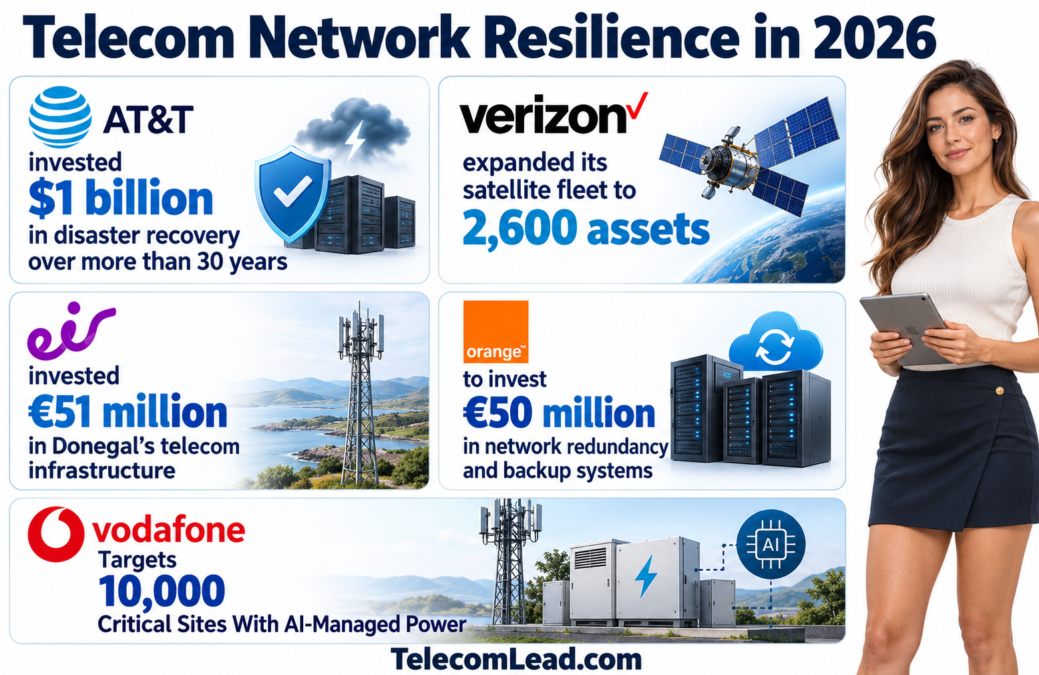
Operator investments illustrate the scale of preparedness. AT&T has invested more than $1 billion in disaster recovery over more than 30 years, while Verizon has expanded its satellite fleet to 2,600 assets. Vodafone’s Enhanced Power programme targets more than 10,000 critical mobile sites in Europe. These figures represent different investment periods and asset categories, rather than comparable annual spending totals.
AT&T Combines $1 Billion Recovery Investment With Weather Intelligence
AT&T’s 2026 hurricane preparedness programme combines weather monitoring, backup-power checks, pre-positioned generators and trained response teams.
Its Network Disaster Recovery programme includes more than 400 trained personnel with access to over 750 recovery assets nationwide. FirstNet’s response organisation is supported by more than 190 dedicated assets reserved for public safety.
AT&T’s Weather Operations Center combines meteorologists and weather modelling to support planning and response. Its Geo Modeler simulates changing network conditions and adjusts nearby cell sites to help close coverage gaps.
Before storms, teams test batteries, fuel generators and position additional power equipment for deployment. AT&T also increases capacity ahead of major storms to support higher demand.
The operational value comes from preparation. A generator available before roads become blocked can provide a faster response than equipment transported after a widespread outage.
Verizon Expands Satellite Recovery to 2,600 Assets
Verizon’s hurricane-season resilience strategy addresses both damaged infrastructure and lost backhaul.
Its 2,600 satellite assets include satellite-linked mobile cell sites, portable link kits and permanent facility connections. Verizon is testing permanent satellite backhaul at storm-prone macro sites in the southeastern US, combined with batteries and generators.
The operator also uses digital twins built from drone-captured 3D imagery. Comparing site images before and after a storm helps engineers identify damaged antennas, cables and other equipment and plan repairs.
Additional resources include nearly 3,000 mobile assets and more than 1,000 portable generators. These inventories cover different functions and should not be added together as a count of deployable cell sites.
A practical example is an intact tower isolated by a fiber cut. Backup power keeps equipment running, while satellite backhaul provides an alternative connection to the wider network. Both are needed to preserve service.
Eir Strengthens Poles and Exchange-Site Backup Power
Ireland’s Eir demonstrates how physical maintenance and distributed backup power support resilience.
The GSMA’s Mobile Economy Europe 2026 report says Eir invested more than €51 million in Donegal’s telecom infrastructure in recent years and replaced more than 160,000 poles nationwide over four years.
All 1,250 exchange sites have backup power. More than 250 critical sites have static generators, mobile generators are available at over 60 locations, and more than 60 percent of mobile sites have battery backup. These are reported infrastructure measures, rather than a single 2026 investment package.
Pole replacement helps address physical vulnerability, while backup power tackles electricity interruptions. However, continuity also depends on fuel availability, battery condition and access for repair crews.
Orange Allocates €50 Million to Redundancy and Backup
Orange disclosed plans in January 2026 to invest €50 million over five years in network redundancy and backup systems. Orange’s investment in network redundancy and backup systems illustrates dedicated funding for continuity alongside network expansion.
For fiber networks, effective redundancy depends on physical route diversity.
As an illustrative example, two connections entering a town through the same bridge can fail together if flooding destroys that crossing. Routes using separate crossings can reduce this shared exposure, provided they also avoid common dependencies elsewhere.
The same principle applies to mobile sites: a second backhaul connection delivers limited protection if both links pass through the same vulnerable duct or aggregation facility.
Vodafone Targets 10,000 Critical Sites With AI-Managed Power
Vodafone’s Enhanced Power initiative targets more than 10,000 critical European mobile sites, with a two-year rollout beginning in Portugal.
The programme prioritises locations serving emergency services, hospitals, government facilities and transport hubs. Its first phase specifies at least four hours of backup power for critical access sites and key aggregation locations.
Vodafone’s AI-controlled Adaptive Power Backup can remotely place non-essential equipment into low-energy states while preserving essential communications. The company says this can potentially double battery backup duration in certain scenarios.
This addresses an important trade-off during prolonged outages: preserving essential coverage may require temporarily reducing other network functions. Operators must test how these settings affect capacity and emergency-service availability.
Telenor Shows Why Grid Failures Matter
Telenor reported that approximately 600 of its 8,900 Norwegian base stations were temporarily out of service at the peak of Storm Amy in October 2025. The event demonstrates the operational exposure that informs subsequent resilience planning despite Telenor’s investment in Norwegian base stations.
Its climate-adaptation approach recognises the need to balance investment in stronger transmission, fiber, mobile networks and data centres against restoration and repair costs.
A site can survive severe winds yet lose connectivity because its electricity supply fails. Network planning therefore needs to assess utilities and transmission routes alongside telecom equipment.
Practical Examples of Extreme-Weather Network Protection
The following illustrative scenarios show why resilience requires several complementary measures.
Flood-prone sites: Raising electrical cabinets and power equipment above assessed flood levels can reduce exposure. Backup equipment also needs protection from the same flood.
Wildfire-affected communities: Portable cell sites with independent power and backhaul can provide temporary coverage where fixed infrastructure is unavailable, subject to safe deployment access.
Remote areas with blocked roads: Longer battery endurance and pre-positioned generators can help bridge the period before refuelling or repairs become possible.
Extreme heat: Cooling capacity, equipment-temperature monitoring and battery-condition checks can help operators identify thermal stress before service fails.
Hospitals and emergency centres: Route diversity, backup power and tested failover procedures can reduce dependence on a single infrastructure path.
These examples are planning applications, rather than quantified results from the operator programmes above.
Climate-Risk Exposure Makes Resilience a Capital-Planning Priority
The GSMA’s Mobile Net Zero 2026 report says 54 operators — 70 percent of those disclosing to CDP in 2025 — identified at least one climate-related risk in their operations or value chains.
Of these, 40 operators quantified potential financial impacts of up to $11 billion, with approximately 60 percent associated with long-term risks. The estimate covers disclosed climate-related risks and should not be presented as annual extreme-weather losses.
For telecom executives, resilience investment should be assessed through outage duration, customers affected, backup endurance, restoration time and repair expenditure. Prioritising sites with high exposure and critical service responsibilities helps connect capital spending to measurable operational protection.
FASNA SHABEER