Airtel, SK Telecom, Ooredoo, Orange and Deutsche Telekom are pursuing different AI infrastructure models, while Verizon demonstrates how operators can monetize the networks connecting large tech companies’ data centers.
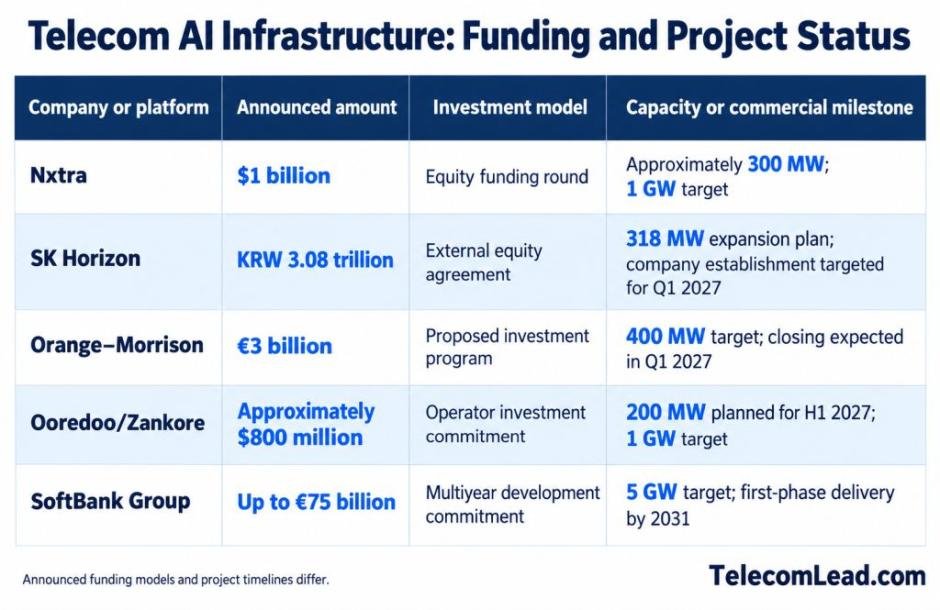
Telecom operators are expanding their infrastructure strategies as AI creates demand for data-center space, GPU computing and high-capacity connectivity. The commercial opportunity extends across several layers: hosting workloads, supplying compute and connecting facilities.
The key development is how operators are combining their networks, enterprise relationships and infrastructure expertise with new investment partners. Some are raising equity for dedicated data-center businesses. Others are selling AI computing services or securing fiber contracts.
The announced amounts require careful interpretation. Funding rounds, development commitments and investment programs are different from completed expenditure. Likewise, future capacity targets do not establish operating capacity or customer utilization.
Airtel’s Nxtra Announces $1 Billion Funding Round
India provides a major example of an operator expanding its data-center subsidiary with external capital.
Airtel’s March 2026 announcement outlined a $1 billion investment round for Nxtra. Alpha Wave Global would contribute $435 million, Carlyle $240 million and Anchorage Capital $35 million, with the remaining $290 million coming from Airtel.
The Nxtra investment announcement envisaged a valuation of approximately $3.1 billion after closing, with Airtel retaining control. The transaction was subject to Indian regulatory approvals.
Nxtra reported approximately 300 MW of capacity and targeted expansion to 1 GW over the following years. Its footprint included 14 large core data centers and more than 120 edge facilities.
The funding model combines operator ownership with institutional capital. Commercial execution will depend on converting expansion into contracted hosting and infrastructure services. The edge footprint adds geographic reach, but should not be interpreted as evidence that every facility supports high-density GPU workloads.
SK Telecom Builds a Dedicated Investment Platform
SK Telecom’s August 2026 announcement outlined a restructuring of SK Broadband to establish SK Horizon for data-center and submarine-cable operations.
KKR and the IMM Investment-Stonebridge consortium agreed to a combined KRW 3.08 trillion equity investment. After completion of all investment phases, SKT would retain 51 percent, with KKR holding 29 percent and the IMM consortium 20 percent.
SK Horizon’s capacity plan totals 318 MW, encompassing eight operating data centers and facilities under construction. The announcement targeted establishment of the company in Q1 2027, subject to the necessary procedures and approvals.
The SK Horizon investment agreement illustrates how operators can bring outside investors into infrastructure subsidiaries while retaining management control.
The strategic advantage is access to capital for expansion. The financial outcome will depend on delivery schedules, customer commitments and the earnings available to each shareholder.
Orange Proposes a €3 Billion Data-Center Platform
Orange’s Morrison deal, announced in July 2026, for a 50-50 French data-center joint venture is expected to close in Q1 2027.
The platform targets 400 MW, supported by a €3 billion investment program combining existing Orange assets, Morrison equity and debt. Orange would contribute five major data centers across four campuses.
Orange Business would distribute the platform’s colocation and hosting services to enterprises, SMEs and public-sector customers. That creates a proposed commercial channel alongside the infrastructure investment.
Ooredoo Moves From Hosting Into AI Compute
Ooredoo’s Zankore investment takes the operator into a different layer: supplying AI computing capacity.
Its August 2026 announcement outlined an approximately $800 million commitment for a 49 percent stake in the Indonesian platform, developed alongside Indosat Ooredoo Hutchison, Nokia and NVIDIA.
Zankore targets 1 GW of NVIDIA DSX AI Factory capacity, with approximately 200 MW planned for H1 2027.
The Ooredoo AI compute announcement described $600 million of cumulative contracted EBITDA contribution, while its detailed explanation framed the first-five-year contribution as an estimate.
Deutsche Telekom Shows Operating Customer Demand
Deutsche Telekom supplies evidence of an operating AI service rather than solely a development commitment.
Its Munich Industrial AI Cloud uses nearly 10,000 NVIDIA Blackwell GPUs. At its official launch, the company said more than one-third of capacity was already in use.
Named users included Agile Robots, working with AI and robotics, and PhysicsX, specializing in engineering simulation. Customers could book computing power and platform services for activities ranging from pilots to production workloads.
The Industrial AI Cloud launch also describes T-Systems’ infrastructure role and collaboration with SAP and Siemens.
For operators, the commercial lesson is that enterprise relationships and industry-specific services can complement physical infrastructure. Customer use is stronger evidence of progress than hardware specifications alone, although revenue and margins remain necessary to assess financial performance.
SoftBank’s €75 Billion Plan Sets a Different Scale
SoftBank Group announced a commitment to develop and operate 5 GW of AI data-center capacity in France, representing investment of up to €75 billion. SoftBank’s investment strategy indicates that the first phase envisages €45 billion and 3.1 GW in Hauts-de-France by 2031.
Verizon Demonstrates the Connectivity Revenue Opportunity
Operators can benefit from AI infrastructure through network contracts.
Verizon disclosed a Google dark-fiber agreement worth more than $1 billion in July 2026 to connect the large tech company’s data centers.
This demonstrates a commercial route built around telecom assets. Contract value, however, is different from annual recognized revenue and does not establish the deal’s margin.
For telecom executives, the choice between hosting, compute and connectivity should reflect customer demand, operating capabilities and capital requirements.
The measures that matter next are energized capacity, contracted customers, utilization, margins and cash generation. Announced investment establishes ambition; operating results will show how much value telecom companies capture from the AI infrastructure cycle.
FASNA SHABEER