Reliance Jio delivered the fastest mobile download speed and the lowest call-drop rate in TRAI’s August 2026 drive test across Balasore and surrounding areas in Odisha. Airtel recorded the highest upload speed, with both operators registering zero limited-service samples during voice coverage testing.
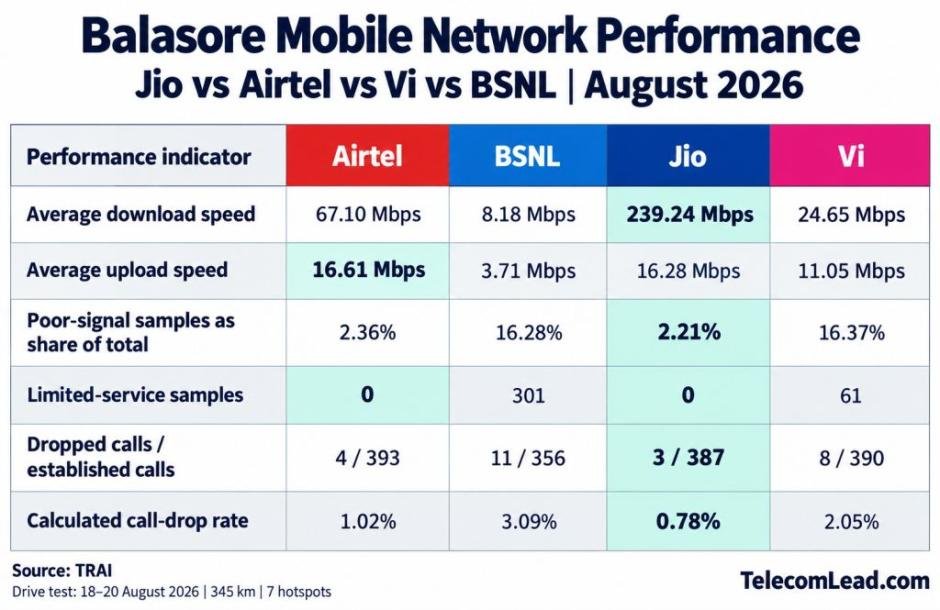
Jio achieved download speed of 239.24 Mbps, followed by Airtel at 67.10 Mbps, Vodafone Idea (Vi) at 24.65 Mbps, and BSNL at 8.18 Mbps. Upload performance was closer between the two leading operators: Airtel recorded 16.61 Mbps, slightly ahead of Jio’s 16.28 Mbps.
Telecom Regulatory Authority of India conducted the tests from August 18 to August 20, 2026, covering 345 km of driving routes and seven hotspots. The findings show differences in mobile data speeds, signal availability and voice reliability across the four operators.
Jio Leads Download Speeds by a Wide Margin
Jio’s 239.24 Mbps download speed was approximately 3.57 times Airtel’s, 9.71 times Vi’s, and 29.25 times BSNL’s measured performance.
The gap made downloads the clearest differentiator in the Balasore test. Jio combined the highest measured download throughput with the lowest proportion of poor-signal samples and the fewest dropped calls.
Airtel ranked second at 67.10 Mbps, approximately 2.72 times Vi’s 24.65 Mbps. BSNL recorded the lowest download speed at 8.18 Mbps.
These are overall measured mobile network performance across the test conditions. They should not be read as standalone 5G speed comparisons, since the tests used automatic network selection and the operators’ reported technology mixes differed.
Airtel Edges Jio on Upload Performance
Airtel led upload throughput at 16.61 Mbps, exceeding Jio’s 16.28 Mbps by 0.33 Mbps, or approximately 2%.
Vi recorded 11.05 Mbps, while BSNL achieved 3.71 Mbps. Airtel’s upload speed was approximately 1.50 times Vi’s and 4.48 times BSNL’s.
The narrow Airtel–Jio upload gap contrasts with their much larger download-speed difference. Upload throughput supports activities such as sending large files, uploading videos and transmitting live video, although these measurements alone do not establish overall application quality.
Jio and Airtel Record Fewer Coverage Gaps
Jio had 948 poor-signal samples out of 42,851, giving it the lowest calculated poor-signal share at 2.21%. Airtel followed closely with 1,029 out of 43,646 samples, or 2.36%.
BSNL recorded 6,758 poor-signal samples out of 41,512, equivalent to 16.28%. Vi registered 7,002 out of 42,776, or 16.37%.
Both Airtel and Jio recorded zero limited-service samples. BSNL registered 301, representing 0.73% of its samples, while Vi recorded 61, or approximately 0.14%.
Poor signal and limited service are separate measurements. A poor-signal sample indicates signal strength below the specified minimum; a limited-service sample identifies a more severe coverage limitation. The results therefore show both weaker signal availability and some limited-service observations for BSNL and Vi along the tested routes.
Jio Records Lowest Call-Drop Rate
Jio recorded three dropped calls from 387 successfully established calls, producing a calculated call-drop rate of 0.78%.
Airtel followed with four drops from 393 calls, or 1.02%. Vi recorded eight drops from 390 calls, equivalent to 2.05%, while BSNL registered 11 drops from 356 calls, or 3.09%.
Jio therefore led this voice-reliability measure, with Airtel close behind. Vi and BSNL experienced higher proportions of dropped calls during the test.
These figures measure failures after calls were successfully established. They do not provide a call setup success rate, which requires separate information on attempted calls.
Airtel Has Fewest Calls Affected by Silence
TRAI also measured voice silence lasting more than three seconds. The report distinguishes the number of affected calls from the total number of silence instances, since one call can experience multiple interruptions.
| Operator | Calls assessed | Calls with silence over 3 seconds | Total silence instances | Calculated share of affected calls |
| Airtel | 375 | 5 | 5 | 1.33% |
| BSNL | 356 | 21 | 31 | 5.90% |
| Jio | 372 | 6 | 6 | 1.61% |
| Vi | 376 | 8 | 9 | 2.13% |
Airtel performed best on this measure, followed by Jio. BSNL recorded the highest number of affected calls and total silence instances.
Measured Speeds Against Operator-Declared Throughput
All four operators exceeded their declared typical download throughput during the test.
Airtel measured 67.10 Mbps against a declared 23 Mbps; BSNL achieved 8.18 Mbps against 6.34 Mbps; Jio recorded 239.24 Mbps against 15 Mbps; and Vi achieved 24.65 Mbps against 15 Mbps.
For uploads, Airtel, Jio and Vi exceeded their declared figures of 10 Mbps, 7 Mbps and 8 Mbps, respectively. BSNL’s measured 3.71 Mbps was below its declared 5.53 Mbps.
These comparisons describe the measured test results against the submitted typical throughput figures; they do not establish speeds available at every location.
What the Balasore Test Shows
The test covered Balasore and surrounding locations, including Remuna, Soro, Nilagiri, Jaleswar and Baliapal. Stationary testing included Balasore Bus Stand, Chandaneswar Temple, Government District Hospital–Balasore, Jaleswar Railway Station, KKS Women College, Main Market Balasore and Max Mall.
Jio led downloads, poor-signal share and call-drop performance. Airtel led uploads and had the lowest share of calls affected by silence. Vi placed third on download and upload speeds, while BSNL recorded the lowest data throughput and the highest call-drop and silence-affected-call rates.