
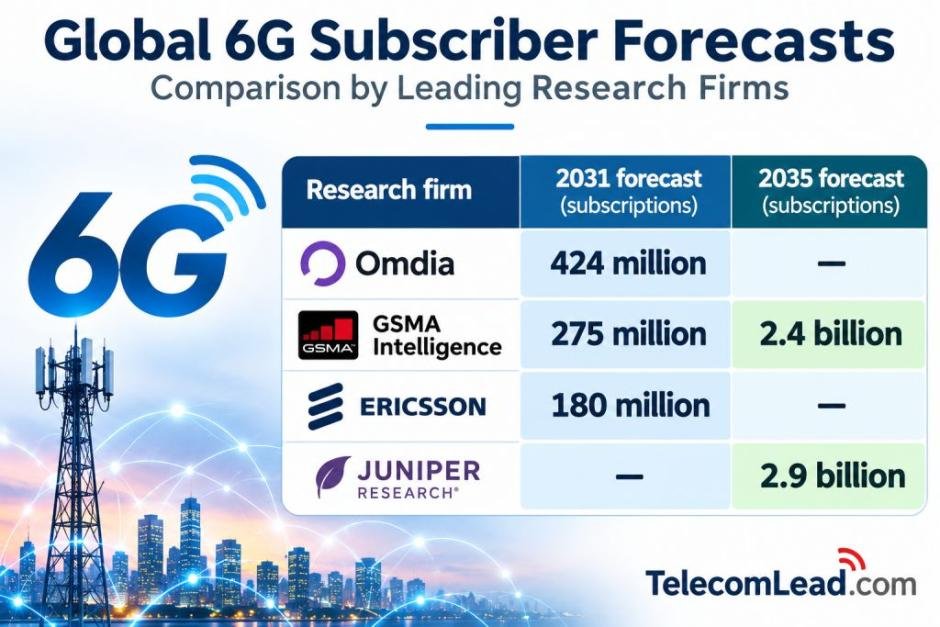
Global 6G mobile subscriptions will reach 424 million by 2031, with commercial networks operating in more than 50 countries, according to Omdia. However, 6G adoption will be slower than previous mobile generations as telecom operators face challenges related to network investment, spectrum availability, smartphone costs and limited consumer demand.
The latest Omdia report on 6G business indicates that 6G will account for approximately 2.8 percent of global mobile subscriptions by 2031, despite the technology’s expansion across major telecom markets.
China, the United States, South Korea, Japan, Saudi Arabia and the United Arab Emirates are expected to lead early 6G commercialization, while European telecom operators are likely to adopt a more cautious investment strategy.
According to the Ericsson Mobility Report, global 6G subscriptions will reach 180 million by 2031, excluding early adoption of AI-enabled IoT devices.
GSMA Intelligence forecasts approximately 275 million 6G connections by 2031, increasing to 740 million in 2032, 1.3 billion in 2033 and 2.4 billion by 2035. The research firm expects 6G to represent 23 percent of global mobile connections in 2035.
Juniper Research projects 2.9 billion 6G connections by 2035, with initial commercial launches in 2029. Its research highlights AI-native networks, enterprise services and integrated computing as potential drivers of 6G investment.
The ITU’s 6G technical framework identifies prospective peak data rates of 50–200 Gbps and spectrum efficiency improvements of 1.5–3 times compared with 5G.
Global 6G Subscriptions: 2029–2031 Forecast
Omdia expects the first commercial 6G networks to launch in 2029, following initial standardization milestones in late 2028 or early 2029.
The research firm forecasts that seven countries will introduce 6G services in 2029, with approximately 4.5 million subscriptions worldwide by the end of that year.
These early subscribers will represent only 0.03 percent of global mobile subscriptions.
| By 2031, the global 6G subscriber base is projected to increase to 424 million, representing approximately 2.8 percent of total mobile subscriptions. | |
Initial 6G deployment will focus on dense urban areas, where telecom operators can justify infrastructure investment through higher network traffic and concentrated enterprise demand.
Multi-RAT Spectrum Sharing (MRSS) will allow operators to introduce 6G using existing spectrum allocations shared with 5G networks, reducing the immediate requirement for new spectrum.
China to Lead Global 6G Adoption
China is expected to become the world’s largest 6G market during the initial commercialization period, supported by its domestic smartphone manufacturing ecosystem and extensive mobile network infrastructure.
Omdia forecasts that 45 percent of smartphone shipments in China will support 6G by 2031, creating a substantial market for compatible devices.
The first commercial 6G Internet of Things (IoT) modules are expected to become available in 2030.
By 2031, 6G devices could represent 7 percent of China’s annual net IoT connection additions.
Chinese telecom operators are expected to benefit from coordinated network development, domestic equipment suppliers and a large customer base.
South Korea and Japan are also preparing for early commercialization, leveraging their telecommunications equipment, semiconductor and smartphone industries.
US Telecom Operators Target 6G Leadership
The United States is emerging as another major market for early 6G investment.
T-Mobile US has outlined ambitions to become an early commercial 6G operator, supported by anticipated spectrum availability in the 2.7 GHz and upper C-band frequencies.
Verizon and Ericsson reported an outdoor 6G field-call demonstration in October 2026, representing progress toward real-world deployment.
US telecom operators are exploring 6G applications beyond conventional mobile broadband, including physical AI, integrated sensing and autonomous systems.
These applications could provide new enterprise revenue opportunities as operators seek to improve returns on network capital expenditure.
Reliance Jio Targets Software-Driven 6G Deployment in India
India’s 6G development strategy is attracting attention as Reliance Jio explores the possibility of upgrading its existing standalone 5G network to support future 6G capabilities.
In September 2026, Reliance Jio Chairman Akash Ambani indicated that the company’s 6G transition could be primarily software-driven rather than requiring an entirely new infrastructure rollout.
Such an approach could reduce incremental deployment costs if existing network architecture, spectrum and equipment can support the necessary upgrades.
India’s 6G strategy is supported by the government’s Bharat 6G Vision, which aims to strengthen domestic research, intellectual property development and participation in international telecommunications standards.
Europe Faces Slower 6G Adoption
European telecom operators are expected to launch commercial 6G services from 2030, approximately one year after the first deployments in Asia and North America.
Omdia forecasts that 6G will account for less than 0.7 percent of mobile subscriptions in Western Europe by 2031.
Eastern Europe’s 6G penetration is projected to reach only 0.03 percent during the same period.
The slower adoption reflects spectrum constraints, fragmented telecommunications markets, limited device availability and cautious capital expenditure strategies.
European operators are also prioritizing 5G-Advanced, fiber broadband expansion and network modernization, which may offer more immediate financial returns.
6G Business Opportunities: AI, IoT and Integrated Sensing
Omdia expects enterprise applications to become increasingly important in justifying 6G network investment.
Traditional smartphone connectivity improvements alone may not generate sufficient incremental revenue to support widespread 6G infrastructure deployment.
Higher smartphone prices, longer device replacement cycles and satisfactory performance from existing 4G and 5G networks could limit consumer upgrades.
Instead, telecom operators are examining revenue opportunities from integrated sensing and communication, autonomous drones, smart transportation, industrial IoT and real-time environmental monitoring.
Integrated Sensing and Communication (ISAC) could allow future mobile networks to combine wireless connectivity with sensing capabilities, supporting applications that require continuous awareness of surrounding environments.
These enterprise use cases could help telecom operators develop new revenue streams beyond conventional mobile data subscriptions.
The central challenge for 6G operators will be converting network capabilities into commercially sustainable services. While more than 50 countries are expected to introduce 6G by 2031, Omdia’s forecast of just 2.8 percent global subscription penetration indicates that network availability will expand considerably faster than customer adoption.
BABURAJAN KIZHAKEDATH