Global telecom operators face a major investment challenge in 2026: financing 5G Advanced, fiber broadband, AI infrastructure and network modernization while managing debt and shareholder returns.
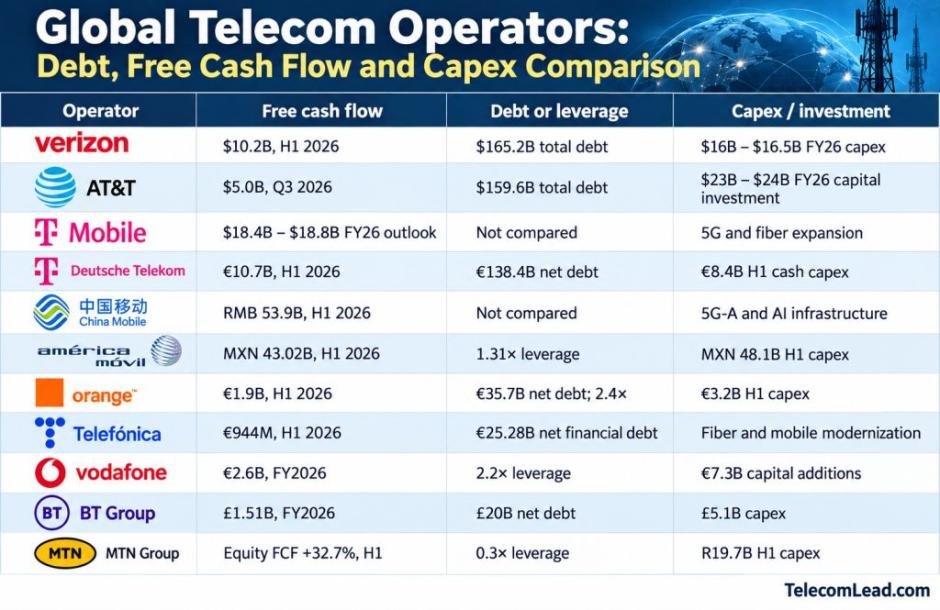
Verizon generated $10.2 billion in first-half free cash flow, Deutsche Telekom delivered €10.7 billion, and China Mobile reported RMB 53.9 billion. Meanwhile, T-Mobile US raised its annual adjusted free cash flow outlook to $18.4 billion–$18.8 billion.
However, free cash flow alone does not determine investment capacity. Debt leverage, interest payments, capital expenditure commitments and cash flow definitions also matter.
Figures cover different reporting periods and use company-specific definitions. They are not directly comparable rankings of absolute financial strength.
Verizon: $10.2 Billion Cash Flow Supports 5G and Fiber
Verizon generated $10.2 billion free cash flow in H1 2026, increasing 16 percent year over year. Operating cash flow reached $18.4 billion, while capex totaled $8.2 billion.
Second-quarter free cash flow increased 24.4 percent to $6.4 billion.
However, Verizon carried $165.2 billion in total debt, including $136.5 billion unsecured debt. Net unsecured debt reached $128.7 billion, with leverage of 2.5 times.
Its planned annual capex of $16 billion–$16.5 billion supports network capacity, 5G modernization and broadband expansion.
Verizon also planned up to $4.5 billion in share repurchases, illustrating the competing demands of infrastructure investment, debt management and shareholder distributions.
AT&T: $159.6 Billion Debt After Spectrum Investment
AT&T’s latest Q3 2026 results provide a more recent assessment than its second-quarter figures.
The operator generated $5 billion quarterly free cash flow, compared with $4.9 billion a year earlier. Operating cash flow reached $10.5 billion, while capex increased to $5.1 billion.
Total debt reached $159.6 billion and net debt stood at $149.8 billion, reflecting the EchoStar spectrum transaction.
AT&T’s financial position is supported by its expanding broadband business:
Fiber connections reached 13.31 million, increasing 23.4 percent.
Fixed wireless connections reached 2.94 million, increasing 65.4 percent.
Advanced Connectivity service revenue increased 6.1 percent to $23.9 billion.
The operator expects capital investment of $23 billion–$24 billion in 2026 and $22 billion–$23 billion annually during 2027–2028.
Its free cash flow targets exceed $18 billion in 2026, $19 billion in 2027 and $21 billion in 2028.
AT&T aims to expand fiber coverage beyond 60 million locations by 2030, making debt reduction and sustainable cash generation important to its network strategy.
T-Mobile US: $18.8 Billion Adjusted Cash Flow Outlook
T-Mobile US raised its 2026 adjusted free cash flow guidance to $18.4 billion–$18.8 billion.
The forecast provides substantial financial resources for 5G network modernization, fiber expansion, customer acquisition and shareholder returns.
At the upper end, the forecast approaches AT&T’s annual free cash flow target.
However, adjusted free cash flow is not necessarily calculated identically across companies. T-Mobile’s reported guidance should therefore not be treated as directly equivalent to AT&T’s measure.
Deutsche Telekom: €20 Billion Annual Cash Flow Target
Deutsche Telekom generated €10.7 billion in first-half free cash flow after leases, increasing 1.8 percent.
Operating cash flow reached €21.1 billion, while cash capex totaled €8.4 billion, including spectrum expenditure.
Net debt stood at €138.4 billion.
The company targets approximately €20 billion annual free cash flow after leases, supporting fiber, 5G, digital services and network automation.
Its substantial cash generation is balanced against significant debt obligations and investment requirements across European operations and T-Mobile US.
China Mobile: RMB 53.9 Billion Cash Flow for 5G-A and AI
China Mobile generated RMB 53.9 billion in first-half free cash flow, increasing 111.6 percent.
Operating cash flow rose 37 percent to RMB 114.9 billion, while revenue reached RMB 538 billion.
The operator served approximately 1.011 billion mobile subscribers and 687 million 5G network customers during the reporting period.
China Mobile’s scale and cash generation support investment in 5G Advanced, AI computing infrastructure, cloud services and network modernization.
Its free cash flow growth is particularly relevant as Chinese operators expand AI-related infrastructure alongside traditional telecom networks.
América Móvil and MTN: Lower Reported Leverage
América Móvil generated MXN 43.02 billion in first-half free cash flow, more than doubling from MXN 20.05 billion.
Its capex reached MXN 48.1 billion, while net debt excluding capitalized leases stood at approximately MXN 402 billion.
Reported leverage of 1.31 times provides a comparatively lower debt burden than several European and US peers, although calculation methods differ.
MTN Group reported even lower net debt leverage of 0.3 times.
MTN invested R19.7 billion during H1 2026, equivalent to 16.6 percent capex intensity, while equity free cash flow increased 32.7 percent.
The group’s financial position supports investment in African mobile broadband, network capacity and digital services.
Orange, Telefónica, Vodafone and BT: Managing Debt While Expanding Fiber
Orange generated €1.9 billion first-half all-in free cash flow, an increase of €774 million.
However, net debt reached €35.7 billion, with leverage of 2.4 times, partly reflecting the MasOrange transaction.
Telefónica reported €944 million first-half free cash flow from continuing operations. Net financial debt declined 8.4 percent to €25.28 billion, while liquidity reached €17.4 billion.
The company targets approximately €3 billion annual free cash flow and leverage of 2.5 times by 2028.
Vodafone generated €2.6 billion adjusted free cash flow in FY2026, with €7.3 billion in capital additions and leverage of 2.2 times. Its FY2027 adjusted free cash flow outlook stands at €2.6 billion–€2.9 billion.
BT Group reported £1.51 billion normalized free cash flow and £20 billion net debt in FY2026.
BT expects approximately £2 billion normalized free cash flow and £4.3 billion capex in FY2027 as Openreach continues expanding fiber broadband.
Which Telecom Operators Have Greater Investment Flexibility?
The available financial results point to three different positions.
Strong absolute cash generation: Verizon, Deutsche Telekom, China Mobile, AT&T and T-Mobile US report substantial cash flow or annual cash flow expectations supporting network investment.
Relatively low reported leverage: América Móvil and MTN have lower reported leverage ratios, potentially providing additional financing flexibility, subject to financing costs and local market risks.
Greater debt-management pressure: Orange, Telefónica, Vodafone and BT must balance fiber and mobile investments with leverage targets, restructuring and shareholder distributions.
The next phase of telecom investment will depend on operators’ ability to finance 5G Advanced, fiber expansion, AI infrastructure and automation without weakening their balance sheets.
Cash flow after capex, sustainable leverage and disciplined network investment — not revenue growth alone — will determine which operators have the greatest flexibility to modernize their networks through 2030.
FASNA SHABEER