
Telecom operators are deploying artificial intelligence (AI) to predict network failures, automate fault diagnosis and reduce maintenance costs as 5G, fiber broadband and cloud infrastructure expand.
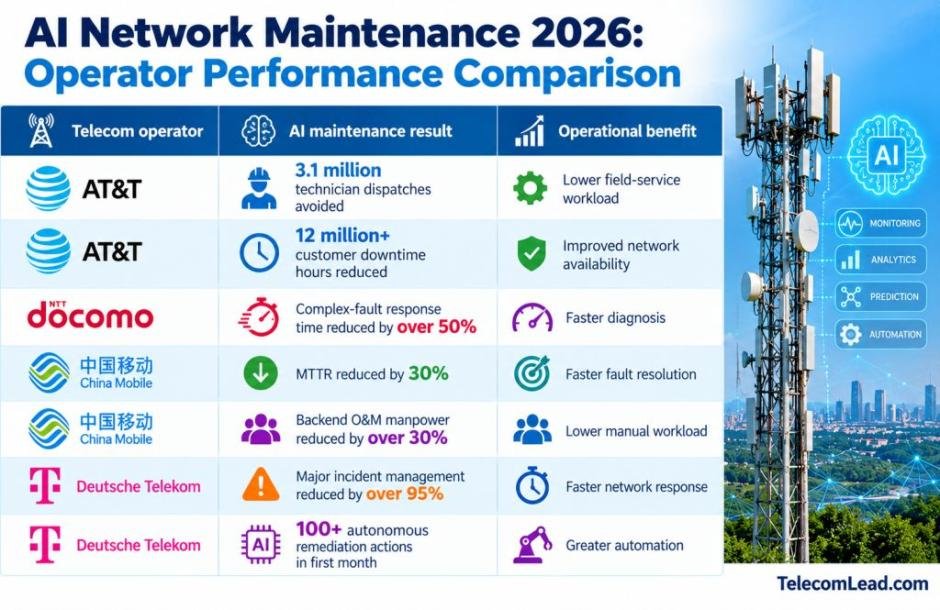
AT&T avoided 3.1 million unnecessary technician dispatches, NTT DOCOMO reduced complex-fault response time by more than 50 percent, and China Mobile reported a 30 percent reduction in mean time to repair (MTTR).
Deutsche Telekom also demonstrated how autonomous AI agents can reduce network incident management from hours to approximately one minute.
These developments highlight a shift from reactive network maintenance toward AI-driven operations that identify problems earlier and resolve incidents with less manual intervention.
Results reflect different network environments, measurement periods and operational definitions. They are not directly comparable financial savings.
AT&T: AI Avoids 3.1 Million Technician Dispatches
AT&T provides one of the largest reported examples of AI improving telecom network maintenance efficiency.
Its AI-powered End-to-End Incident Management platform helped avoid 3.1 million unnecessary technician dispatches and reduced customer downtime by more than 12 million hours over the preceding year.
The system combines machine learning, generative AI and network analytics to identify potential failures, investigate root causes and determine whether incidents require physical repairs.
AT&T has organized approximately 10 petabytes of network data and developed more than 30 AI models to support fault detection and operational decision-making.
The models analyze network configurations, weather-related risks and equipment conditions to help maintenance teams distinguish genuine faults from incidents that can be resolved remotely.
What Could 3.1 Million Avoided Dispatches Save?
The financial implications can be substantial, although AT&T has not disclosed an equivalent repair-cost saving.
| Assumed cost per avoided dispatch | Illustrative gross cost avoided |
| $50 | $155 million |
| $100 | $310 million |
| $150 | $465 million |
| $200 | $620 million |
These calculations assume each avoided dispatch would otherwise have incurred the stated cost. They are scenarios, not AT&T-reported savings, and exclude AI implementation expenses and other operational effects.
The results were detailed in a July 2026 report on AT&T’s AI network operations.
NTT DOCOMO: AI Cuts Complex Network Fault Response Time by 50%
NTT DOCOMO began commercial deployment of its AI-agent network maintenance system in February 2026.
The platform analyzes traffic and alarm information from more than one million network devices, including mobile base stations and core-network infrastructure.
Multiple AI agents cooperate to identify abnormalities, locate potential failure points and recommend corrective actions.
DOCOMO reported a reduction of more than 50 percent in response time for complex network failures compared with conventional manual analysis.
For illustration, a fault requiring 120 minutes of manual investigation could take less than 60 minutes if a comparable reduction were achieved.
The actual time saving depends on the type of incident and network conditions.
The technology uses network topology information to correlate alarms across different infrastructure domains, reducing the need for engineers to investigate individual alerts separately.
Faster diagnosis can improve service availability and reduce maintenance workload, although DOCOMO has not provided a corresponding monetary saving.
The deployment was described in NTT DOCOMO’s February 2026 announcement.
China Mobile: AI Reduces Network Repair Time by 30%
China Mobile is using AI agents and autonomous network operations to improve maintenance productivity across its extensive telecom infrastructure.
The operator reported a 30 percent reduction in average MTTR for network faults and customer complaints.
It also reported more than 30 percent lower backend operations and maintenance manpower requirements and over 5 percent savings in frontline installation and maintenance manpower.
These results illustrate the potential of AI-assisted fault identification, alarm correlation and automated troubleshooting.
For example, reducing an average repair duration of 100 minutes by 30 percent would bring it down to 70 minutes, saving 30 minutes per incident.
Across 100,000 comparable incidents, this would represent 50,000 hours of reduced cumulative repair duration. It would not necessarily mean 50,000 engineer-hours saved, because repair duration and staffing requirements are different measures.
China Mobile’s automation achievements were highlighted in TM Forum’s 2026 autonomous network analysis.
Deutsche Telekom: AI Resolves Network Events in Around One Minute
Deutsche Telekom is deploying MINDR, a multi-agent AI initiative developed with Google Cloud to improve network fault detection, diagnosis and remediation.
Its RAN Guardian Agent, operating in Germany, reduced the time required to manage major network events from hours to approximately one minute, representing an improvement exceeding 95 percent.
Deutsche Telekom also reported more than 100 autonomous remediation actions during the system’s first month.
The platform analyzes information across radio access, transport and core network infrastructure.
Rather than treating every alarm as an isolated incident, AI agents correlate related events, identify probable causes and support corrective actions.
This approach can reduce repeated investigations and accelerate responses to service degradation.
The system also demonstrates how telecom operators are moving beyond AI-assisted monitoring toward autonomous network remediation.
Deutsche Telekom described the initiative in its MINDR AI network announcement.
Where AI Predictive Maintenance Can Reduce Telecom Costs
The strongest opportunities extend across radio networks, fiber infrastructure, power systems and network operations centers.
| Network infrastructure | AI maintenance application | Potential cost benefit |
| 5G radio units | Detect abnormal equipment performance | Fewer unexpected failures |
| Fiber networks | Identify degradation and probable fault locations | Faster repair dispatch |
| Tower batteries | Predict battery deterioration | Fewer emergency replacements |
| Cooling systems | Detect temperature and equipment anomalies | Lower breakdown risk |
| Network operations centers | Correlate alarms and recommend remediation | Reduced manual investigation |
| Backup power systems | Identify generator and power-system faults | Fewer emergency site visits |
These are potential applications rather than additional verified operator savings.
AI predictive maintenance is most valuable when it prevents unnecessary field work, shortens outages or reduces repeat repairs.
How Telecom Operators Should Measure AI Maintenance ROI
For CTOs and network operations executives, deployment success should be measured against operational and financial indicators.
Consider an illustrative operator managing 50,000 sites and completing 200,000 annual maintenance dispatches.
If AI reduces unnecessary dispatches by 15 percent, the operator would avoid 30,000 visits.
At an assumed average cost of $100 per dispatch, gross annual savings would reach $3 million.
If AI software, integration and ongoing operations cost $1 million annually, the simplified net benefit would be $2 million before other expenses and benefits.
The same calculation could be applied to battery maintenance, fiber fault management and automated network diagnostics.
However, operators must also measure false alarms, missed failures, repeat-visit rates and customer downtime to ensure that lower maintenance expenditure does not reduce network reliability.
AI Network Maintenance Outlook for 2027–2030
The 2026 deployments show that telecom AI is producing measurable operational improvements.
AT&T demonstrates the scale of field-service workload reduction, NTT DOCOMO highlights faster complex-fault diagnosis, China Mobile shows improvements in repair duration and maintenance manpower, and Deutsche Telekom illustrates autonomous remediation.
The next challenge is converting these operational gains into transparent financial results.
Cost per repair, technician dispatches avoided, MTTR, outage hours and maintenance expenditure per network site will be essential indicators for evaluating AI investments.
As telecom operators expand 5G Advanced, fiber broadband and cloud-native networks, AI predictive maintenance could become an important tool for controlling operating costs while improving network reliability.
FASNA SHABEER