
Telecom operators are accelerating rural network-sharing agreements in 2026 to reduce the cost of expanding 4G and 5G coverage, particularly in areas where low population density makes independent network construction expensive.
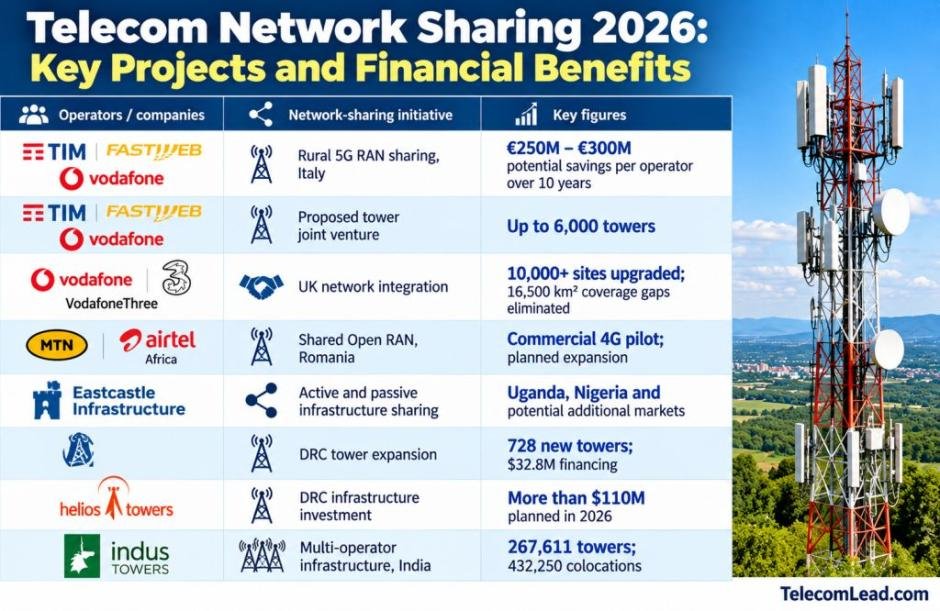
TIM and Fastweb + Vodafone could save €250 million–€300 million each over 10 years, while VodafoneThree has eliminated 16,500 square kilometres of mobile coverage gaps through network integration.
In Africa, MTN, Airtel Africa and tower infrastructure providers are expanding shared networks to improve rural connectivity. India’s Indus Towers demonstrates the benefits of infrastructure sharing with more than 432,000 colocations.
The emerging strategy combines shared towers, radio access networks (RAN), fiber backhaul and energy infrastructure to improve coverage while controlling capital expenditure and operating costs.
TIM and Fastweb + Vodafone: €300 Million Savings From Rural 5G Sharing
TIM and Fastweb + Vodafone announced a preliminary RAN-sharing agreement in January 2026 targeting Italian municipalities with fewer than 35,000 residents.
The arrangement could generate €250 million–€300 million in savings for each operator over 10 years, according to reported estimates.
That represents approximately €25 million–€30 million in average annual savings per operator if the full projected benefits are achieved evenly.
The agreement focuses on reducing duplication of active network equipment, including antennas and radio infrastructure, while preserving independent commercial operations.
In March 2026, the companies signed a separate non-binding agreement to develop and operate up to 6,000 towers through a proposed 50:50 joint venture.
Both operators would become anchor tenants, potentially allowing additional operators to share infrastructure.
The combination of RAN sharing and tower sharing addresses two major cost categories: radio equipment and physical site infrastructure.
Further details are available in Fastweb + Vodafone’s tower-sharing announcement.
VodafoneThree: 16,500 Square Kilometres of Coverage Gaps Eliminated
VodafoneThree’s UK network integration provides a major example of coverage expansion through shared infrastructure.
By May 2026, the operator had upgraded more than 10,000 sites, enabling up to 28.6 million Vodafone and Three customers to access improved coverage across the combined network.
The deployment uses Multi-Operator Core Network technology alongside existing Multi-Operator Radio Access Network infrastructure.
VodafoneThree reported eliminating 16,500 square kilometres of mobile coverage gaps.
Its wider network modernization programme includes £11 billion in investment, targeting 99 percent 5G standalone population coverage by 2030.
The operator also identified approximately £700 million in annual cost and capex synergies by FY2030 across the merger programme.
These savings are not exclusively attributable to rural network sharing. They include network consolidation and other operational efficiencies.
The project demonstrates how operators can improve coverage and network resilience by integrating existing assets rather than independently constructing duplicate infrastructure.
See VodafoneThree’s network integration update.
Vodafone and Orange: Shared Open RAN Reduces Equipment Duplication
Vodafone and Orange are developing a shared Open RAN architecture for rural European networks.
Their Romania pilot demonstrated successful 4G calls over shared commercial infrastructure near Bucharest.
The deployment combines Samsung’s virtualized RAN technology, Wind River’s software abstraction layer and Dell PowerEdge servers.
The architecture allows operators to share radio hardware and cloud infrastructure while independently managing RAN software.
Potential benefits include lower equipment duplication, reduced maintenance requirements, shared energy consumption and more efficient software upgrades.
The companies plan to extend the approach to additional network generations, including 2G and 5G.
Although financial savings have not been quantified, the deployment provides an example of how virtualization can support active network sharing without eliminating commercial differentiation.
MTN and Airtel Africa: Sharing Networks Across African Markets
MTN Group and Airtel Africa are expanding infrastructure-sharing cooperation in Uganda and Nigeria.
Their arrangements cover selected passive and active network components, allowing the companies to remain commercial competitors while reducing unnecessary infrastructure duplication.
Additional opportunities are being explored in Congo-Brazzaville, Rwanda and Zambia, including RAN and fiber sharing.
Airtel Africa’s FY2026 results demonstrate the scale of infrastructure deployment required across the region.
| Airtel Africa infrastructure metric | FY2026 |
| Capital expenditure | $884 million |
| Additional 4G sites | More than 3,600 |
| Fiber backbone expansion | 3,200 km |
| 4G population coverage | 75.6% |
| Rural infrastructure sites | More than 14,500 |
| Rural sites added | More than 800 |
These figures cover Airtel Africa’s investment programme, not exclusively its sharing arrangements with MTN.
The partnership could help operators extend coverage in locations where independent deployment would generate insufficient revenue to justify duplicating infrastructure.
Read MTN’s network-sharing case study.
Eastcastle and Helios Towers: $143 Million in DRC Infrastructure Commitments
Tower companies are helping African operators expand rural connectivity through shared infrastructure.
In August 2026, the Emerging Africa & Asia Infrastructure Fund committed $32.8 million to Eastcastle Infrastructure DRC to finance 728 new telecom towers.
The investment will increase Eastcastle’s portfolio from 1,072 to approximately 1,800 towers.
Around 70 percent of the new sites are planned for rural and underserved communities, equivalent to approximately 510 towers.
The financing represents roughly $45,000 per planned tower when divided across all 728 sites. This is a financing allocation, not the full construction cost per tower.
The project also includes solar panels and lithium batteries to reduce dependence on diesel generators.
Separately, Helios Towers announced more than $110 million in DRC infrastructure investment during 2026.
Helios operates nearly 2,800 sites in the country and plans further urban and rural deployments.
Together, the two announced investment and financing commitments exceed $142 million, although they represent different financial measures and should not be interpreted as a single capital expenditure programme.
Indus Towers: 432,250 Colocations Support India’s Rural Networks
India’s tower-sharing model illustrates how infrastructure companies can improve asset utilization across multiple mobile operators.
Indus Towers operated 267,611 towers and 432,250 colocations as of June 30, 2026, covering all 22 telecom circles.
During FY2026, the company added approximately 15,400 net towers and 22,500 net colocations.
Around 30 percent of new towers were deployed in rural areas.
Its reported sharing factor was approximately 1.62 tenants per tower.
How Additional Tenants Reduce Tower Costs
Consider an illustrative rural tower with monthly site operating expenses of ₹60,000.
| Operators sharing a tower | Site opex per operator |
| One operator | ₹60,000 |
| Two operators | ₹30,000 |
| Three operators | ₹20,000 |
This simplified calculation assumes equal cost sharing and unchanged operating expenses.
Actual costs can increase with additional tenants because of electricity consumption, equipment loading and maintenance requirements.
Nevertheless, higher tenancy can reduce average infrastructure costs compared with constructing separate towers for every operator.
Indus Towers’ operating and financial performance can be reviewed through its investor results.
Rural 5G Network Sharing: Where Operators Can Save Money
Telecom network sharing generally involves three approaches.
Passive infrastructure sharing: Operators share towers, land, shelters, power systems and related facilities, reducing construction and site operating costs.
Active RAN sharing: Operators share selected antennas, radio equipment and network infrastructure, potentially lowering equipment expenditure and maintenance requirements.
Fiber and backhaul sharing: Shared transmission infrastructure reduces the cost of connecting rural towers to core networks and data centers.
The financial impact depends on population density, network design, energy availability, existing infrastructure and the number of participating operators.
Rural Network Sharing Outlook for 2027–2030
The 2026 projects demonstrate that network sharing is becoming a central part of rural telecom investment strategies.
Italy provides a quantified example of potential long-term savings, while VodafoneThree demonstrates measurable coverage improvements through network integration.
African operators and tower companies are using shared infrastructure to extend coverage into underserved markets, while India’s established tower-sharing ecosystem continues expanding.
For telecom CTOs and CFOs, the main performance indicators are cost per rural site, tenancy ratio, energy cost, network coverage gained per dollar invested and capital expenditure avoided through sharing.
As operators expand 5G Advanced and rural broadband, infrastructure sharing can help balance coverage obligations with sustainable network economics.
FASNA SHABEER