
AT&T is creating a major U.S. fiber infrastructure joint venture with Global Infrastructure Partners (GIP), part of BlackRock, and Canada Pension Plan Investment Board (CPP Investments), giving the telecom operator a capital-light platform to accelerate fiber expansion beyond its traditional service territories.
The 50:50 joint venture will combine Forged Fiber 37, which holds fiber assets and construction operations AT&T acquired from Lumen Technologies, with Gigapower, AT&T’s existing wholesale fiber joint venture with GIP.
At closing, the combined company will have nearly 5 million fiber locations and serve more than 1 million AT&T Fiber subscribers across major metropolitan markets in 16 states.
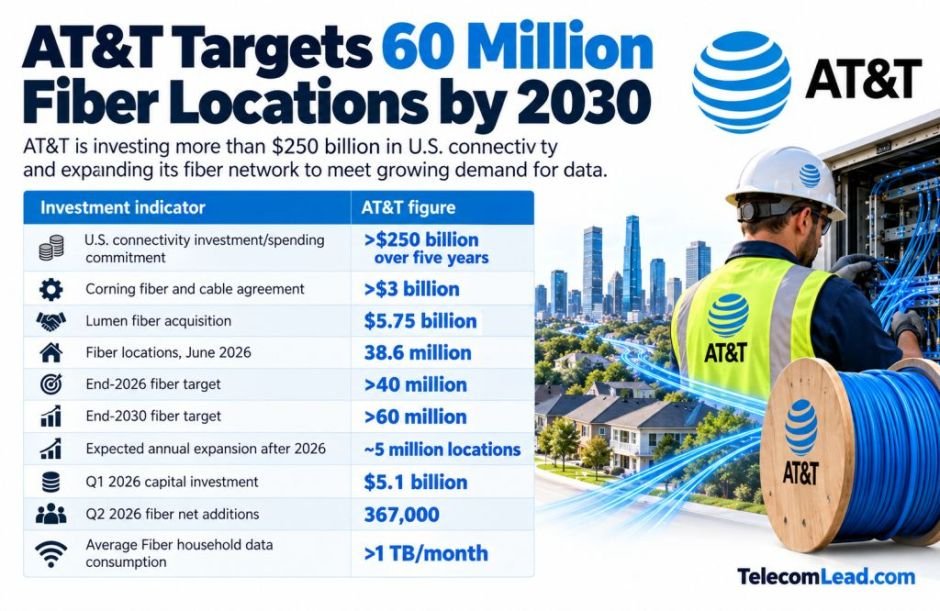
The JV supports AT&T’s target of reaching more than 60 million fiber locations by the end of 2030, compared with 38.6 million locations at the end of June 2026.
AT&T plans to reach approximately 50 million locations through fiber infrastructure it owns and operates directly, while the JV will become its primary partner for expansion outside traditional AT&T service territories.
AT&T Fiber JV Starts with Nearly 5 Million Locations
AT&T will own 50 percent of the new JV, while GIP and CPP Investments will collectively own the remaining 50 percent. The financial value of the transaction has not been disclosed.
The company will operate as a wholesale open-access fiber provider, using the construction capabilities of Forged Fiber 37 and Gigapower to accelerate deployments.
The structure enables AT&T to expand its addressable broadband market while sharing infrastructure investment requirements with institutional investors.
$5.75 Billion Lumen Acquisition Provides the Foundation
Forged Fiber 37 contains the assets AT&T acquired through its $5.75 billion acquisition of substantially all of Lumen’s Mass Markets fiber business.
The transaction added more than 4 million fiber-enabled locations and over 1 million fiber customers across 11 states.
TelecomLead earlier examined the strategic implications of AT&T’s $5.75 billion Lumen fiber acquisition, including its role in accelerating AT&T’s broadband expansion.
Combining these assets with Gigapower creates a larger platform for fiber construction outside AT&T’s traditional footprint.
AT&T Targets More Than 60 Million Fiber Locations
AT&T had reached 38.6 million consumer and business fiber locations by June 2026, including 33.7 million owned-and-operated locations and 4.9 million locations through AT&T Fiber Ventures.
The company expects its fiber availability to exceed 60 million locations by 2030, with approximately 50 million covered by AT&T’s owned-and-operated network.
AT&T expects to receive proceeds when the transaction closes and plans to use the money in line with existing priorities, including continued network investment, shareholder returns and achieving a net-debt-to-adjusted EBITDA ratio of around 2.5x within approximately three years. The transaction is expected to close during H1 2027.
AT&T Maintains $23-$24 Billion Investment Program
The JV comes as AT&T maintains one of the industry’s largest network investment programs.
AT&T expects annual capital investment of approximately $23 billion-$24 billion during 2026-2028, covering fiber, 5G, spectrum and network modernization.
TelecomLead’s analysis of telecom capex trends in 2026 shows how operators are increasingly directing investment toward fiber, spectrum, capacity and network efficiency.
The fiber JV provides AT&T with another route for increasing infrastructure investment without financing every new fiber location directly.
$3 Billion Corning Deal Supports Fiber Expansion
AT&T has also signed a multi-year agreement worth more than $3 billion with Corning for fiber and cable to support its expansion. TelecomLead recently detailed AT&T’s $3 billion Corning agreement and fiber investment strategy.
Together, the Corning agreement, Lumen acquisition and new infrastructure JV demonstrate the scale of AT&T’s effort to build a broader U.S. fiber platform.
Fiber and 5G Convergence Strengthens AT&T Strategy
Fiber expansion also supports AT&T’s strategy of selling both broadband and mobile connectivity to the same household.
At the end of Q2 2026, 40.5 percent of AT&T Fiber customers also subscribed to AT&T Wireless, representing approximately 4.92 million converged fiber customers.
Expansion outside AT&T’s traditional wireline footprint therefore gives the operator opportunities not only to add broadband customers but also to sell wireless services to those households.
Growing data consumption strengthens the fiber investment case. The average AT&T Fiber household consumes more than 1 TB of data per month, and AT&T expects usage to reach approximately 2-2.5 TB by 2030.
TelecomLead’s analysis of the telecom fiber capacity crunch examines how AI, cloud applications and rising data traffic are increasing requirements for higher-capacity fiber and optical networks.
AT&T Builds Two-Track Fiber Investment Model
The new JV brings several parts of AT&T’s fiber strategy together.
The $5.75 billion Lumen acquisition provided more than 4 million fiber-enabled locations and an established construction platform. Gigapower contributes an existing open-access fiber model, while GIP and CPP Investments provide infrastructure capital.
At closing, the combined platform will already have nearly 5 million fiber locations and more than 1 million AT&T Fiber subscribers.
AT&T is effectively developing a two-track fiber strategy: directly owning infrastructure as it works toward approximately 50 million locations, while using the JV as its primary partner for expansion outside traditional markets.
The approach could help AT&T increase its overall fiber reach from 38.6 million locations in June 2026 to more than 60 million by 2030, while sharing part of the capital required for expansion and increasing the addressable market for its converged fiber and 5G services.
BABURAJAN KIZHAKEDATH