
India’s mobile data market is undergoing a major 4G-to-5G transition, with 5G data consumption almost doubling during FY2025-26 and accounting for 37.63 percent of the country’s total wireless data traffic. While 4G remains the dominant mobile broadband technology with a 62.15 percent share, the latest TRAI data indicates that 5G is rapidly closing the gap.
India recorded 285,376 PB of wireless data usage in 2025-26, an increase of 24.74 percent from 228,779 PB in 2024-25, according to TRAI.
The most important change within this growth is the rapid expansion of 5G traffic. 5G data usage in India increased from 57,042 PB in 2024-25 to 107,384 PB in 2025-26, representing an increase of approximately 88.25 percent in just one year.
By comparison, 4G data consumption increased only modestly, from 170,603 PB to 177,375 PB, or about 3.97 percent.
The figures indicate that much of India’s incremental mobile data growth is now being generated by 5G rather than 4G.
5G Reaches 37.63% of India’s Wireless Data Traffic
Despite the acceleration of 5G adoption, 4G remains India’s largest mobile data technology.
Of the 285,376 PB of total wireless data consumed during 2025-26, 177,375 PB was carried over 4G networks, giving LTE a 62.15 percent share.
5G accounted for 107,384 PB, representing 37.63 percent of wireless data usage.
Legacy technologies have become almost insignificant in India’s data market. 3G carried only 425 PB, representing 0.15 percent, while 2G accounted for 192 PB, or just 0.07 percent.
The data traffic split in 2025-26 was therefore:
| Technology | Data usage | Share |
| 4G | 177,375 PB | 62.15% |
| 5G | 107,384 PB | 37.63% |
| 3G | 425 PB | 0.15% |
| 2G | 192 PB | 0.07% |
| Total | 285,376 PB | 100% |
The numbers show that India’s mobile broadband market is effectively becoming a 4G-plus-5G market, with 2G and 3G contributing only a tiny fraction of total data consumption.
5G Data Usage Has Increased More Than Fivefold in Two Years
The speed of India’s 5G traffic expansion becomes clearer when comparing data consumption since commercial 5G services began scaling.
In 2022-23, TRAI recorded no 5G data usage in this series. Total wireless data traffic stood at 160,054 PB, including 158,206 PB on 4G, 1,598 PB on 3G and 251 PB on 2G. Overall wireless data traffic increased 16.44 percent that year.
During 2023-24, 5G generated 21,074 PB, while 4G traffic reached 172,201 PB. 3G usage fell to 1,314 PB and 2G to 184 PB. Total wireless data consumption increased to 194,774 PB, representing 21.69 percent annual growth.
In 2024-25, 5G traffic jumped to 57,042 PB, while 4G stood at 170,603 PB. 3G generated 915 PB and 2G 218 PB. Total wireless data usage reached 228,779 PB, up 17.46 percent.
By 2025-26, 5G traffic had reached 107,384 PB.
That means India’s annual 5G data consumption has increased more than fivefold from 21,074 PB in 2023-24 to 107,384 PB in 2025-26.
| Period | 2G | 3G | 4G | 5G | Total | Annual Growth |
| 2022-23 | 251 PB | 1,598 PB | 158,206 PB | 0 | 160,054 PB | 16.44% |
| 2023-24 | 184 PB | 1,314 PB | 172,201 PB | 21,074 PB | 194,774 PB | 21.69% |
| 2024-25 | 218 PB | 915 PB | 170,603 PB | 57,042 PB | 228,779 PB | 17.46% |
| 2025-26 | 192 PB | 425 PB | 177,375 PB | 107,384 PB | 285,376 PB | 24.74% |
5G Generated Nearly 89% of India’s Incremental Data Traffic
Another way to measure the impact of 5G is to examine the additional traffic generated during 2025-26.
Total wireless data consumption increased by 56,597 PB, from 228,779 PB to 285,376 PB.
5G alone added 50,342 PB of traffic, rising from 57,042 PB to 107,384 PB. This means 5G contributed roughly 89 percent of the net increase in India’s wireless data traffic during the year.
4G added only 6,772 PB, while 3G usage declined by 490 PB and 2G usage declined by 26 PB.
This is an important indicator for telecom operators including Reliance Jio, Bharti Airtel, Vodafone Idea and BSNL because future network capacity investment will increasingly need to address traffic generated by 5G subscribers.
4G Growth Is Flattening as Users Move Toward 5G
The contrast between 4G and 5G traffic trends is becoming increasingly pronounced.
4G usage rose from 158,206 PB in 2022-23 to 172,201 PB in 2023-24, before slipping slightly to 170,603 PB in 2024-25 and recovering to 177,375 PB in 2025-26.
5G, meanwhile, moved from zero in 2022-23 to 21,074 PB, 57,042 PB and then 107,384 PB over the following three years.
This does not mean 4G is disappearing. With a 62.15 percent traffic share, LTE remains the foundation of India’s mobile broadband market. But the relatively flat 4G traffic curve compared with the rapid rise in 5G suggests that subscriber upgrades and increasing usage on 5G smartphones are shifting incremental network traffic toward next-generation networks.
5G FWA Subscribers Jump to 12.32 Million
The 5G expansion is also extending beyond smartphones through Fixed Wireless Access.
India’s 5G FWA subscriber base increased from 6.77 million at the end of March 2025 to 12.32 million at the end of March 2026, representing growth of nearly 82 percent.
Interestingly, 5G FWA adoption is almost equally divided between urban and rural India.
Urban areas accounted for 6.17 million 5G FWA subscribers, representing 50.37 percent of the total, while rural areas accounted for 6.15 million, or 49.63 percent.
At the end of March 2026, India’s telephone subscriber structure included 1,141.85 million wireless consumer SIMs, 123.88 million M2M SIMs, 12.32 million 5G FWA subscriptions and 4.29 million UBR FWA connections.
These categories resulted in 1,282.34 million wireless subscriptions. India also had 48.25 million wireline subscribers, taking the overall telephone subscriber base to 1,330.58 million.
Wireless Data Revenue Rises to ₹2.40 Lakh Crore
India’s massive increase in data consumption is also producing higher wireless data revenue, although revenue is expanding much more slowly than traffic.
Total wireless data revenue increased from ₹2,15,078 crore in 2024-25 to ₹2,39,874 crore in 2025-26, representing 11.53 percent annual growth.
Wireless data revenue has increased consistently over the past four years.
Revenue stood at ₹1,74,144 crore in 2022-23, when annual growth was 21.63 percent. It increased to ₹1,86,226 crore in 2023-24, growing 6.94 percent, before reaching ₹2,15,078 crore in 2024-25, an increase of 15.49 percent.
| Period | Wireless Data Revenue | Annual Growth |
| 2022-23 | ₹1,74,144 crore | 21.63% |
| 2023-24 | ₹1,86,226 crore | 6.94% |
| 2024-25 | ₹2,15,078 crore | 15.49% |
| 2025-26 | ₹2,39,874 crore | 11.53% |
The comparison between 24.74 percent traffic growth and 11.53 percent revenue growth highlights the continuing challenge for Indian telecom operators: data consumption is expanding considerably faster than the revenue generated from that traffic.
Data ARPU Rises, but Revenue per GB Falls to ₹8.02
There is nevertheless an improvement in average data revenue per subscriber.
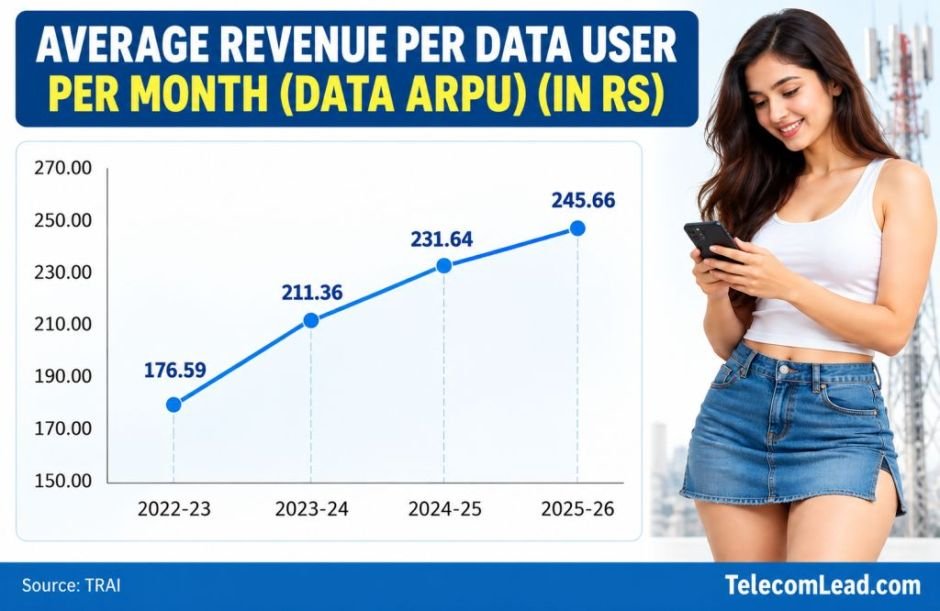
TRAI says monthly Data ARPU increased from ₹231.64 per data subscriber in 2024-25 to ₹245.66 in 2025-26, an increase of about 6.05 percent.
However, the average revenue realization per subscriber per GB declined from ₹8.97 per GB to ₹8.02 per GB.
That represents a decline of around 10.6 percent in revenue realization per GB despite higher overall data revenue and Data ARPU.
For Indian telecom operators, this creates a crucial 5G monetization challenge. Network traffic is moving rapidly toward 5G, but the economic value generated by every GB continues to decline.
5G Is Becoming India’s Main Mobile Data Growth Engine
TRAI’s 2025-26 figures provide one of the clearest indications yet of India’s transition from a 4G-dominated mobile broadband market toward a combined 4G-5G ecosystem.
4G remains comfortably ahead with 177,375 PB and a 62.15 percent share, compared with 107,384 PB and 37.63 percent for 5G. But the direction of travel is very different.
During 2025-26, 4G traffic increased by only about 4 percent, while 5G traffic surged by more than 88 percent. 5G also generated approximately 89 percent of the country’s incremental wireless data traffic.
At the same time, total wireless data traffic accelerated to 285,376 PB, growing 24.74 percent, compared with 17.46 percent growth in the previous year.
The next important milestone for India’s telecom market will be whether 5G can overtake 4G in annual data consumption. With 5G already accounting for nearly 38 percent of wireless traffic and its annual data usage approaching two-thirds of the 4G volume, TRAI’s numbers show that India’s mobile data growth story is increasingly becoming a 5G data story.
BABURAJAN KIZHAKEDATH