AT&T is accelerating one of the largest telecom infrastructure investment programs in the United States, signing a multi-year agreement worth more than $3 billion with Corning for fiber and cable as it expands broadband capacity to support surging demand from AI, cloud computing, streaming and connected devices.
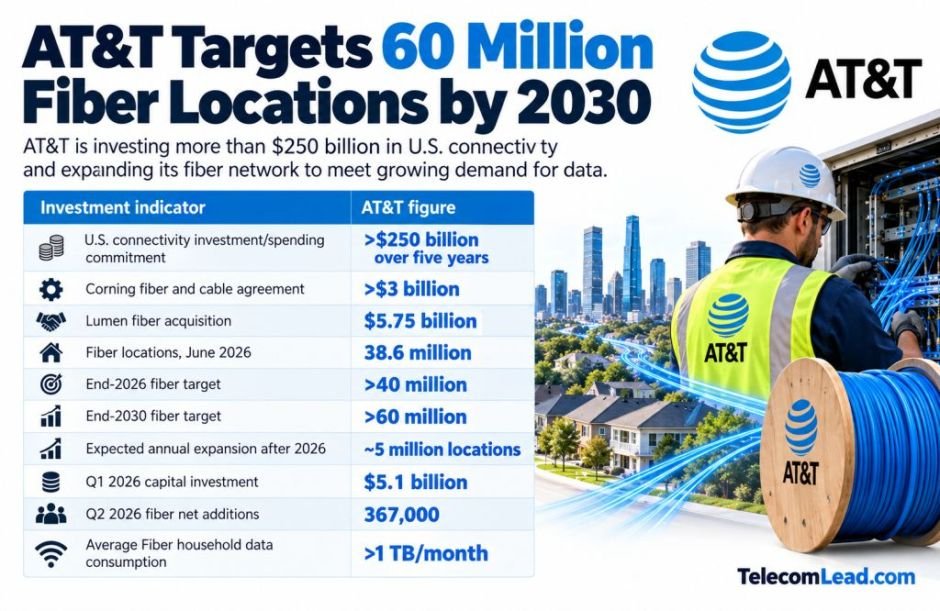
The Corning agreement is part of a much bigger investment cycle. AT&T has committed more than $250 billion in investment and spending over five years to strengthen U.S. connectivity infrastructure, covering fiber, 5G wireless, satellite connectivity, network modernization, resilience and security.
The telecom operator is simultaneously expanding through acquisitions. AT&T completed its $5.75 billion acquisition of substantially all of Lumen Technologies’ Mass Markets fiber business in February 2026, adding more than 4 million fiber locations.
Together, the Corning procurement agreement, Lumen acquisition and accelerating organic fiber construction demonstrate how AT&T is directing billions of dollars toward creating a converged fiber and wireless network.
AT&T Signs More Than $3 Billion Corning Fiber Deal
Under the latest agreement, Corning will supply the fiber and cable AT&T requires to expand its broadband network over multiple years.
The contract is worth more than $3 billion and supports AT&T’s target of extending fiber connectivity to more than 60 million locations by the end of 2030.
For AT&T, the agreement provides access to domestically manufactured fiber and cable as the operator accelerates network construction.
The procurement also demonstrates the scale of materials required for AT&T’s expansion. Fiber deployment involves not only laying new cable but connecting neighborhoods, homes and businesses while increasing the density and capacity of the underlying network.
The deal builds on AT&T’s more than $250 billion U.S. connectivity investment through 2030.
AT&T says the program will expand fiber and wireless networks, modernize critical infrastructure and strengthen network resilience and security. Investments will also support 5G home internet, satellite connectivity and FirstNet infrastructure.
Importantly, the $250 billion figure should not be interpreted as fiber capex alone. It represents AT&T’s broader investment and spending commitment across U.S. connectivity infrastructure.
AT&T Fiber Footprint Reaches 38.6 Million Locations
AT&T’s fiber expansion is already accelerating.
At the end of June 2026, AT&T’s fiber network reached 38.6 million consumer and business locations, compared with more than 36 million following the Lumen transaction earlier this year.
The operator added more than 1 million fiber locations during the second quarter alone.
AT&T remains on track to surpass 40 million fiber locations by the end of 2026 and reach more than 60 million locations by the end of 2030.
That implies another major expansion from today’s network.
After 2026, AT&T has indicated that it expects to expand fiber coverage by approximately 5 million additional locations annually, illustrating the construction pace required to achieve its 2030 objective.
The Corning contract therefore represents an important supply-chain component of a multi-year infrastructure build rather than an isolated equipment purchase.
$5.75 Billion Lumen Acquisition Accelerates Fiber Expansion
AT&T is using acquisitions alongside organic network construction to increase its fiber scale.
The company completed its $5.75 billion acquisition of Lumen’s Mass Markets fiber business in February.
The transaction added more than 4 million fiber locations and over 1 million fiber subscribers across 11 states. It also expanded AT&T’s fiber home internet operations into additional metropolitan markets including Denver, Seattle and Salt Lake City.
AT&T gained access to Lumen’s fiber construction capabilities in those territories, which should help the company accelerate deployment outside its traditional wireline footprint.
The acquired network also provides significant room for subscriber growth.
AT&T said fiber penetration within the acquired footprint was approximately 25 percent when the transaction closed. Increasing that penetration closer to levels achieved across AT&T’s established fiber markets could generate additional broadband revenue without requiring an equivalent expansion in locations passed.
Data Consumption Makes Fiber Investment Critical
AT&T’s investment strategy is being supported by rapid growth in household data consumption.
The average AT&T Fiber household now consumes more than 1 terabyte of data every month, approximately five times the level recorded in 2016.
AT&T expects monthly consumption to increase further to around 2–2.5 terabytes by 2030.
AI applications could add another source of traffic growth alongside streaming video, gaming, cloud applications, video conferencing and connected-home services.
Fiber offers operators large amounts of scalable capacity and high upstream and downstream speeds, making the infrastructure particularly useful as household and enterprise traffic increases.
AT&T’s strategy therefore extends beyond connecting additional homes. The operator is investing in infrastructure designed to accommodate substantially higher data consumption over the lifetime of the network.
AT&T Investment Is Already Showing in Capex
AT&T’s financial results provide further evidence of the investment push.
During the first quarter of 2026, the company reported $4.9 billion of capital expenditures and $5.1 billion of capital investment.
AT&T specifically attributed lower year-on-year free cash flow partly to higher capital investment as it accelerated fiber deployment.
The company is effectively accepting significant near-term infrastructure spending to increase the scale of assets capable of generating broadband and converged-services revenue over many years.
The strategy was gaining momentum by the second quarter.
AT&T added 367,000 fiber internet customers during Q2 2026 as part of 646,000 total advanced-connectivity internet net additions.
Its Advanced Connectivity business generated $23.5 billion in service revenue, up 5.1 percent, while operating income increased 20.3 percent to $7.3 billion.
These figures help explain why fiber remains one of AT&T’s highest investment priorities.
Fiber and 5G Convergence Strengthens Investment Case
AT&T’s fiber strategy cannot be separated from its wireless business.
Rather than treating broadband and mobile networks as independent businesses, AT&T is increasingly attempting to sell customers both services.
In Q2 2026, 42.5 percent of households using AT&T’s advanced home internet services also subscribed to AT&T wireless.
AT&T says customers taking both fiber broadband and wireless services are more likely to recommend the company, remain customers longer and generate stronger returns.
That makes expansion of the fiber footprint strategically important beyond broadband revenue.
Every additional fiber location potentially expands the addressable market for AT&T’s converged fiber-and-5G proposition.
The company’s fiber and wireless convergence strategy is therefore becoming an increasingly important part of the economics supporting network investment.
AI and Cloud Add Another Driver for AT&T Network Investment
The growth of AI also strengthens the long-term case for high-capacity connectivity.
AT&T specifically identifies AI, autonomous technologies, cloud computing and data-heavy digital services among the technologies driving demand for always-on connectivity.
Its investment plan therefore combines fiber with wireless, satellite, network resilience and security rather than relying on a single access technology.
The company says satellite connectivity will complement fiber and wireless in roughly 2 percent of remote locations where conventional networks may not be available.
Corning Deal Shows AT&T’s $250 Billion Strategy Moving Into Deployment
The significance of the Corning agreement is ultimately less about the $3 billion contract itself than what it reveals about AT&T’s investment trajectory.
AT&T has assembled three major components of its fiber expansion strategy: a $250 billion-plus broader U.S. connectivity commitment, the $5.75 billion Lumen fiber acquisition, and now a more than $3 billion multi-year fiber and cable supply agreement with Corning.
Meanwhile, the network has already reached 38.6 million fiber locations, with AT&T targeting more than 40 million by the end of 2026 and 60 million-plus by 2030.
The combination of rising household data consumption, AI and cloud traffic, fiber subscriber growth and opportunities to bundle broadband with 5G gives AT&T a commercial rationale for maintaining elevated infrastructure investment.
The Corning deal therefore provides another indication that AT&T’s investment strategy is moving from long-term commitments into large-scale network procurement and deployment.
BABURAJAN KIZHAKEDATH