Vodafone, e&, VEON, América Móvil, Jio and Orange are among the telecom operators showing strong revenue momentum in 2026 as 5G, broadband, enterprise connectivity, financial services and digital platforms create new growth engines.
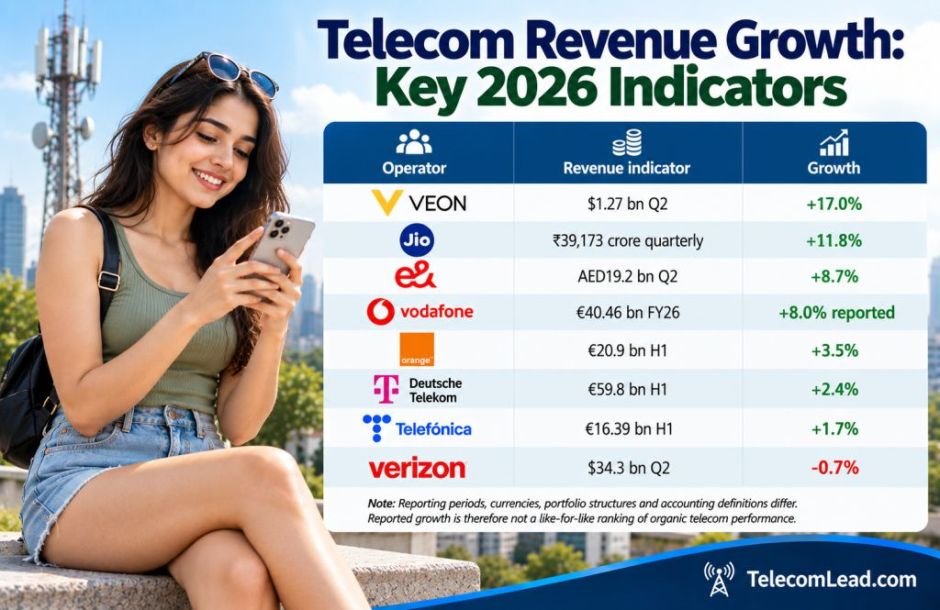
Global telecom revenue increased 2.5 percent year over year to $472.5 billion in Q2 2026, according to MTN Consulting, while annualized revenue reached approximately $1.89 trillion.
The headline numbers, however, hide major differences between operators. Some are benefiting from acquisitions and consolidation, while others are generating organic growth from mobile data, ARPU, fiber, fixed wireless, enterprise services and digital businesses.
For that reason, reported revenue growth should not always be interpreted as underlying telecom growth.
Vodafone: Service Revenue Growth Accelerates
Vodafone has returned to stronger growth following portfolio restructuring and the integration of Three UK.
The group generated €40.46 billion of FY2026 revenue, up from €37.45 billion, while service revenue increased from €30.76 billion to €33.48 billion.
More importantly, organic service revenue increased 5.2 percent in Q1 FY27, while organic adjusted EBITDAaL rose 6.2 percent.
Vodafone’s latest financial performance shows substantial differences between markets. Africa has been a particularly strong engine, with FY2026 organic service revenue growth of 12.9 percent.
Vodafone demonstrates why acquisition-driven headline growth needs to be separated from organic performance, particularly following the UK combination.
e&: Q2 Revenue Rises 8.7% to AED19.2 Billion
UAE-based e&, formerly Etisalat, adds another major growth operator to the comparison.
The group generated AED19.2 billion of Q2 2026 revenue, up 8.7 percent year over year, while EBITDA increased even faster at 9.8 percent to AED9.0 billion.
Its aggregate subscriber base reached 251.5 million, up 30.4 percent, reflecting both operational expansion and changes to the group portfolio.
e&’s Q2 2026 financial results also show capital expenditure of AED3.6 billion and operating free cash flow of AED6.1 billion.
The operator is evolving beyond conventional connectivity through digital services, financial technology and international investments.
VEON: Revenue Jumps 17% as Digital Business Expands
VEON reported $1.27 billion of Q2 2026 revenue, up 17 percent.
Telecom and infrastructure revenue increased 7.6 percent to $929 million, while mobile ARPU increased 6.3 percent.
The standout growth engine was digital revenue, which surged 53.6 percent to $342 million and represented 26.9 percent of group revenue.
Financial-services revenue increased 48.5 percent to $151 million.
VEON’s Q2 2026 results demonstrate how telecom operators can generate growth outside traditional connectivity through digital platforms and financial services.
VEON increased its 2026 revenue-growth outlook to 15–18 percent.
América Móvil: Scale Across Latin America
América Móvil adds an important Latin American dimension to the global comparison.
Its operations across Mexico, Brazil and other Latin American markets give it one of the industry’s largest mobile and fixed customer bases.
Growth is supported by mobile service revenue, postpaid customers, broadband and enterprise connectivity rather than subscriber numbers alone.
América Móvil is particularly important to a global revenue comparison because Latin America continues to offer stronger opportunities for mobile-data and broadband monetization than many saturated European markets.
Its scale also demonstrates why currency movements must be considered when comparing reported revenue growth across international telecom groups.
Jio: Revenue Rises 11.8% as Customer Base Reaches 533 Million
Reliance Jio reported quarterly revenue of ₹39,173 crore, up 11.8 percent year over year.
The connectivity customer base reached 533 million, following 35.2 million net additions over the preceding 12 months.
Jio’s 5G customer base reached 285 million, while home broadband connections increased to 28.6 million.
ARPU rose to ₹215.60 from ₹208, despite no tariff increase during the previous 12 months.
The combination of customer growth, 5G adoption, broadband and ARPU expansion makes Jio one of the industry’s clearest examples of connectivity-led revenue growth.
Orange: Africa and Middle East Revenue Surges 13.9%
Orange generated €20.9 billion of H1 2026 revenue, up 3.5 percent, but its regional performance varied significantly.
Africa and the Middle East delivered 13.9 percent revenue growth, substantially outpacing the group average.
Europe 6 increased 4.1 percent and France grew 1.2 percent.
Orange also passed 3 million fiber customers in Europe, reinforcing fixed broadband as an additional growth engine.
Orange Business revenue declined 3.1 percent, however, showing why enterprise operations do not automatically produce growth even as demand for cloud, cybersecurity and digital services expands.
AT&T: Home Internet Revenue Jumps 27.3%
AT&T generated $31.6 billion of Q2 2026 revenue, but the more important story lies inside its connectivity businesses.
Advanced Connectivity service revenue increased 5.1 percent to $23.5 billion.
Wireless service revenue increased 3.3 percent to $17.4 billion, while Advanced Home Internet service revenue surged 27.3 percent to $2.93 billion.
AT&T added 646,000 Advanced Connectivity internet customers, including 367,000 fiber and 279,000 fixed-wireless customers.
Business Fiber and Advanced Connectivity revenue also increased 10 percent to $1.95 billion.
Telefonica: Enterprise Revenue Rises 9.5%
Telefonica generated €16.39 billion in H1 2026 revenue, up 1.7 percent.
Its underlying growth areas performed considerably better.
B2B revenue increased 9.5 percent to €2.02 billion in Q2, while B2C revenue increased 5.6 percent to €4.89 billion.
FTTH revenue increased 5.1 percent, while Telefonica’s 5G customer base reached 25 million, up 41 percent.
The figures demonstrate how enterprise connectivity, fiber and 5G can produce growth even when consolidated group revenue rises relatively slowly.
Deutsche Telekom: Service Revenue Reaches €50.4 Billion
Deutsche Telekom generated €59.8 billion of H1 2026 revenue, up 2.4 percent.
Service revenue performed better, increasing 2.8 percent to €50.4 billion, with organic service revenue growth of 3.9 percent.
The U.S. business generated €39.3 billion of H1 revenue, Germany €12.85 billion and the broader European operations €6.25 billion.
Deutsche Telekom’s results illustrate the advantages of scale combined with exposure to the U.S. postpaid market.
Verizon: Broadband Grows Despite Lower Group Revenue
Verizon provides an important counterexample to the fastest-growing operators.
Q2 operating revenue declined 0.7 percent to $34.3 billion, but mobility and broadband service revenue increased 2.8 percent to about $23.4 billion.
Verizon added 348,000 broadband connections, comprising 193,000 fixed-wireless and 155,000 fiber customers.
Verizon Business revenue increased 2.6 percent to $7.2 billion.
The results demonstrate that telecom operators can have growing strategic businesses even when consolidated revenue is flat or declining.
Five Engines Are Driving Telecom Revenue Growth
The operator results identify five particularly important revenue engines in 2026.
5G and mobile monetization remain fundamental. Jio combines subscriber expansion with rising ARPU, while e& and VEON are growing across large mobile markets.
Fiber and FWA are becoming major contributors. AT&T’s home internet revenue surged 27.3 percent, while Verizon continues adding hundreds of thousands of broadband customers.
Emerging markets are producing some of the industry’s strongest growth. Orange Africa and Middle East expanded 13.9 percent, while Vodafone reported double-digit organic service-revenue growth in Africa.
Enterprise connectivity is another growth pool, illustrated by Telefonica’s 9.5 percent B2B growth and AT&T’s 10 percent increase in Business Fiber and Advanced Connectivity.
Finally, digital and financial services are emerging as significant businesses. VEON’s digital revenue jumped 53.6 percent, demonstrating how operators can monetize their customer relationships beyond connectivity.
Global Telecom Growth Is Moving Beyond Mobile
Global telecom revenue reached $472.5 billion in Q2 2026, but the industry is becoming diverse.
Mobile connectivity remains the foundation, yet the fastest growth is coming from 5G monetization, fiber, FWA, enterprise connectivity, financial services and digital platforms.
VEON demonstrates the potential of digital services, Jio combines customer growth with ARPU expansion, e& is scaling connectivity and digital businesses, Orange and Vodafone benefit from strong African growth, while AT&T shows how broadband can become a major new revenue engine.
The key question for telecom operators is therefore no longer simply how quickly subscriber numbers are increasing. In 2026, revenue growth depends on how effectively operators monetize each customer across mobile, broadband, enterprise and digital services.
FASNA SHABEER