Artificial intelligence is moving from telecom trials into commercial networks in 2026 as operators use AI to cut energy consumption, automate network operations, improve spectrum efficiency and reduce operating costs.
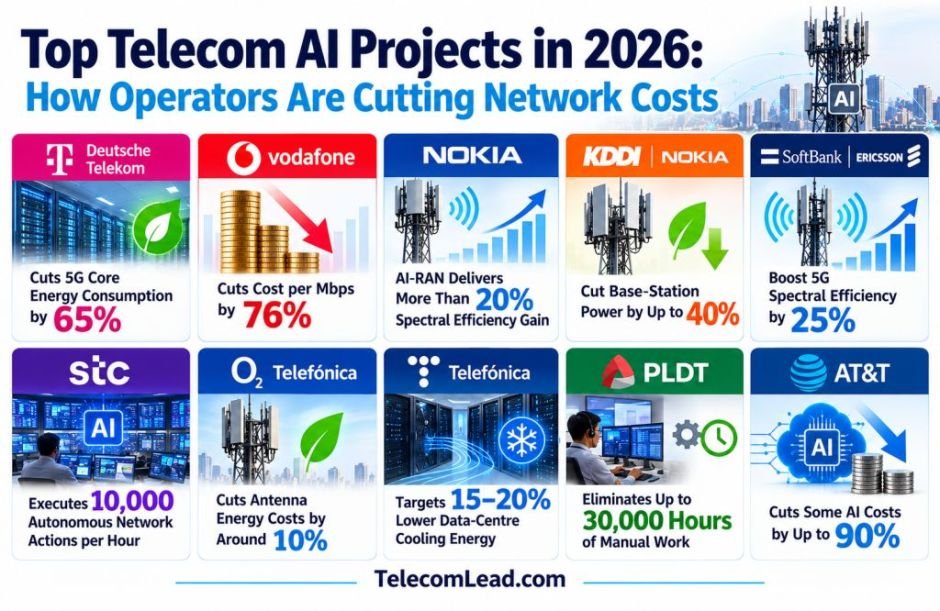
The results are becoming measurable. Deutsche Telekom has demonstrated up to 65 percent lower 5G core energy consumption. Vodafone reports a 76 percent reduction in cost per Mbps, while SoftBank and Ericsson achieved up to 25 percent higher spectral efficiency in a commercial 5G network.
Meanwhile, stc is executing 10,000 autonomous RAN corrective actions per hour, PLDT is eliminating tens of thousands of hours of manual work, and AT&T says intelligent model routing can reduce some AI costs by as much as 90 percent.
Here are 10 telecom AI projects showing where operators are generating measurable efficiency gains in 2026.
1. Deutsche Telekom Cuts 5G Core Energy Consumption by 65%
Deutsche Telekom has demonstrated up to a 65 percent reduction in mobile-core energy consumption through its Full Stack Energy Efficiency approach.
The architecture dynamically controls computing and network resources according to actual demand rather than keeping infrastructure continuously active.
Deutsche Telekom developed the technology with Lenovo, HPE, AMD and Mavenir. Importantly, the existing 65 percent result comes primarily from demand-driven resource control and hardware/software optimization. AI is the next stage rather than the sole reason for the saving.
The operator plans to introduce AI algorithms that predict traffic demand and activate resources before traffic increases.
The Deutsche Telekom 5G core energy project follows the principle of “Zero Bits, Zero Watts” — minimizing power consumption when network resources are not carrying traffic.
For telecom operators, lower power consumption can translate directly into reduced network OpEx.
2. Vodafone Cuts Cost per Mbps by 76%
Vodafone provides one of the broadest examples of AI-driven telecom efficiency.
Its FY2026 results show that GenAI-based Zero Touch Operations achieves more than 70 percent automated resolution of network issues. Centralized international network management has also produced a 76 percent reduction in cost per Mbps.
Vodafone reports more than 10 percent annual productivity improvement in its Network Operations Centre and a double-digit reduction in unit radio-site rollout costs.
Its FY2026 AI and network efficiency programme extends beyond the network.
SuperTOBi, Vodafone’s GenAI customer assistant, achieves more than 70 percent end-to-end resolution, while AI-powered customer-value management has cut campaign-analysis time by 85 percent.
More than 5,000 developers use GenAI coding tools, delivering a 12 percent productivity improvement across the software-development lifecycle.
3. Nokia AI-RAN Delivers More Than 20% Spectral Efficiency Gain
AI-RAN could become strategically important because spectrum is one of an operator’s most valuable assets.
Nokia says its AI-RAN technology has demonstrated more than 20 percent improvement in spectral efficiency through AI-powered radio innovations.
The technology combines Nokia RAN software with NVIDIA’s Aerial platform, bringing AI processing closer to the radio network.
Nokia’s AI-RAN programme involves operators including A1 Group, Chunghwa Telecom, du, e&, Mobily, stc, TPG Telecom and Zain Saudi Arabia.
A 20 percent spectral-efficiency improvement does not give an operator 20 percent more spectrum. But carrying substantially more traffic over existing spectrum could help operators improve network capacity without relying entirely on additional spectrum or cell-site expansion.
Nokia is targeting approximately 50 percent spectral-efficiency gains by 2027 and more than 100 percent by 2028, although these remain targets rather than demonstrated commercial results.
4. KDDI and Nokia Cut Base-Station Power by Up to 40%
KDDI Research and Nokia Bell Labs demonstrated up to approximately 40 percent lower base-station power consumption while maintaining the same throughput.
Their Intelligent 4D Resource Optimization Technology simultaneously manages four radio resources: time, frequency, space and transmission power.
The March 2026 proof of concept also achieved up to four times the throughput without increasing power consumption compared with existing 5G base-station equipment.
The KDDI-Nokia 4D resource optimization project dynamically coordinates network resources instead of optimizing individual parameters separately.
The results demonstrate the potential to increase network capacity without a corresponding increase in energy consumption.
5. SoftBank and Ericsson Boost 5G Spectral Efficiency by 25%
SoftBank and Ericsson tested AI directly on an operating commercial 5G network in Japan.
Ericsson’s AI-native Scheduler for Link Adaptation delivered up to 25 percent higher spectral efficiency and 50 percent higher downlink user throughput.
Across evaluated locations, average spectral efficiency and downlink throughput improved by approximately 10 percent.
The SoftBank-Ericsson AI-RAN trial is significant because it was conducted on a commercial network rather than only under laboratory conditions.
For operators, consistently extracting more traffic capacity from existing spectrum could help manage mobile-data growth before additional radios, spectrum or cell sites are required.
6. stc Executes 10,000 Autonomous Network Actions per Hour
Saudi operator stc is demonstrating how AI can move network operations toward greater autonomy.
Nokia’s MantaRay AutoPilot performs approximately 10,000 autonomous corrective actions every hour in stc’s network.
The deployment has delivered 30 percent higher cell utilization and a 10 percent average improvement in downlink throughput.
AI-powered RAN energy management has separately generated an average 6 percent reduction in energy consumption on top of existing energy-saving features without degrading network KPIs.
At 10,000 corrective actions per hour, manual intervention would be impractical. AI therefore becomes an operating mechanism for detecting network conditions, analysing them and executing approved corrective actions automatically.
7. O2 Telefonica Cuts Antenna Energy Costs by Around 10%
O2 Telefonica Germany is combining AI-based network operations with energy management.
Its Network Operations Agent, or NOA, helps engineers analyse incidents, identify causes, troubleshoot outages and retrieve information required for faster resolution.
AI-supported energy-saving functions also dynamically adapt frequency bands and network capacity according to traffic demand.
The operator says these measures are helping reduce electricity costs across its antenna network by around 10 percent.
O2 Telefonica’s broader Autonomous Network Journey targets Level 4 autonomous network operations by 2030, when many operational processes could be handled autonomously within defined policies.
8. Telefonica Targets 15–20% Lower Data-Centre Cooling Energy
Telefonica Germany and EkkoSense are applying IoT sensors, analytics and a real-time 3D digital twin to improve thermal management at data centres and technical infrastructure sites.
Initial evaluations indicate 15–20 percent lower cooling-system energy consumption.
The Telefonica AI digital-twin project continuously monitors equipment and thermal conditions to identify inefficiencies.
The potential financial benefit goes beyond electricity savings. Better visibility into infrastructure capacity could help avoid unnecessary investment, while predictive alerts can support proactive maintenance.
Telefonica plans to progressively deploy the technology at sites with the highest energy consumption.
9. PLDT Eliminates Up to 30,000 Hours of Manual Work
PLDT’s AI programme demonstrates how telecom operators can generate savings beyond the network.
Working with UiPath, the Philippine operator has deployed agentic AI across knowledge retrieval, customer engagement and risk assessment.
Its KAI knowledge agent converts information searches that previously took up to five days into contextual responses delivered within one to three seconds.
UiPath estimates KAI eliminates 25,000–30,000 hours of manual work annually, equivalent to approximately 12 full-time employees’ productivity capacity.
PLDT’s Ellie digital assistant delivers customer responses up to 80 percent faster and generates another 18,000–25,000 hours of annual productivity capacity.
Its ERICA risk-intelligence agent has reduced manual risk-assessment effort by 97–99 percent.
The PLDT agentic AI deployment shows why operators are extending AI into knowledge management, customer operations and enterprise workflows.
10. AT&T Cuts Some AI Costs by Up to 90%
AT&T is addressing another challenge: the cost of running AI itself at telecom scale.
The US operator processes an average of 45 billion AI tokens every day.
Instead of sending every task to the most powerful and expensive model, AT&T’s intelligent AI Gateway evaluates factors including cost, speed and expected output quality before selecting an appropriate model.
AT&T says this approach is reducing some AI costs by as much as 90 percent and has already generated millions of dollars in savings.
The operator is also developing telecom-specific AI models. Its OTel 2.0 model was post-trained using more than 400 billion tokens on AMD GPUs, while AT&T says it has processed more than 1 trillion tokens for training through Microsoft Foundry Managed Compute.
The AT&T AI Gateway strategy highlights an emerging telecom AI challenge: operators must optimize not only what AI saves, but also what AI costs to operate.
Telecom AI ROI Becomes Measurable in 2026
The leading telecom AI projects in 2026 point to three major areas of financial impact: energy efficiency, network capacity and automation.
Deutsche Telekom demonstrated up to 65 percent lower 5G-core energy consumption, while KDDI and Nokia achieved up to 40 percent lower base-station power consumption.
SoftBank and Ericsson achieved up to 25 percent higher spectral efficiency, demonstrating how AI could help operators carry more traffic over existing spectrum.
Automation is advancing rapidly as well. Vodafone reports more than 70 percent automated resolution through Zero Touch Operations, while stc executes 10,000 autonomous corrective actions per hour.
The productivity opportunity extends beyond networks. PLDT is eliminating tens of thousands of hours of repetitive work, while AT&T is demonstrating that operators can also use intelligent routing to control the rapidly growing cost of AI workloads.
Not every percentage translates directly into equivalent OpEx or capex savings. Some results remain trials or initial evaluations rather than nationwide commercial deployments.
But the direction is increasingly clear. The competitive benchmark for telecom AI is shifting from the number of AI projects an operator launches to measurable improvements in energy per bit, cost per Mbps, spectrum efficiency, network automation and employee productivity.
FASNA SHABEER