Agentic AI was the defining theme of Snapdragon Summit 2026, as Qualcomm unveiled new Snapdragon smartphone chips, expanded Snapdragon X2 into Linux PCs, pushed AI into glasses and earbuds, and laid out a vision in which personal AI agents operate across virtually every device a consumer uses.
Qualcomm CEO Cristiano Amon used the opening keynote at Snapdragon Summit 2026 to argue that computing is shifting from an app-centric model, where users initiate individual tasks, toward an agent-centric model where software understands intent, maintains context and acts on the user’s behalf.
The smartphone remains central to that strategy. But by the end of the Summit, Qualcomm had extended its agentic AI pitch across PCs, glasses, watches, earbuds, cars and emerging personal AI devices.
The announcements demonstrate how far Qualcomm’s AI strategy has expanded beyond smartphone processors. But IDC’s Tom Mainelli sees an important gap between the technological vision presented at Snapdragon Summit and today’s consumer reality: the hardware required for personal agents is arriving faster than the applications and user behaviour needed to make autonomous AI mainstream.
Here are the major hits and misses from Snapdragon Summit 2026.
HIT: Qualcomm Finally Has a Coherent On-Device AI Story
The biggest Snapdragon Summit success was not an individual processor. It was Qualcomm’s explanation of why AI should run on personal devices rather than exclusively in the cloud.
Google’s Rick Osterloh joined Amon on stage and said Gemini has reached 1 billion monthly users, while token usage has increased 7x year over year. Those figures demonstrate the enormous scale of cloud AI adoption.
Qualcomm’s argument is that the next stage of AI requires something different.
A personal agent needs access to context, permissions, preferences and potentially sensitive information. It must respond quickly, work when connectivity is limited and continuously understand what its user is doing.
Those requirements strengthen the case for on-device processing.
IDC sees Qualcomm’s hybrid approach — combining local inference with cloud intelligence — as a more compelling proposition than simply positioning the NPU as another performance specification.
The cloud can provide massive models and deep reasoning. Smartphones and PCs provide privacy, low latency and personal context.
Qualcomm’s opportunity is to connect the two.
HIT: Snapdragon 8 Elite Extreme Gen 6 Is the Hardware Star
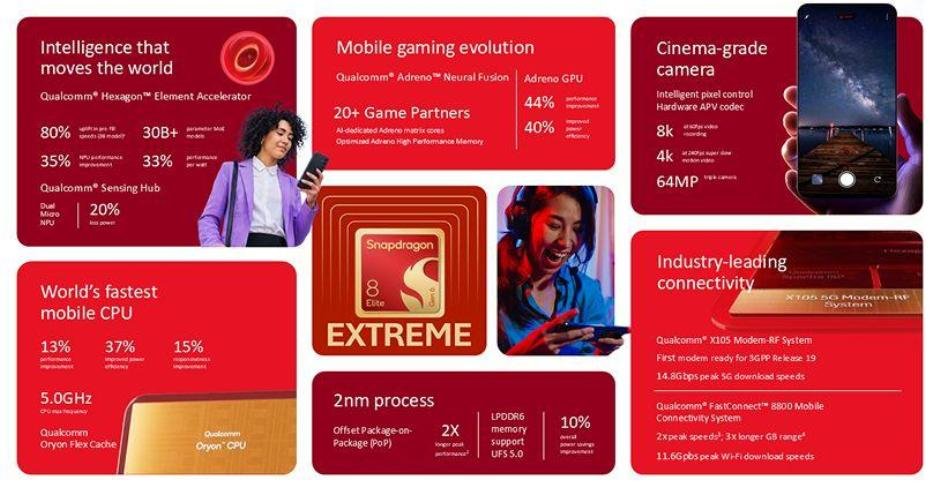
The strongest product announcement was Qualcomm’s decision to split its flagship mobile processor family into two platforms: Snapdragon 8 Elite Extreme Gen 6 and Snapdragon 8 Elite Gen 6.
Both are manufactured using a 2nm process and combine Qualcomm’s Oryon CPU, Adreno GPU and Hexagon NPU.
The Extreme version represents the more aggressive technology play, while Snapdragon 8 Elite Gen 6 gives smartphone manufacturers greater flexibility to build premium devices around different performance, efficiency and cost requirements.
The strategy makes sense because today’s premium smartphone market is no longer one category.
Conventional flagship phones, Ultra and Pro Max devices, foldables, gaming smartphones and camera-focused phones have different thermal, performance and pricing requirements.
Qualcomm says devices powered by the two processors will come from HONOR, iQOO, Motorola, OnePlus, OPPO, REDMI, RedMagic, vivo and Xiaomi.
The new platforms also strengthen Qualcomm’s wider agentic AI smartphone strategy, where the phone evolves from a device that simply executes commands into one capable of understanding context and coordinating tasks across applications.
HIT: The Smartphone Becomes the Personal AI Hub
Amon was careful not to suggest that AI glasses or other emerging devices will replace smartphones.
Instead, Qualcomm believes the smartphone could become even more important.
The phone is always with the user. It already contains communications, photographs, location information, applications, identity credentials and a growing amount of behavioural context.
That makes it a natural location for the personal knowledge layer required by AI agents.
Qualcomm’s redesigned sensing and AI architecture is intended to allow future devices to understand user routines and context locally.
IDC believes this is one of the stronger parts of Qualcomm’s strategy. Personal context could become the competitive advantage of edge AI, rather than simply the ability to run increasingly large models on a smartphone.
Qualcomm also teased High Bandwidth Compute (HBC), designed to bring memory and AI processing closer together. The technology is expected to eventually extend across smartphones, laptops, glasses and automotive platforms, with more details anticipated around Mobile World Congress 2027.
If Qualcomm can substantially improve the efficiency of memory-intensive AI processing, HBC could become an important component of its future edge-AI architecture.
HIT: Qualcomm Extends Agentic AI Beyond Smartphones
Day two demonstrated the larger ambition.
Qualcomm wants Snapdragon processors to power personal intelligence across PCs, smart glasses, watches, earbuds and other wearable devices.
The logic becomes particularly interesting when those devices are considered together.
A smartphone understands location and communications. Glasses can potentially understand what the user sees. Earbuds provide an always-available voice interface. A smartwatch captures activity and health information. A PC offers greater memory, processing capacity and a larger interface.
The strategic opportunity is therefore not simply putting AI into every device.
It is enabling one personal intelligence layer to move between devices.
That distinction will determine whether Qualcomm’s vision succeeds.
HIT: Linux Makes Snapdragon X2 More Credible for Developers
One of the Summit’s most strategically important announcements received less attention than the flagship smartphone processors.
Qualcomm is bringing official Linux support to the Snapdragon X2 Series.
Debian support is expected by the end of 2026, while Qualcomm and Canonical are targeting Ubuntu certification during the first half of 2027.
The move expands Snapdragon PCs beyond Windows and opens the architecture to developers, AI engineers and technical users who depend heavily on Linux.
Qualcomm is also upstreaming core Snapdragon X2 drivers, including support related to the Hexagon NPU and Adreno GPU.
That matters because the long-term battle for AI computing will be fought partly through developer ecosystems.
The expansion of Snapdragon X2 into Linux therefore has implications beyond selling additional laptops. It gives Qualcomm another route into AI development environments traditionally dominated by x86 processors and NVIDIA GPUs.
HIT: AI Inference Economics Strengthen Qualcomm’s Edge Strategy
Kedar Kondap, who leads Qualcomm’s compute business, framed one of the Summit’s most important questions simply: Where should inference run?
Cloud infrastructure provides access to the biggest AI models and deepest reasoning capabilities.
Devices offer privacy, low latency and personal information.
There is also an economic argument.
Sending every prompt, image, audio stream and token generated by potentially billions of devices to datacenters creates enormous infrastructure and inference costs.
As AI shifts from occasional chatbot interactions toward continuously available agents, those economics become increasingly important.
Moving appropriate workloads onto smartphones, PCs and other edge devices could reduce cloud processing requirements while improving responsiveness.
IDC believes this economic argument may ultimately prove more persuasive than headline NPU performance figures.
HIT: Earbuds Could Become an Important AI Interface
Qualcomm also introduced Snapdragon Sound Elite Gen 2, its first premium audio platform designed specifically around Personal AI.
The platform combines on-device AI with cloud-connected intelligence and integrated micro-power Wi-Fi 6E.
That last capability is significant because future earbuds could potentially connect directly with AI services rather than relying entirely on a smartphone.
Qualcomm’s Personal AI hearables strategy reflects a broader change in how consumers may interact with AI.
Voice remains one of the most natural ways to communicate with an assistant. If AI agents become persistent rather than something users deliberately open on a screen, earbuds could evolve from audio accessories into important AI endpoints.
Qualcomm says Snapdragon Sound Elite Gen 2 also supports a new generation of intelligent and multimodal audio wearables.
MISS: Qualcomm Showed the Agentic Future Better Than the Agentic Present
The biggest weakness of Snapdragon Summit was embedded in its biggest theme.
Agentic AI remains more convincing as a technology roadmap than as an everyday consumer experience.
Qualcomm explained why personal agents could become important. What remains less obvious is why mainstream consumers need autonomous agents today.
There is an enormous difference between asking Gemini or ChatGPT a question and allowing an AI agent to independently send messages, make purchases, book travel or interact with business applications.
Reliability becomes critical.
A chatbot producing an incorrect answer can be inconvenient. An autonomous agent taking an incorrect action can have financial, professional or personal consequences.
Amon acknowledged this challenge by emphasizing that consumers will delegate tasks only when the agent is trustworthy and easier to use than performing the task themselves.
IDC sees trust, reliability and permissions as potentially bigger barriers to agentic AI adoption than processor performance.
Qualcomm can provide the computing platform. Google, Microsoft, application developers and AI model providers still need to make the agents dependable.
MISS: Too Many AI Devices Could Create Fragmentation
Qualcomm demonstrated agentic AI across phones, PCs, glasses, watches, earbuds and emerging personal AI devices.
That makes sense for a chip supplier seeking to expand its addressable market.
The consumer proposition is more complicated.
Users probably do not want separate agents running independently on their phone, laptop, glasses, watch and earbuds.
They want one assistant that understands them regardless of which device they happen to be using.
Context, memory, identity and permissions therefore need to move securely between devices.
This creates one of the most difficult technical and ecosystem problems behind Qualcomm’s strategy.
The personal AI vision succeeds only when users experience one agent across many devices, rather than multiple devices competing for their attention.
MISS: AI Glasses and Pins Still Lack a Killer Use Case
Smart glasses were among the Summit’s most interesting demonstrations.
Qualcomm said Snapdragon AR1 and AR1+ can support highly efficient multimodal AI models, potentially allowing more intelligence to operate locally despite the severe power, thermal and memory limitations of eyewear.
The technical progress is impressive.
The commercial proposition is less certain.
Smartphones became indispensable because they combined communications, internet access, photography, navigation, entertainment and applications into a single device.
AI glasses and pins have not yet demonstrated an equivalent must-have proposition.
IDC sees significant potential for AI glasses because cameras, microphones and AI models can combine visual and contextual information in ways smartphones cannot.
But technical capability does not automatically create consumer demand.
Qualcomm can make AI glasses smaller, more powerful and easier for OEMs to develop. The industry still needs applications compelling enough to convince millions of consumers to wear them.
MISS: Googlebook Uses First-Generation Snapdragon X Elite
Googlebook was one of the more strategically interesting announcements around Snapdragon Summit.
The new laptop category combines elements of Chrome OS and Android and is aimed particularly at Android smartphone users, with native Android applications, desktop Chrome and Gemini-based AI experiences.
Dell and HP are among the first hardware partners.
But there is an unusual detail.
The first Googlebook systems use the first-generation Snapdragon X Elite rather than Snapdragon X2.
From a product-development perspective, using mature silicon may provide advantages in cost, availability and platform stability.
From a marketing perspective, however, it creates an awkward contrast.
Qualcomm was simultaneously demonstrating its newest Snapdragon X2 technology while one of the Summit’s most interesting new computing categories launched on an older generation.
IDC’s detailed assessment of the new category — Googlebook: A Modern, AI-Forward Take on Notebooks — explores why the platform could nevertheless become strategically important.
MISS: Qualcomm Still Faces a Massive Developer Ecosystem Challenge
Hardware alone will not determine the winners of the AI computing era.
Developers will.
NVIDIA’s success demonstrates the strategic power of combining strong processors with a software ecosystem that developers know and depend upon.
Qualcomm is clearly aware of the challenge.
Its developer strategy now includes Snapdragon AI tools, Linux support and technologies gained through the Modular acquisition, including the Mojo programming language.
The ambition is important because Qualcomm wants developers to deploy AI across smartphones, PCs, automotive platforms, wearables and eventually datacenter infrastructure.
But developer ecosystems take years to build.
Qualcomm needs to make deploying models across Snapdragon devices dramatically easier if it wants its huge installed device footprint to translate into AI platform power.
Biggest Hit: Qualcomm Now Has a Strategy Bigger Than Smartphones
The most important takeaway from Snapdragon Summit 2026 is that Qualcomm increasingly looks less like a smartphone-chip supplier.
Its strategy stretches from smartphones and PCs to automotive systems, XR, glasses, earbuds, wearables and datacenter infrastructure.
Agentic AI provides the common thread.
Qualcomm is betting that future AI will be distributed: the largest models and most complex reasoning will remain in datacenters, while increasingly capable inference, sensing and personal context move onto devices.
IDC believes this hybrid AI architecture is one of Qualcomm’s strongest strategic advantages.
Qualcomm already has silicon inside many of the personal devices that could become endpoints for AI agents.
The challenge is turning those endpoints into a coherent ecosystem.
Biggest Miss: Where Is the Killer Agent?
For all the impressive processors, demonstrations and partnerships at Snapdragon Summit, one question remains unanswered:
What is the application that makes consumers decide they cannot live without an AI agent?
Consumers already understand why they need smartphones and laptops.
The value proposition for AI pins, persistent agents and some forms of smart glasses remains less obvious.
AI adoption itself is not the problem. Gemini’s reported 1 billion monthly users and rapidly expanding token consumption suggest enormous consumer appetite for AI.
The next transition is harder.
It requires consumers to move from asking AI for information to trusting AI to take action.
That is the real bet behind Snapdragon Summit 2026.
Qualcomm demonstrated that the underlying hardware is becoming increasingly capable of supporting that transition. Its new Snapdragon mobile processors, X2 PC platform, Linux expansion, AI wearables and Personal AI strategy give the company a credible position across the edge.
But IDC believes the defining question for the next phase of agentic AI will not be how many TOPS a processor delivers.
It will be much simpler:
Can AI become reliable, personal and useful enough that consumers are willing to hand over the task?
Snapdragon Summit 2026 showed that Qualcomm is increasingly ready for that future. Whether consumers and the software ecosystem are ready may determine whether agentic AI becomes the next major computing platform — or remains an impressive technology looking for its killer application.
BABURAJAN KIZHAKEDATH