Verizon and T-Mobile report postpaid ARPA above $150, Telefónica España generates €91.1 ARPU, while Airtel, Jio, Vi and China Telecom demonstrate very different approaches to monetizing mobile customers.
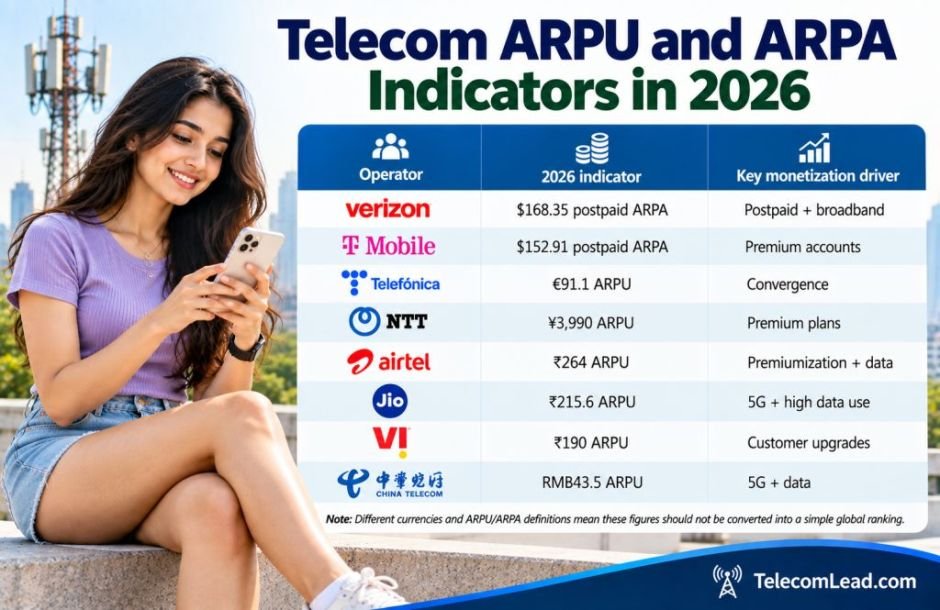
Telecom operators are focusing on ARPU, ARPA, customer mix, convergence and data consumption as subscriber growth becomes harder to sustain in mature markets.
The latest 2026 results from Verizon, T-Mobile, AT&T, Telefónica, Airtel, Jio, NTT, Vodafone Idea and China Telecom demonstrate that high data consumption alone does not guarantee high customer revenue.
The figures are not a strict global ranking because operators use different definitions and currencies. Verizon and T-Mobile report postpaid ARPA, while Airtel, Jio and China Telecom report mobile ARPU and Telefónica España reports a broader ARPU measure.
Verizon: $168.35 Postpaid ARPA
Verizon’s Q2 2026 results demonstrate the revenue advantage of its predominantly postpaid customer base.
Verizon reported wireless retail postpaid ARPA of $168.35, up from $166.66 a year earlier.
Mobility and broadband service revenue reached $23.4 billion, up 2.8 percent, while Verizon added 184,000 postpaid phone customers and 348,000 broadband connections.
The operator ended Q2 with approximately 17.1 million fiber and fixed wireless broadband connections, giving it additional opportunities to increase household revenue through convergence.
T-Mobile: $152.91 ARPA and 13% Postpaid Revenue Growth
T-Mobile reported postpaid ARPA of $152.91, up 2 percent year over year.
Postpaid service revenue increased 13 percent to $15.9 billion, while total service revenue reached $19 billion.
T-Mobile added 277,000 postpaid accounts, taking the base to 34.7 million, while postpaid account churn was 0.99 percent.
Its results demonstrate why ARPA needs to be assessed alongside account size, premium plans, churn and additional connectivity services. T-Mobile’s ARPA measures monthly postpaid service revenue per account rather than revenue from an individual mobile subscriber.
Telefonica Espana: €91.1 ARPU with Churn at 0.7%
Telefonica provides an important European comparison.
The operator reported ARPU of €91.1 in Spain during Q2 2026, while churn remained at a record-low 0.7 percent.
Telefonica’s H1 2026 results show more than 16 million mobile contract accesses in Spain and 25.82 million IoT lines.
The combination of high ARPU and exceptionally low churn demonstrates the value of convergence. Telefonica Espana sells mobile, fiber, television and digital services, making customer value substantially broader than smartphone connectivity alone.
Telefonica Brasil provides another model. Vivo ended June with almost 119 million accesses, while its Vivo Total converged customer base reached 3.8 million, up 29 percent.
AT&T: Convergence Expands Household Value
AT&T measures monetization through its broader Advanced Connectivity business rather than publishing a directly comparable mobile ARPA figure.
Advanced Connectivity service revenue reached $23.5 billion in Q2 2026, up 5.1 percent.
AT&T added 432,000 postpaid phone customers and 646,000 internet connections, including fiber and fixed wireless.
Most importantly, 42.5 percent of households with AT&T advanced home internet also take AT&T wireless.
This convergence strategy demonstrates an important shift in telecom economics: the relevant measure is revenue per household or relationship, rather than revenue from one SIM.
Airtel: ₹264 ARPU with 34.4 GB Monthly Data Consumption
Bharti Airtel demonstrates that ARPU can rise substantially in a predominantly prepaid market.
Airtel reported India mobile ARPU of ₹264, up from ₹250 a year earlier.
Its mobile base reached approximately 376.5 million, including 30 million postpaid customers. Monthly data consumption increased to 34.4 GB per customer.
Airtel’s quarterly results show how premiumization, postpaid migration, smartphones and increasing 4G/5G consumption are helping the operator raise customer revenue.
The results are particularly important because postpaid accounts for only about 8 percent of Airtel’s Indian mobile base.
Jio: ₹215.6 ARPU Despite 43.7 GB Data Consumption
Reliance Jio presents one of the clearest examples of the difference between usage and monetization.
Jio reported ARPU of ₹215.6, an increase of ₹7 year over year, while monthly data consumption reached an extraordinary 43.7 GB per customer.
Its connectivity base reached 533 million, including 285 million 5G users, while total data traffic increased 27 percent to 69.4 exabytes.
Jio said ARPU improved despite no tariff increase during the preceding 12 months.
The comparison with Airtel is revealing: Jio customers consumed substantially more data, but Airtel generated higher ARPU. Pricing, customer mix, postpaid penetration and premiumization therefore remain as important as network usage.
NTT: ¥3,990 ARPU as Premium Plans Expand
Japan’s NTT reported consumer communications ARPU of ¥3,990, increasing ¥70 year over year.
The improvement was supported by adoption of the docomo MAX proposition.
Japan is already a highly mature smartphone market, making NTT an example of how operators can increase monetization through premium plans and larger data allowances rather than relying on subscriber growth.
China Telecom: ARPU Falls Despite Rising Data Traffic
China Telecom provides an important counterpoint to operators reporting ARPU growth.
Mobile ARPU decreased from RMB46.0 in H1 2025 to RMB43.5 in H1 2026, even as handset data traffic increased from 49,953 kTB to 57,289 kTB.
Its mobile customer base reached 442 million, including 323 million 5G network subscribers.
The China Telecom H1 2026 operating results demonstrate that growing traffic does not automatically translate into higher customer revenue.
Pricing competition, customer mix and service packaging can offset the monetization benefits of greater 5G consumption.
Vodafone Idea: ₹190 ARPU as Customers Upgrade
Vodafone Idea reported customer ARPU of ₹190, compared with ₹175 a year earlier, representing growth of about 8.3 percent.
Vi attributed the improvement primarily to customer upgrades.
Its subscriber base stood at 192.8 million, while 4G/5G subscribers increased to 128.9 million.
Vi also recorded positive postpaid net additions for an eighth consecutive quarter, supporting its strategy of moving customers toward higher-value relationships.
Orange: Revenue Growth Highlights Africa Opportunity
Orange adds another dimension because some of its strongest monetization growth is coming from emerging markets.
Orange’s H1 2026 revenue increased 3.5 percent to €20.9 billion, but its Africa and Middle East business grew much faster at 13.9 percent. EBITDAaL in the region increased 16.1 percent.
Orange also remains a major convergence operator in Europe, with 9.3 million convergent customers reported in Q1 2026, up 1.9 percent.
Its results show that customer monetization can come through two different routes: higher-value converged households in mature European markets and rapidly expanding digital and connectivity demand in Africa and the Middle East.
Data Consumption Does Not Guarantee Higher ARPU
The most important lesson from 2026 is that network usage and customer monetization are not the same thing.
Jio customers consume 43.7 GB monthly but generate lower ARPU than Airtel customers consuming 34.4 GB. China Telecom’s data traffic increased while ARPU declined.
Meanwhile, Telefónica España combines €91.1 ARPU with just 0.7 percent churn, and Verizon and T-Mobile generate ARPA above $150 from large postpaid account relationships.
The strongest monetization strategies combine 5G, premium plans, postpaid migration, fiber-mobile convergence, multiple lines, device financing, digital services and low churn.
For telecom operators, the strategic question is therefore shifting from “How many subscribers do we have?” to “How much long-term value can we generate from each customer relationship?”
FASNA SHABEER