
Spark New Zealand is strengthening its mobile network, 5G coverage, broadband services and artificial intelligence (AI) capabilities under its SPK-30 strategy, with planned capital expenditure (Capex) of NZ$350 million to NZ$380 million for FY27, compared with NZ$401 million in FY26.
In its November 2026 UBS Conference presentation, Spark reported 4.4 percent growth in mobile revenue and 1.1 percent growth in mobile service revenue during FY26. The telecom operator is prioritizing mobile ARPU improvement, digital customer acquisition, network coverage leadership and AI-enabled operations to support future revenue growth.
Spark New Zealand Strategy Focuses on Connectivity, 5G and Digital Services
Spark’s SPK-30 strategy, launched in September 2025, focuses on strengthening core connectivity, improving customer experiences and simplifying businesses outside its core telecom operations.
The strategy emphasizes mobile network leadership, 5G monetization, broadband convergence, AI-enabled customer service and digital transformation.
Spark is prioritizing investments in areas that improve mobile revenue, customer retention and network differentiation.
The company is also reviewing its Digital Services business as part of its strategy to concentrate resources on core connectivity.
Spark completed its data centre transaction while retaining a 25 percent shareholding, allowing it to maintain exposure to the business while shifting its strategic focus toward telecommunications.
Spark Capex to Decline to NZ$350–380 Million in FY27
Spark New Zealand reported business-as-usual Capex of NZ$401 million in FY26, unchanged from FY25.
The company also recorded NZ$66 million in strategic Capex associated with its data centre transaction.
For FY27, Spark maintained its Capex guidance of NZ$350 million to NZ$380 million, representing a reduction of approximately 5.2 percent to 12.7 percent from FY26 business-as-usual Capex.
Under SPK-30, Spark targets a Capex-to-revenue ratio of 10–12 percent by FY30.
The FY26 business-as-usual Capex-to-adjusted-revenue ratio stood at 10.8 percent.
Spark’s capital allocation strategy emphasizes maintaining network coverage, supporting 5G capabilities and improving digital customer experiences while controlling investment requirements.
Spark Mobile Revenue Grows 4.4% as ARPU Improves
Spark reported 4.4 percent growth in total mobile revenue during FY26, while mobile service revenue increased 1.1 percent.
Consumer and small-business pay-monthly ARPU rose 3.6 percent to NZ$46.08 in FY26, compared with NZ$44.46 in FY25.
The improvement was supported by mobile plan revisions, pricing changes and higher-value customer propositions.
Spark reported approximately 15 percent growth in interest-free payment acquisitions, supporting customer acquisition and retention in higher-value mobile plans.
The company is also introducing new roaming, satellite connectivity, children’s mobile plans and longer-term offers to improve customer value and encourage migration to higher-ARPU plans.
Spark’s FY27 mobile strategy includes offering premium smartphones through interest-free payment arrangements linked to higher-tier mobile subscriptions.
Spark Mobile Subscribers Stabilize Following 3G Shutdown
Spark reported stabilization in its overall mobile subscriber base during FY26 despite the closure of its 3G network.
Consumer prepaid connections declined 3.6 percent, compared with a 5.2 percent reduction in FY25.
Approximately 25 percent of the FY26 prepaid subscriber decline was attributable to the 3G shutdown.
Spark’s New Zealand recurring-pack prepaid subscriber base reached 506,000 in FY26, compared with 516,000 in FY25 and 540,000 in FY24.
Prepaid ARPU for the New Zealand recurring-pack customer base increased 1.1 percent despite competitive pricing conditions.
Skinny, Spark’s mobile brand, recorded approximately 2 percent growth, supported by the introduction of longer-term prepaid plans.
Enterprise and government mobile connections remained broadly stable at 310,000 in FY26, compared with 312,000 in FY25.
Enterprise and government mobile ARPU declined by NZ$1.92, or 7.2 percent, in FY26, compared with a decline of NZ$3.26, or 10.9 percent, in FY25.
Spark did not disclose a mobile churn rate in the November 2026 presentation. Its customer retention strategy focuses on higher-value mobile plans, interest-free handset payments, digital engagement and broadband-mobile bundling.
Spark 5G Network Leads New Zealand Coverage Rankings
Spark retained its network coverage leadership in New Zealand, according to the October 2026 Opensignal Mobile Network Experience report cited in its investor presentation.
The operator was recognized as the outright winner for overall coverage, 5G network coverage, time on 5G, download speed, 5G reliability and 5G download speed.
Spark also shared leading positions in overall reliability, video experience and 5G video experience.
The company is extending its 5G capabilities through 5G+ services and spectrum recycling following the shutdown of its 3G network.
Spark sees 5G+ as an opportunity to differentiate its mobile network and introduce higher-value connectivity services.
The presentation does not disclose the percentage of New Zealand’s population covered by Spark’s 5G network or the number of active 5G subscribers.
Spark Satellite Service Reaches More Than 237,000 Customers
Spark launched satellite-to-mobile connectivity in April 2026, extending mobile services into remote locations and areas beyond conventional cellular coverage.
By the November 2026 presentation, more than 237,000 customers had connected to Spark’s satellite service.
The satellite offering supports text messaging and selected satellite-ready applications in areas where terrestrial mobile towers cannot provide coverage.
Spark is positioning satellite connectivity as an extension of its existing mobile network rather than a replacement for 4G and 5G infrastructure.
The service strengthens the operator’s coverage proposition for customers travelling or operating in remote areas.
Spark Fiber Broadband Strategy Targets Mobile Convergence
Spark is strengthening its broadband business through fixed-mobile convergence, digital sales and bundled connectivity offers.
In October 2026, Spark introduced an offer allowing existing broadband-only customers to save NZ$15 per month when adding an eligible Spark Pay Monthly mobile plan.
The strategy is designed to increase mobile subscriber acquisition from Spark’s existing broadband customer base and improve customer retention through bundled services.
Spark is also using digital channels to simplify broadband and mobile account management.
Although the company identifies broadband as a core connectivity business, its November 2026 presentation does not provide separate fiber broadband subscriber totals, fiber coverage figures or fiber-specific revenue growth.
Spark Digital Strategy Targets Higher Customer Acquisition and ARPU
Spark reported 30 percent growth in digital customer acquisition during FY26.
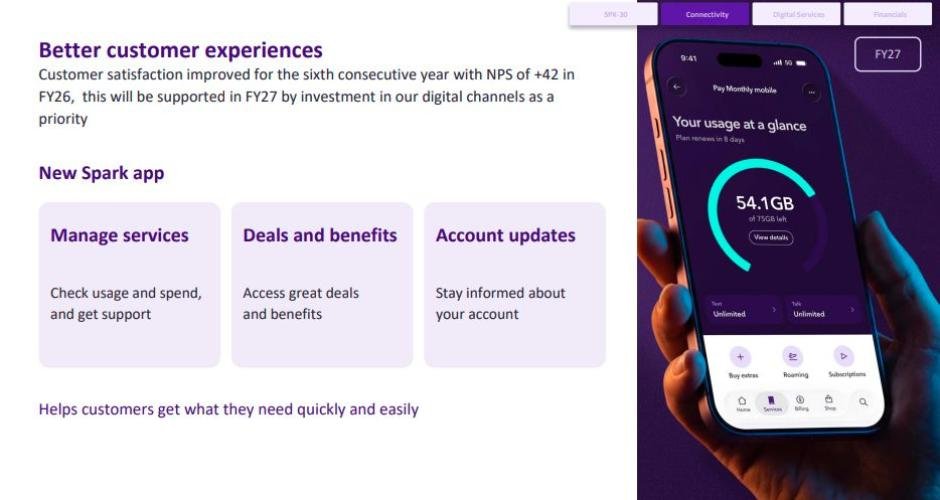
The company is expanding its digital sales capabilities through the new Spark app, which supports mobile account management, customer offers, subscription information and service assistance.
The Spark Upgrader feature allows customers to purchase new smartphones, use trade-in value and access exclusive offers through a digital interface.
Spark is also expanding digital engagement through its Skinny brand and Everyday Rewards partnership.
Approximately 30,000 Skinny customers had registered for Everyday Rewards through the partnership.
Spark expects improved digital acquisition and mobile self-service capabilities to support customer retention and higher-value subscriptions.
Spark AI Strategy Focuses on Customer Service and Enterprise Efficiency
Artificial intelligence is a central component of Spark’s SPK-30 strategy.
The company is moving from individual AI applications toward enterprise-wide process improvements, with a focus on customer service automation, operational efficiency and digital customer engagement.
Spark is using AI-enabled customer care to reduce service handling time and improve the customer experience.
The company is also developing AI capabilities across its Digital Services portfolio, including cloud computing, IT services and enterprise data platforms.
Its Qrious business provides data and AI services, while CloudIQ supports hybrid cloud environments and ServiceFlex delivers IT services.
Spark maintains partnerships with Microsoft, Infosys, HPE and major hyperscale cloud providers to support enterprise digital transformation.
The company is also expanding managed services capabilities as enterprise customers migrate from private cloud environments toward public cloud platforms.
Spark Reviews Digital Services Business as Connectivity Takes Priority
Spark has initiated a strategic review of its Digital Services business to evaluate options for maximizing value and supporting the SPK-30 strategy.
The review includes a business with established enterprise customers, recurring revenue, cloud services, IT solutions and AI capabilities.
Spark has appointed an external adviser and expects the review to conclude during the first half of FY27.
The company has emphasized that the review does not guarantee a transaction.
Spark’s Digital Services strategy currently includes modernizing its portfolio, transitioning customers from legacy IT products to ServiceFlex and expanding managed cloud capabilities.
The review reflects Spark’s intention to concentrate investment on core telecom connectivity while evaluating the future ownership and operating structure of its digital businesses.
Spark FY27 Outlook: Lower Capex, Higher Mobile ARPU and Stronger 5G Services
Spark’s FY27 strategy prioritizes mobile revenue growth, ARPU improvement, broadband-mobile convergence, 5G network leadership and AI-enabled customer experiences.
The company expects its new roaming packages, premium mobile plans, satellite connectivity and digital sales capabilities to support mobile service revenue.
Its planned Capex of NZ$350 million to NZ$380 million reflects a more selective investment approach following FY26 spending of NZ$401 million.
Spark is also emphasizing customer retention through mobile-broadband bundling, higher-value plans and digital engagement.
The company’s SPK-30 strategy positions core connectivity, 5G coverage, digital customer acquisition and AI automation as its principal areas of investment and revenue development through FY30.
BABURAJAN KIZHAKEDATH