
Huawei, Ericsson, Nokia, ZTE and Samsung controlled 96 percent of the global radio access network (RAN) equipment market in the first half of 2026, as telecom operators continued investing in 5G coverage, network modernization, cloud-native core infrastructure and AI-powered networks.
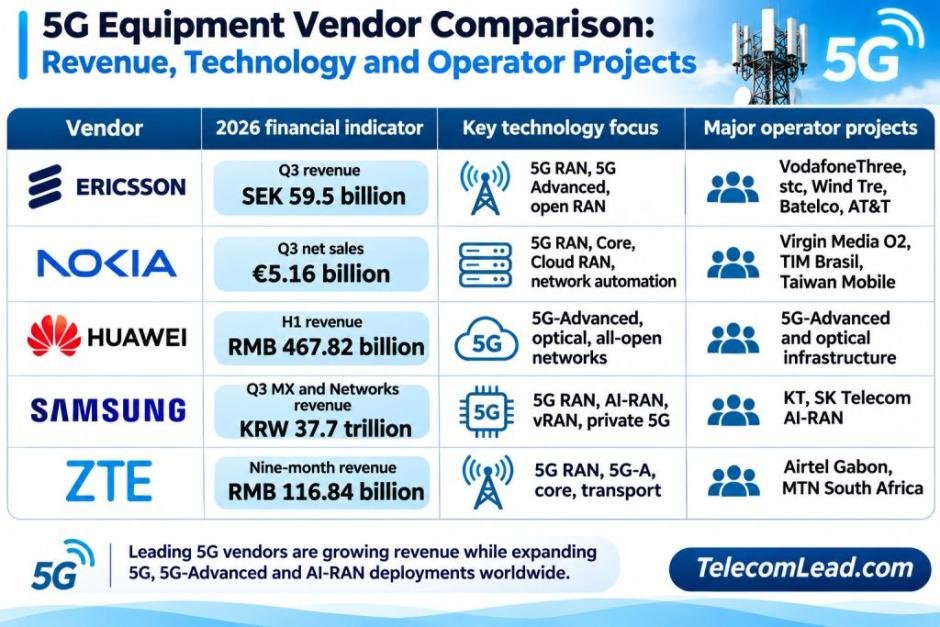
The RAN equipment market is influenced by operator capital expenditure, equipment pricing, network energy consumption and demand for 5G Standalone services.
While Huawei remains the largest global RAN supplier, Ericsson and Nokia are winning major modernization contracts across Europe, Asia and the Middle East. Samsung is expanding its AI-RAN and private 5G business, while ZTE is combining telecom infrastructure with AI computing.
According to Dell’Oro Group’s 2026 RAN market assessment, Huawei ranked first, followed by Ericsson, Nokia, ZTE and Samsung. Although second-quarter RAN revenue increased modestly, the research firm expects the full-year market to remain broadly flat.
Ericsson: 5G Contracts with VodafoneThree, stc, Wind Tre and Batelco
Ericsson reported Q3 2026 revenue of SEK 59.5 billion, increasing 6 percent year over year, with organic sales growth of 7 percent.
Revenue for the first nine months reached SEK 161.5 billion, while adjusted EBITA was SEK 22.55 billion.
Ericsson’s growth strategy focuses on 5G radio modernization, cloud-native core networks, 5G Standalone and differentiated connectivity.
In Saudi Arabia, stc expanded its partnership with Ericsson through a multi-year agreement covering additional network sites, higher capacity, 5G Standalone expansion and newly acquired 600 MHz spectrum.
In the United Kingdom, VodafoneThree selected Ericsson for a cloud-native 5G Core project under a SEK 12.5 billion agreement.
The upgraded network is designed to support 28.6 million customers and capacity of 9 terabits per second.
In Italy, Wind Tre selected Ericsson for a seven-year core modernization agreement covering 2026–2032, supporting 4G, 5G Non-Standalone and 5G Standalone services.
In Bahrain, Batelco selected Ericsson radio access and core technologies to expand 5G capacity and introduce AI-enabled network capabilities.
Ericsson is also supplying radio technology to AT&T for deployment of additional spectrum acquired from EchoStar.
These projects demonstrate Ericsson’s ability to secure radio and core-network contracts across different operator investment cycles.
Nokia: Virgin Media O2, TIM Brasil and Taiwan Mobile Drive 5G Expansion
Nokia reported Q3 2026 net sales of €5.16 billion.
Network Infrastructure revenue increased 17 percent to €2.16 billion, while Mobile Infrastructure revenue increased 5 percent to €2.90 billion.
Nokia raised its full-year Network Infrastructure growth outlook to 12–14 percent and maintained comparable operating profit guidance of €2.1 billion to €2.6 billion.
Its 2026 capital expenditure outlook was €750 million to €850 million.
In the United Kingdom, Virgin Media O2 selected Nokia for a multi-year 5G radio network modernization programme.
The project includes Nokia’s AirScale portfolio, Massive MIMO radios and next-generation baseband equipment.
Virgin Media O2 allocated £700 million to its 2026 mobile transformation programme, involving Nokia and Ericsson.
In Brazil, TIM Brasil expanded its partnership with Nokia to modernize 5G infrastructure across 14 additional states.
The deployment covers areas representing approximately 42 percent of Brazil’s population and includes AI-ready network capabilities developed with NVIDIA.
In Taiwan, Taiwan Mobile selected Nokia for additional 5G network expansion using AirScale radio equipment and AI-driven network software.
Nokia is also working with Deutsche Telekom on AI-RAN technology, including NVIDIA-based channel estimation.
Initial laboratory tests reported 10–15 percent uplink throughput improvements, although commercial field validation remains necessary.
The Nokia Q3 2026 financial report highlights its expanding AI, cloud and network infrastructure business.
Huawei: World’s Largest RAN Vendor Invests Heavily in AI and 5G-Advanced
Huawei retained first position in the global RAN equipment market during the first half of 2026.
The Chinese technology supplier reported first-half revenue of RMB 467.82 billion, increasing 9.6 percent year over year.
However, net profit declined 36 percent to RMB 23.81 billion.
Research and development expenditure increased 25.2 percent to RMB 121.38 billion, representing 25.9 percent of revenue.
Huawei’s investments cover 5G-Advanced, AI computing, semiconductors, optical networking and next-generation telecommunications infrastructure.
Its network portfolio includes MetaAAU radio equipment, Massive MIMO, 5G core systems, optical transport and intelligent network management technologies.
Huawei’s technology is relevant to operators pursuing higher network capacity, improved spectrum efficiency and AI-assisted network automation.
China Mobile, China Telecom and China Unicom are important participants in China’s large-scale 5G and 5G-Advanced network ecosystem, where Huawei competes with other domestic and international suppliers.
Huawei also promotes AI-centric all-optical networking for high-capacity transport infrastructure.
However, national security policies and procurement restrictions limit Huawei’s access to some telecom markets, particularly in North America and parts of Europe.
These restrictions create opportunities for competing vendors, including Ericsson, Nokia and Samsung.
Samsung: KT and SK Telecom Select AI-RAN Technology
Samsung Electronics is expanding its telecom equipment business through 5G Standalone, AI-RAN, private wireless networks and software-based network automation.
Samsung reported Q3 2026 consolidated revenue of KRW 195.3 trillion, supported primarily by semiconductor demand.
Its combined Mobile eXperience and Networks businesses generated KRW 37.7 trillion.
Samsung did not separately disclose Networks revenue, so the combined figure should not be treated as telecom equipment sales.
In September 2026, Samsung signed contracts with KT and SK Telecom under South Korea’s Hyper AI Network initiative.
Samsung was selected as the sole global vendor for KT and the main vendor for SK Telecom.
The projects involve 5G Standalone private networks for industrial environments, including shipyards and petrochemical facilities.
The deployments are intended to validate AI-RAN technology, network automation and industrial connectivity.
Samsung’s telecom equipment portfolio includes virtualized RAN, Massive MIMO radios, 5G core solutions and private network technologies.
Its AI-RAN projects with KT and SK Telecom illustrate its strategy to compete beyond conventional 5G radio equipment.
Samsung is also participating in advanced fixed wireless access development through its collaboration with Broadcom on integrated 5G and Wi-Fi 8 technology.
ZTE: Airtel Gabon Deployment Demonstrates 107 Percent Throughput Improvement
ZTE reported revenue of RMB 116.84 billion during the first nine months of 2026, increasing 16.2 percent year over year.
Third-quarter revenue increased 34 percent to RMB 38.81 billion.
Its first-half Operator Network business generated RMB 31.77 billion, representing 40.7 percent of total revenue.
International revenue increased 33.1 percent to RMB 27.87 billion, while computing revenue increased more than 55 percent.
ZTE is combining 5G equipment, optical networking, servers, storage and AI data center infrastructure.
On November 3, 2026, ZTE and Airtel Gabon announced the commercial deployment of an FDD and TDD Massive MIMO solution.
ZTE reported a 107 percent improvement in site-level throughput, a 20 percent increase in capacity and a 41 percent improvement in physical resource block efficiency.
These figures represent the reported deployment results rather than guaranteed improvements across other networks.
ZTE is also working with MTN South Africa on AI-based energy optimization.
An EnergyTurbo trial in Cape Town reported 13.5 percent energy savings per site, compared with 2.8 percent from conventional energy-saving features.
The projects demonstrate ZTE’s focus on radio efficiency, capacity improvements and lower network operating costs.
Financial figures cover different reporting periods and business scopes and are not directly comparable telecom equipment revenues.
Telecom Operator Capex and Subscriber Growth Influence Vendor Orders
Network equipment spending depends heavily on operators’ revenue growth, subscriber additions and capital expenditure.
Saudi Arabia’s stc reported nine-month revenue of SAR 60.1 billion, increasing 3.7 percent, while capital expenditure rose 27.4 percent to SAR 7.75 billion.
Its Ericsson agreement supports additional 5G coverage and capacity.
TIM Brasil reported Q2 service revenue of R$6.79 billion, increasing 5.7 percent, while mobile ARPU increased 5 percent to R$34.30.
TIM had 61.88 million mobile customers, including 33.67 million postpaid subscribers. First-half capex reached R$2.29 billion.
MTN Group reported 317.7 million subscribers at the end of H1 2026, increasing 6.7 percent.
Its active data subscriber base reached 179.3 million, while service revenue was R115.3 billion and capex excluding leases reached R19.7 billion.
Virgin Media O2 reported 46.3 million mobile connections in Q3 2026 and a fibre footprint of 9.4 million homes.
Its network modernization investments are taking place alongside pressure on mobile service revenue.
These figures demonstrate why equipment suppliers must justify network spending through measurable improvements in coverage, capacity, efficiency and operating costs.
AI-RAN, 5G Standalone and Energy Efficiency Shape Vendor Competition
The next phase of telecom equipment procurement will involve several technology priorities.
Ericsson and Nokia are competing for large-scale 5G radio and cloud-native core modernization programmes.
Huawei continues investing in 5G-Advanced, AI and optical networking while maintaining the largest global RAN market position.
Samsung is developing AI-RAN and industrial private 5G networks.
ZTE is expanding its international equipment business while integrating AI-based network optimization and computing infrastructure.
Other suppliers, including Mavenir, NEC, Fujitsu, Rakuten Symphony, Tejas Networks and Parallel Wireless, participate in Open RAN, cloud-native networking, private wireless and network modernization opportunities.
For telecom operators, the key procurement criteria are equipment cost, energy efficiency, spectrum utilization, network coverage, throughput, software flexibility and long-term maintenance expenditure.
With the global RAN market expected to remain broadly flat in 2026, vendor growth will depend on securing modernization contracts, replacing legacy equipment and demonstrating stronger returns on network investment.
FASNA SHABEER