AT&T, Verizon, T-Mobile, Deutsche Telekom, Orange, Telefónica and Vodafone are using convergence, network quality, loyalty programs and higher-value customer relationships to reduce churn in 2026.
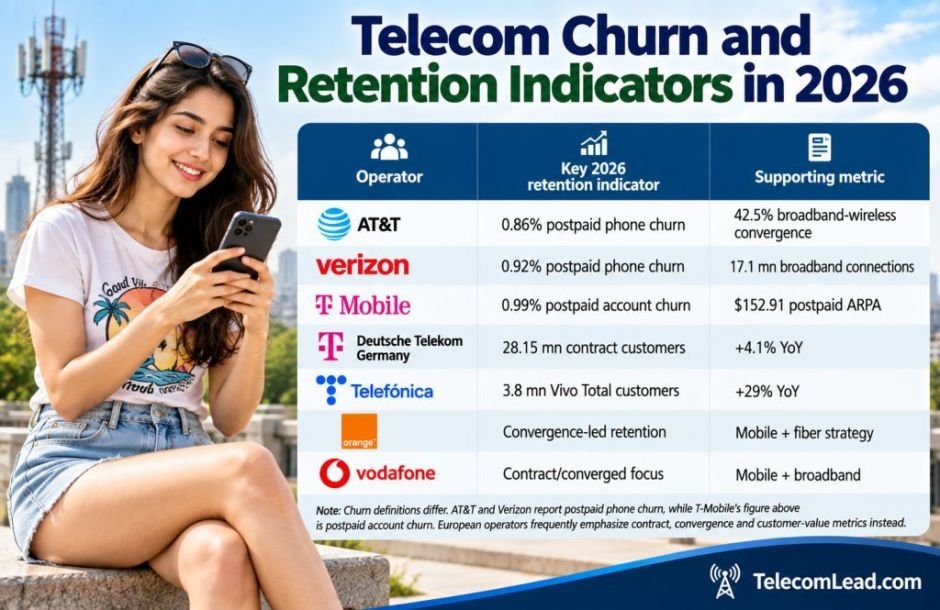
Customer retention is becoming a bigger growth lever for telecom operators as mature mobile markets make it more expensive to rely solely on subscriber acquisition.
The clearest churn disclosures come from major U.S. operators. AT&T reported 0.86 percent postpaid phone churn in Q2 2026, Verizon reported 0.92 percent, while T-Mobile reported 0.99 percent postpaid account churn. European operators use different KPIs, making direct comparisons difficult, but their results demonstrate how convergence and premium contract customers are becoming central to retention.
AT&T: 0.86% Churn as Wireless-Fiber Convergence Expands
AT&T reported 0.86 percent postpaid phone churn in Q2 2026 while adding 432,000 postpaid phone customers.
The operator also added 646,000 Advanced Connectivity internet customers, comprising 367,000 fiber and 279,000 fixed wireless additions.
One of AT&T’s strongest retention indicators is convergence. 42.5 percent of households subscribing to AT&T advanced home internet also take AT&T wireless.
That relationship gives AT&T multiple customer touchpoints and potentially increases switching friction because leaving the operator can affect more than one household service.
The AT&T Q2 2026 results also demonstrate how fiber investment is becoming part of the company’s wireless retention strategy rather than simply a separate broadband business.
Verizon: Postpaid Phone Churn Improves to 0.92%
Verizon reduced wireless retail postpaid phone churn to 0.92 percent in Q2 2026 from 0.97 percent a year earlier.
First-half churn improved to 0.94 percent from 0.96 percent.
Verizon added 184,000 postpaid phone connections and 348,000 broadband connections during the quarter. Its broadband base reached around 17.1 million fiber and fixed wireless connections.
The operator’s contract structure provides another interesting retention indicator. Approximately 95 percent of Verizon’s wireless postpaid contracts were month-to-month at June 30.
This suggests retention depends on network experience, pricing, device propositions and bundled services rather than conventional multi-year service contracts.
Verizon’s Q2 2026 results provide further evidence that broadband and mobile are being managed as connected customer relationships.
T-Mobile: 0.99% Account Churn with ARPA of $152.91
T-Mobile reported 0.99 percent postpaid account churn in Q2 2026 compared with 1.04 percent in Q1.
The operator added 277,000 postpaid accounts, while postpaid average revenue per account increased 2 percent year over year to $152.91. Postpaid service revenue reached $15.9 billion, up 13 percent.
T-Mobile’s numbers highlight why churn should not be considered in isolation. Retaining customers becomes more valuable when those relationships also generate higher revenue.
The operator is competing through network coverage, premium plans, customer benefits and home broadband alongside traditional smartphone connectivity.
Deutsche Telekom: Contract Customers Rise to 28.15 Million
Deutsche Telekom provides a different retention model in Germany.
Its mobile base reached 76.733 million customers at June 2026, including 28.148 million contract customers, up 4.1 percent year over year.
The company added approximately 419,000 high-value contract customers under its Telekom and congstar brands compared with year-end 2025.
The Deutsche Telekom H1 2026 Germany results show continued demand for plans with larger data allowances.
Contract-customer growth matters because these relationships typically provide more predictable recurring revenue than prepaid connections.
Telefónica: Convergence Strengthens Vivo’s Customer Relationships
Telefónica provides another important retention example through Vivo in Brazil.
Telefónica Brasil reached almost 119 million accesses in H1 2026, while its Vivo Total converged proposition expanded to approximately 3.8 million customers, up 29 percent year over year.
Vivo Total combines mobile and fiber services into one customer relationship. This is strategically important because customers taking multiple services can be more deeply integrated into the operator’s ecosystem.
Telefónica’s continuing operations ended June with approximately 299.8 million accesses, up 5.3 percent year over year.
Rather than looking at mobile churn alone, Telefónica’s model demonstrates how operators measure retention through convergence, customer value and service penetration.
Orange: Convergence Creates a Multi-Service Retention Model
Orange offers another useful European comparison because its strategy combines mobile, fiber and converged services across multiple markets.
Its customer proposition centers on households taking several telecom products rather than treating mobile and fixed broadband as separate relationships.
This approach is particularly relevant in European markets where subscriber penetration is already high. Growth depends on retaining customers, moving them to fiber and 5G, and increasing the number of services per household.
Orange’s strategy demonstrates why convergence penetration can become a retention KPI even when operators do not publish directly comparable quarterly churn figures.
Vodafone: Customer Value Moves Ahead of Subscriber Volume
Vodafone provides another European retention model built around contract customers, convergence and network experience.
Its major European operations combine mobile with fixed broadband, while the company continues to focus on higher-value contract relationships and customer experience.
The Vodafone investor reporting illustrates how customer KPIs need to be evaluated alongside service revenue and commercial performance rather than total subscriber numbers alone.
Vodafone also highlights an important limitation of global churn comparisons: operators can report contract churn, mobile churn, prepaid activity or other customer measures using different definitions.
Device Financing Is Replacing Traditional Contract Lock-In
One of the most significant changes in telecom retention is the declining importance of traditional long-term service contracts.
Verizon’s 95 percent month-to-month postpaid contract base demonstrates the shift.
However, month-to-month service does not necessarily mean customers have no economic incentive to remain. Device financing, handset promotions and bill credits can create relationships lasting two or three years.
AT&T, for example, uses smartphone promotions involving 36 monthly bill credits, requiring customers to maintain eligible service to receive the full promotional value.
The retention mechanism is therefore shifting from contractual lock-in toward device economics, network experience, loyalty benefits and bundled services.
Broadband Is Becoming a Powerful Churn-Reduction Tool
The most important structural change may be the integration of fixed and mobile connectivity.
AT&T has 42.5 percent wireless penetration among advanced home internet households. Verizon is expanding both fiber and FWA. T-Mobile is building a substantial home internet business, while Vivo, Orange and Vodafone use fixed-mobile convergence extensively.
A household buying mobile, fiber and entertainment or other digital services from the same provider represents a deeper relationship than a customer buying a standalone SIM.
Operators can also use data across those relationships to personalize offers and identify customers at risk of leaving.
Network Quality Remains the Foundation of Retention
Bundles cannot compensate indefinitely for poor network performance.
5G coverage, indoor connectivity, capacity, reliability, latency and fiber quality remain fundamental because customers experience the network every day.
This explains why AT&T, Verizon, T-Mobile, Deutsche Telekom, Telefónica, Orange and Vodafone continue investing heavily in 5G and fiber even as subscriber growth slows.
Telecom Retention Is Shifting from Churn to Customer Lifetime Value
The 2026 results demonstrate that churn remains an important telecom KPI, but it no longer tells the whole story.
AT&T leads the operators in this comparison with 0.86 percent postpaid phone churn, while Verizon follows at 0.92 percent. T-Mobile’s 0.99 percent account churn accompanies rising ARPA, demonstrating the importance of customer value.
European operators add another dimension. Deutsche Telekom is expanding high-value contract customers, while Telefónica, Orange and Vodafone use convergence to deepen household relationships.
The emerging retention formula is therefore broader than simply preventing customers from cancelling:
better networks + fiber and mobile convergence + device financing + loyalty benefits + higher-value plans + personalized customer experience.
For telecom operators in mature markets, keeping a valuable customer across multiple services can be more profitable than continually replacing customers lost to churn.
FASNA SHABEER