
India’s telecom industry is carrying substantially more mobile data, but operators are generating less revenue from every gigabyte delivered — highlighting one of the biggest monetization challenges facing Reliance Jio, Bharti Airtel, Vodafone Idea and BSNL as 5G traffic expands.
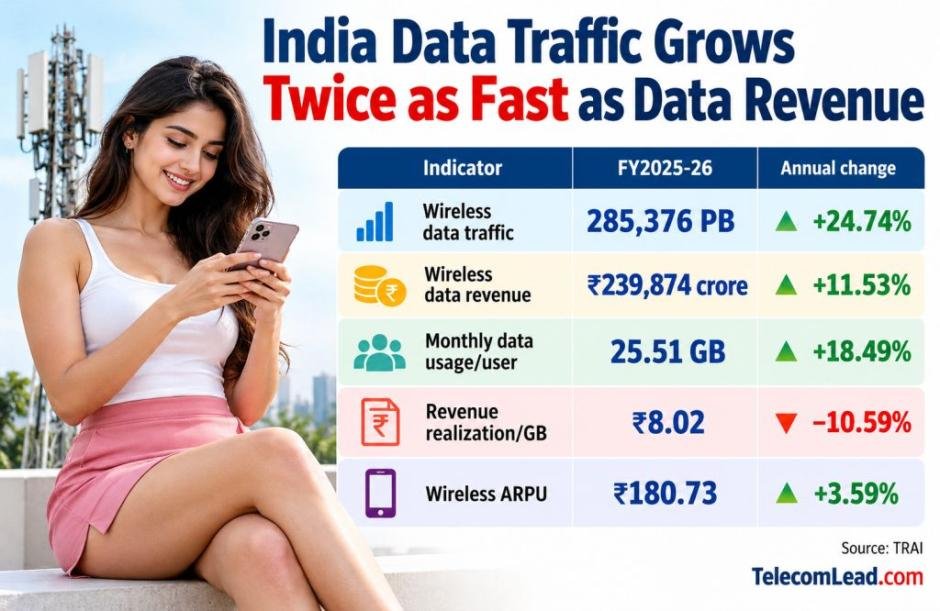
Wireless data consumption increased 24.74 percent to 285,376 petabytes (PB) in FY2025-26, from 228,779 PB a year earlier, according to TRAI’s Indian Telecom Services Yearly Performance Indicators 2025-26. Wireless data subscribers increased 9.29 percent to 1.027 billion, while average monthly data consumption per subscriber climbed 18.49 percent to 25.51 GB.
But revenue did not keep pace.
| Total wireless data revenue increased only 11.53 percent to ₹239,874 crore, compared with ₹215,078 crore in FY2024-25. More significantly, operators’ average revenue realization per GB dropped 10.59 percent from ₹8.97 to ₹8.02. The numbers reveal a widening gap between data traffic growth and data monetization at a time when operators are investing heavily in 5G spectrum, radio networks, fiber, data centres and network automation. | ||
Overall wireless ARPU increased from ₹174.46 in FY2024-25 to just ₹180.73 in FY2025-26, representing growth of 3.59 percent.
In other words, Indian consumers are using significantly more network capacity, but the corresponding improvement in revenue per customer remains much smaller.
That creates an important question for India’s telecom operators: Can 5G turn rapidly increasing consumption into proportionately higher revenue?
5G Is Driving India’s Data Explosion
The monetization issue becomes more significant when the traffic is broken down by technology.
India’s 5G data usage surged 88 percent to 107,384 PB during FY2025-26, from 57,042 PB a year earlier. 5G consequently accounted for 37.63 percent of total wireless data traffic.
Meanwhile, 4G traffic increased only around 4 percent to 177,375 PB, representing 62.15 percent of traffic.
Most remarkably, 5G generated roughly 89 percent of India’s incremental wireless data traffic during FY2025-26.
This represents a major change from the earlier 5G vs 4G data usage trend in India, when LTE remained much more dominant.
The transition is continuing rapidly. TRAI’s March 2026 quarterly numbers showed 5G already accounting for 42.75 percent of mobile data traffic during the quarter, suggesting that its share was accelerating toward the end of FY2025-26.
For operators, however, shifting traffic from 4G to 5G does not automatically mean higher revenue.
5G Monetization Is Becoming More Important Than 5G Coverage
The first stage of India’s 5G competition centered on coverage, spectrum and subscriber acquisition. The next stage increasingly concerns monetization.
Jio and Airtel have established large 5G networks, while Vodafone Idea and BSNL are expanding their next-generation network capabilities. But operators need either higher ARPU, lower cost per GB, or new revenue streams to support continuing traffic growth.
The TRAI numbers illustrate the challenge: 24.74 percent traffic growth generated only 11.53 percent additional data revenue.
One reason the model remains sustainable is that 5G can carry much greater traffic volumes more efficiently than previous mobile technologies. Higher network utilization allows spectrum, radio, fiber and core-network investments to be spread across more gigabytes.
The challenge is therefore not simply to increase the price of each GB. Operators need to improve the economics of delivering each GB while simultaneously generating more revenue from each customer.
Our recent analysis of telecom network cost per GB in 2026 showed how 5G, network automation, AI and energy efficiency are changing this equation.
Jio Uses Scale to Build Revenue Beyond Mobile Data
Reliance Jio’s strategy illustrates one possible route.
By June 2026, Jio had more than 533 million customers, including around 285 million 5G users. Average monthly data consumption reached 43.7 GB per customer, substantially above TRAI’s industry-wide FY2025-26 average.
Jio’s ARPU increased to ₹215.6, while quarterly data traffic rose 26.9 percent to 69.4 EB.
Rather than relying entirely on mobile-data pricing, Jio is extending its 5G network across JioAirFiber, JioFiber, enterprise connectivity, IoT, cloud and AI services.
This effectively changes the monetization equation: the same network can generate revenue from smartphones, homes and enterprises rather than depending solely on the price consumers pay for mobile data.
Airtel Pushes Premiumization as Data Usage Rises
Bharti Airtel is pursuing a somewhat different strategy.
Airtel’s India mobile ARPU reached ₹264 in the June 2026 quarter, compared with Jio’s ₹215.6 and Vodafone Idea’s ₹195. Average mobile data consumption reached 34.4 GB per customer per month.
Airtel is therefore generating substantially higher revenue per customer while also supporting increasing traffic.
Its strategy emphasizes premium customers, higher-value plans, postpaid, convergence and network experience rather than competing only on data volume.
The contrast between the two largest operators is an important feature of India’s evolving 5G monetization strategies: Jio has a massive scale advantage, while Airtel currently has the stronger mobile ARPU.
Vodafone Idea and BSNL Face a Different Monetization Challenge
For Vodafone Idea and BSNL, the issue is more complicated because they must simultaneously expand or modernize networks while defending their customer bases.
TRAI’s broader subscriber figures show how concentrated India’s telecom market has become. At March 2026, Jio had 524.45 million total telephone subscribers, Airtel 492.90 million, Vodafone Idea 199.34 million and BSNL 100.40 million.
BSNL’s subscriber base increased 1.68 percent during FY2025-26, but its market share declined from 8.22 percent to 7.55 percent because the overall market expanded faster. Vodafone Idea’s subscriber base declined 3.32 percent.
The financial figures reveal another pressure point. BSNL’s access-service AGR declined 2.96 percent to ₹8,185 crore, while Jio’s increased 12.15 percent to ₹125,100 crore and Airtel’s increased 12.90 percent to ₹112,039 crore. Vodafone Idea recorded 4.94 percent growth to ₹32,237 crore.
This means network modernization alone will not determine the winners. Operators must convert improved network capacity into paying customers and higher-value services.
India’s Data Consumption Could Keep Accelerating
The monetization challenge is unlikely to disappear because traffic growth has much further to run.
Ericsson Mobility Report estimates that India, Nepal and Bhutan already averaged around 37 GB of monthly data traffic per active smartphone at the end of 2025, with consumption forecast to reach 70 GB by 2031.
India is also expected to have more than 1.1 billion 5G subscriptions by 2031, according to Ericsson.
At the same time, 5G is expanding beyond smartphones. India’s 5G FWA subscriber base reached 12.32 million by March 2026, creating another opportunity for operators to monetize their spectrum and 5G infrastructure through home broadband.
The Next Telecom Battle Is Revenue, Not Gigabytes
India has already demonstrated that consumers will use enormous quantities of mobile data when networks and smartphones make it accessible.
The more difficult task is turning that usage into sustainable returns.
FY2025-26 captures the challenge clearly: data traffic +24.74 percent, data usage per subscriber +18.49 percent, data revenue +11.53 percent, overall wireless ARPU +3.59 percent and revenue realization per GB −10.59 percent.
The falling price per GB is not necessarily bad news if operators can reduce network cost per GB faster, increase ARPU and develop new revenue sources around 5G FWA, enterprise connectivity, cloud, IoT and digital services.
But the numbers suggest that simply carrying more traffic will not be enough.
India’s next 5G battle will therefore be less about who carries the most gigabytes and increasingly about who can generate the most value from them.
BABURAJAN KIZHAKEDATH