Latvia, Saudi Arabia, Finland and Estonia have emerged as the world’s heaviest mobile data markets, while operators including Jio, Zain, DNA, LMT, T-Mobile, Orange and China Telecom are investing in 5G capacity to support rapidly increasing traffic.
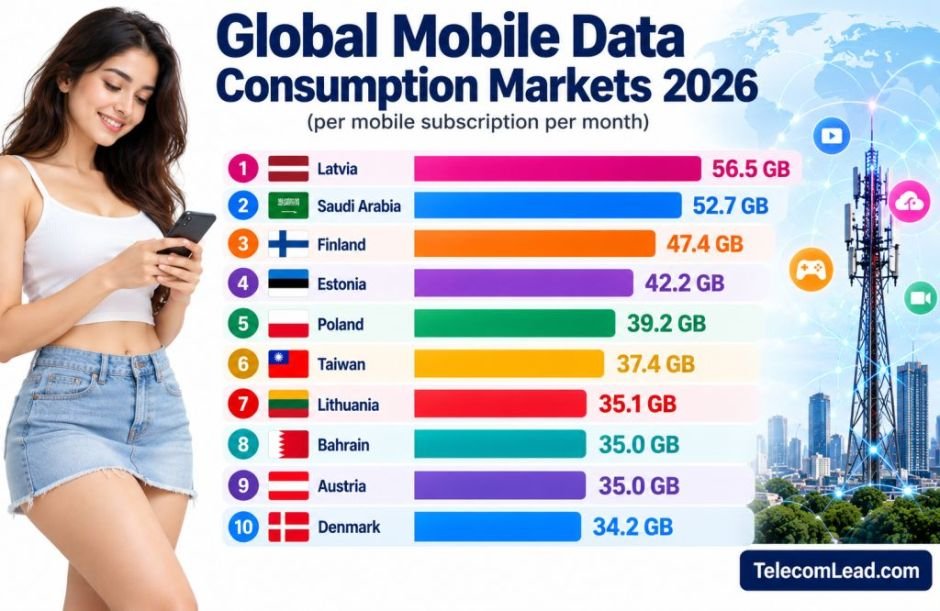
Global mobile data consumption continues to rise sharply in 2026 as 5G adoption, unlimited plans, fixed wireless access and video services encourage customers to consume significantly more data.
The latest 2026 Tefficient mobile data analysis, published in June and updated through July, compares 40 countries where M2M and IoT traffic can be excluded. The ranking uses full-year 2025 consumption, making it the latest globally comparable dataset available in 2026.
Latvia leads with 56.5 GB per mobile subscription per month, followed by Saudi Arabia at 52.7 GB, Finland at 47.4 GB and Estonia at 42.2 GB.
Poland ranks fifth at 39.2 GB, followed by Taiwan at 37.4 GB and Lithuania at 35.1 GB. Bahrain and Austria both record 35 GB, while Denmark reaches 34.2 GB.
The figures reveal an important telecom trend: markets combining 5G coverage, unlimited data and competitive pricing are generating dramatically higher traffic per subscriber.
Latvia Leads Global Mobile Data Consumption at 56.5 GB
Latvia tops the global ranking at 56.5 GB per mobile subscription per month.
Operators LMT, Tele2 and Bite compete aggressively with high-capacity mobile broadband and large or unlimited data packages.
LMT, for example, offers unlimited mobile internet for €15.99 per month, demonstrating how affordable unlimited plans can encourage significantly higher usage.
The effect becomes even more visible among data-only subscriptions. Latvia records an extraordinary 236 GB per month per data-only subscription.
This suggests that fixed wireless and mobile broadband are becoming important contributors to overall network traffic rather than smartphones being the only driver.
Saudi Arabia Reaches 52.7 GB as 5G Usage Expands
Saudi Arabia ranks second globally at 52.7 GB per subscription per month.
Separate data from Saudi Arabia’s Communications, Space and Technology Commission showed average monthly mobile consumption of approximately 53 GB per person, around three times the global average, while median 5G download speed reached 320 Mbps.
Operators are converting that consumption into revenue.
Zain KSA reported 8.9 million customers in Q2 2026, while data contributed 42 percent of revenue during H1 2026.
Zain also markets an unlimited-data postpaid plan costing SAR373.75 per month.
The Saudi market illustrates how 5G network investment and unlimited mobile data plans can simultaneously increase traffic and create monetization opportunities.
Finland Shows the Impact of Unlimited Data
Finland ranks third at 47.4 GB per subscription per month.
The country’s unusually high consumption is closely connected to its mobile pricing model.
At the end of 2025, 89 percent of Finnish mobile subscriptions included unlimited domestic data. Mobile network usage reached 78 GB per capita per month during July-December 2025.
Operators DNA, Elisa and Telia have built their mobile strategies around extensive 5G coverage and generous data allowances.
Elisa, for example, sells unlimited 5G packages starting from €34.99 for 30 days, including unlimited data across Finland and selected Nordic and Baltic markets.
Finland therefore provides one of the clearest demonstrations of the relationship:
Unlimited plans + strong 5G coverage → higher usage → heavier network traffic.
Estonia Reaches 42.2 GB as 5G Becomes Mainstream
Estonia ranks fourth globally at 42.2 GB per month.
Telia Estonia opened its 5G network to all mobile customers in January 2026. At that point, nearly 350,000 customers already had 5G-capable smartphones.
By September, Telia’s 5G network covered 99 percent of Estonia’s population, while 5G carried more than 30 percent of total mobile data traffic.
Elisa Estonia is also expanding 5G Standalone capabilities, including VoNR support.
Estonia demonstrates how rapidly traffic can migrate once operators remove barriers to accessing 5G.
Poland Hits 39.2 GB as Operators Add 5G Capacity
Poland ranks fifth at 39.2 GB per subscription per month, putting increasing pressure on operator capacity.
T-Mobile Poland ended H1 2026 with 5,110 5G C-band sites, 878 700 MHz 5G locations and 94 percent population coverage.
The capacity expansion is already being absorbed by customers.
T-Mobile’s network carried 1,067 petabytes during Q2 2026, up more than 19 percent year over year, while 5G traffic surged 82 percent.
Orange Poland reached 88.96 percent 5G population coverage by the end of Q2 and targeted at least 90 percent by year-end.
Plus is undertaking an even larger modernization program targeting up to 5,000 new sites and four 5G frequency bands.
The Polish market shows why operators are accelerating 5G network capacity expansion rather than treating population coverage as the only 5G KPI.
Taiwan Operators Consume More Than Country Average
Taiwan ranks sixth in the comparable country dataset at 37.4 GB per month, but operator-level figures show substantially higher consumption.
In July 2026, Far EasTone customers averaged 51.85 GB, Taiwan Mobile customers consumed 46.58 GB and Chunghwa Telecom customers averaged 38.09 GB.
The weighted average across the three operators was approximately 44.7 GB per subscriber.
Taiwan demonstrates why country-level figures and operator-level consumption can differ significantly depending on measurement periods and subscriber definitions.
Lithuania Moves Half of Bite Traffic onto 5G
Lithuania records 35.1 GB per subscription per month.
Bite Lithuania completed a six-month network modernization program in 2026 that repurposed existing 4G spectrum for 5G.
The operator reported urban 5G speed improvements of up to 25 percent.
More importantly, approximately half of Bite’s network traffic was already running over 5G, while customer mobile-data consumption increased around 30 percent over eight months.
The figures illustrate how spectrum refarming can provide additional 5G capacity without operators relying exclusively on new spectrum.
Jio Reaches 43.7 GB per User in India
India is not included in Tefficient’s comparable 40-country ranking because available regulatory reporting does not provide all the M2M exclusions needed for a like-for-like comparison.
Reliance Jio nevertheless demonstrates the enormous scale of Indian mobile-data consumption.
Jio reported 43.7 GB of monthly per-user data engagement in June 2026, alongside 285 million 5G subscribers. The operator said its 5G traffic was already 1.5 times its 4G traffic.
Its FY2025-26 annual report recorded 241 exabytes of annual data traffic, more than 524 million customers and over 268 million 5G users at the end of March.
Unlimited 5G offers are helping reinforce that trend.
The relationship between Jio’s 5G subscriber growth and mobile data consumption demonstrates the scale of the capacity challenge facing Indian operators as customers migrate from 4G to 5G.
China Telecom Reports 10.6% Increase in Data Usage
China is experiencing a similar transition.
China Telecom reported that mobile subscriber data usage increased 10.6 percent year over year during H1 2026.
Its 5G network subscriber penetration reached 72.9 percent, while 5G-Advanced subscriptions reached 4.68 million.
Across China’s three major operators, mobile internet traffic reached an enormous 219.7 billion GB during H1 2026, up 17.7 percent.
China’s scale means even moderate increases in average consumption translate into enormous additional network traffic.
5G Is Becoming the Main Mobile Traffic Engine
The operator examples reveal that rising mobile data consumption is no longer simply a customer-behavior statistic. It has become a network investment issue.
Ericsson reported that global mobile network data traffic exceeded 220 exabytes per month in Q2 2026, representing 23 percent year-over-year growth.
Global 5G subscriptions were approaching 3.3 billion, while 5G networks were already carrying approximately half of global mobile data traffic.
Fixed wireless access is adding another layer of demand. Around 70 percent of FWA service providers were offering services over 5G.
These trends mean operators must focus on capacity rather than simply coverage.
More spectrum, additional mid-band sites, carrier aggregation, spectrum refarming, 5G Standalone, Massive MIMO and network densification will become important as average data consumption continues to rise.
The global shift from 4G traffic toward 5G traffic is therefore likely to become one of the major drivers of telecom capex.
Mobile Data Growth Is Turning into a Capacity Race
The world’s highest-consumption markets provide an early indication of what other countries may experience as 5G adoption increases.
Latvia’s 56.5 GB, Saudi Arabia’s 52.7 GB, Finland’s 47.4 GB and Estonia’s 42.2 GB demonstrate how unlimited plans, affordable mobile broadband and widespread 5G can push consumption significantly higher.
Operators are responding differently. LMT, DNA and Elisa use unlimited-data models; Zain is monetizing heavy usage; T-Mobile Poland, Orange and Plus are expanding network capacity; Bite Lithuania is refarming spectrum; while Jio and China Telecom are handling traffic growth across enormous subscriber bases.
The competitive question for operators is consequently changing from “How much 5G coverage do we have?” to “How much 5G traffic can our network economically support?”
As 5G becomes the dominant mobile traffic technology, the operators that can deliver more capacity at a lower cost per gigabyte will be better positioned to turn the global surge in mobile data consumption into profitable growth.
FASNA SHABEER