
VodafoneThree has raised its annual cost savings target to £1 billion by FY2032, setting out a growth strategy that combines network integration, an £11 billion investment programme, expanding broadband services and new business opportunities in security and artificial intelligence.
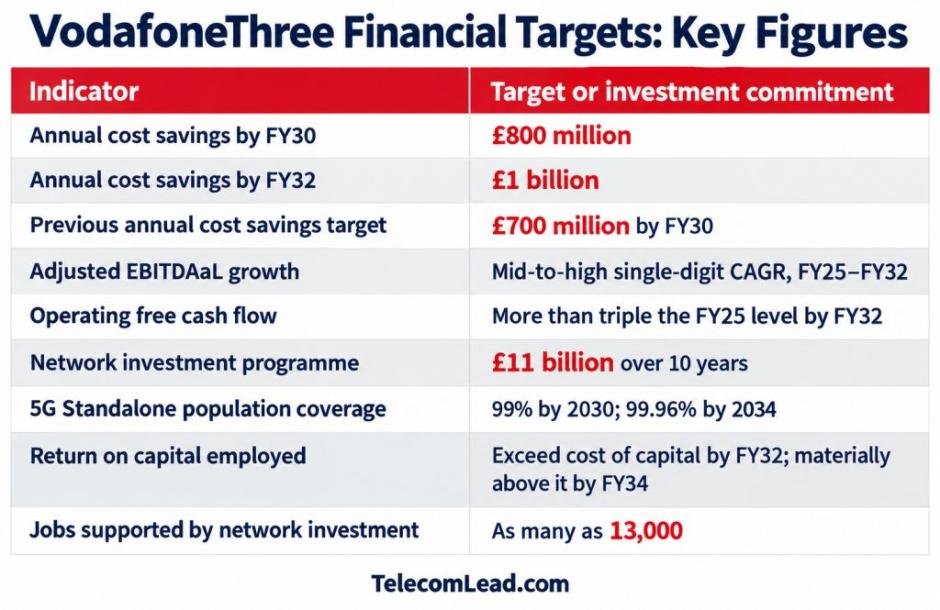
In its October 8, 2026 investor briefing announcement, Vodafone CEO Margherita Della Valle outlined plans for mid-to-high single-digit compound annual growth in adjusted EBITDAaL between FY25 and FY32. VodafoneThree also aims to increase operating free cash flow to more than three times its FY25 level by FY32.
The targets put the UK business at the centre of Vodafone’s medium-term growth ambitions. For telecom industry readers, the key issue is how VodafoneThree converts the scale created by the merger into better network performance, stronger customer retention and higher cash generation.
Annual Savings Target Rises to £800 Million by FY30
VodafoneThree’s updated financial framework includes an important near-term improvement: annual savings are now targeted at £800 million by FY30, compared with the previous £700 million ambition.
That is a £100 million increase, or approximately 14.3 percent, for the same financial-year milestone.
The longer-term target rises to £1 billion annually by FY32. This is £300 million above the original £700 million figure, although the two targets have different deadlines and should not be treated as a like-for-like increase.
Vodafone attributes the additional savings opportunity to further network rationalisation as the build programme progresses, alongside benefits from full Group ownership. The company says its detailed execution plan gives it greater confidence in delivering the revised targets.
The distinction between the FY30 and FY32 milestones matters. VodafoneThree is targeting higher savings within the original timeframe while expecting further efficiencies as network integration advances.
£11 Billion Investment Focuses on 5G Standalone
VodafoneThree’s network strategy centres on a 10-year, £11 billion investment programme to build a next-generation 5G Standalone network.
The operator was formed through the merger of Vodafone UK and Three UK in June 2025. It now brings together Vodafone UK, Three UK, VOXI Mobile, SMARTY and Talkmobile under one business.
According to VodafoneThree, its network build plan targets 99 percent UK population coverage with 5G Standalone by 2030, increasing to 99.96 percent by 2034.
Population coverage measures the proportion of people within the network’s coverage footprint. It should not be interpreted as the same percentage of UK land area.
VodafoneThree describes the programme as fully funded, regulated and guaranteed, and says the investment could create as many as 13,000 jobs. The operator’s ambition is to improve connectivity across cities, towns and communities throughout the UK.
The company also positions the future network as AI-ready. However, the announcement does not provide a separate investment allocation for AI or quantify the revenue expected from AI-related services.
Customer Retention and ARPU Support Consumer Strategy
VodafoneThree says it has maintained commercial momentum following the merger, reporting record-low customer churn across its brands and growth in average revenue per user, or ARPU.
The announcement does not disclose the underlying churn percentages or ARPU values. These statements therefore indicate the direction of performance without establishing the size of the improvement.
Its consumer strategy uses multiple brands to serve different customer segments. This gives VodafoneThree several routes to market as it integrates its network assets and develops new propositions.
Recently launched offerings include SuperMobile and Vodafone TV. VodafoneThree also identifies broadband, fixed wireless access and convergence as areas for further growth.
For the operator, the commercial challenge is to turn improved network quality into measurable customer outcomes: stronger retention, additional subscriptions and higher spending. Network investment can support those goals, but the announcement does not quantify the revenue contribution expected from each product category.
Broadband and Fixed Wireless Access Expand Growth Opportunities
VodafoneThree describes itself as the UK’s fastest-growing broadband provider and says it has the largest fibre footprint of any operator.
The briefing announcement does not provide broadband subscriber additions, growth rates or a premises-reached figure to accompany those claims.
Nevertheless, the strategy makes clear that VodafoneThree’s growth ambitions extend beyond mobile subscriptions. Broadband and fixed wireless access provide additional services through which the company can broaden customer relationships.
Convergence is another priority, bringing fixed and mobile services into a wider customer offering. VodafoneThree identifies these opportunities alongside its multi-brand mobile strategy, rather than setting out separate financial targets for each service.
Future disclosures on broadband additions, customer take-up and revenue contribution would help establish how much these businesses contribute to the overall growth plan.
Vodafone Business Targets Security, Sovereignty and AI
Vodafone Business plans to expand beyond core connectivity into digital services, sovereignty, security and AI.
The business serves UK customers ranging from small and medium-sized companies to large organisations and the public sector. Its execution priorities include simplifying operations, improving efficiency and building on customer experience.
Vodafone says network and customer scale will help differentiate its business services. The company sees opportunities to combine connectivity with a broader range of digital capabilities.
However, the announcement does not disclose revenue targets, contract values or investment budgets for these areas. They are identified as growth opportunities rather than quantified earnings contributors.
This creates a separate measure of progress for VodafoneThree: whether its business-services expansion produces additional revenue alongside the savings generated by network integration.
Cash Flow and Returns Will Measure Merger Execution
VodafoneThree aims to deliver mid-to-high single-digit adjusted EBITDAaL CAGR from FY25 to FY32, while increasing operating free cash flow to more than three times the FY25 level.
Vodafone defines operating free cash flow in this announcement as adjusted EBITDAaL less capital additions. That definition matters when assessing a strategy that combines substantial network investment with rising earnings.
The company also targets pre-tax return on capital employed, including goodwill, to exceed its cost of capital by FY32 and move materially above it by FY34.
These milestones connect the network programme to financial returns. VodafoneThree must deliver the coverage build, realise integration savings and grow customer revenues to achieve its ambitions.
Vodafone expects the UK business to become a key contributor to the Group’s medium-term ambition for double-digit organic growth in adjusted free cash flow.
The most useful indicators to track are therefore the £800 million savings milestone in FY30, the £1 billion target in FY32, delivery of the 2030 and 2034 coverage commitments, and evidence that customer retention, ARPU and broadband growth are translating into higher cash generation.
BABURAJAN KIZHAKEDATH