Telefonica, AT&T and Orange are introducing post-quantum enterprise connectivity, while Vodafone’s migration programme and quantum-networking projects show the different stages of operator readiness.
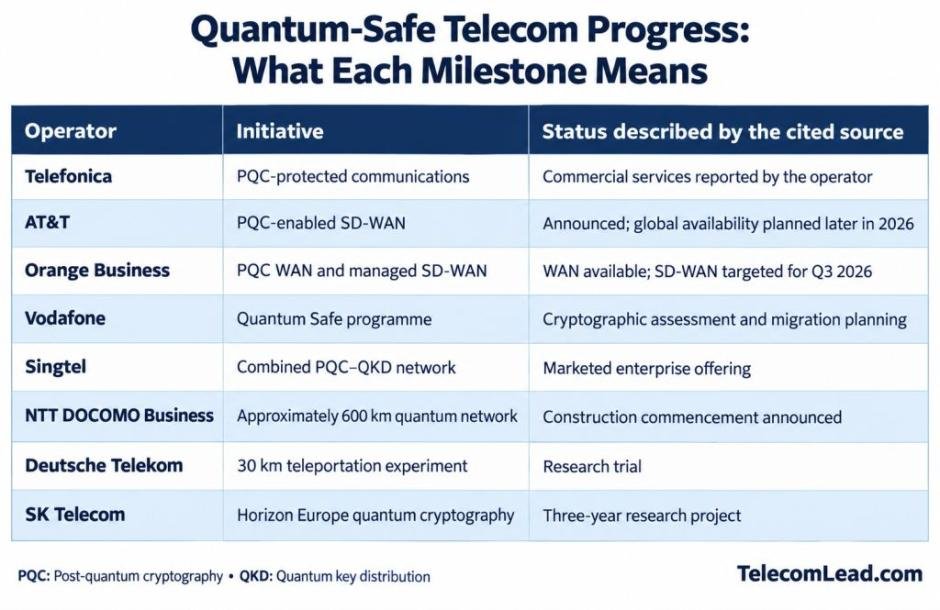
Quantum-safe security is becoming a telecom modernization issue in 2026. Operators are developing enterprise services, reviewing vulnerable cryptography and testing infrastructure for future quantum communications.
The immediate commercial opportunity centers on protecting sensitive information exchanged between offices, clouds and data centers. The wider operational challenge is identifying and upgrading cryptography across networks, software and supplier systems.
However, post-quantum cryptography, quantum key distribution and quantum teleportation are different technologies. Their announcements should be assessed separately, with clear distinctions between available services, future availability, migration programmes and research trials.
Why Telecom Operators Need to Prepare Now
The concern is that sufficiently capable future quantum computers could compromise widely used public-key cryptographic systems. That does not mean quantum computers have already broken telecom encryption at operational scale.
For information that must remain confidential for years, the risk begins earlier. Attackers may collect encrypted traffic today and attempt to decrypt it later — a scenario known as “harvest now, decrypt later.”
Operators therefore need to consider both the lifetime of sensitive data and the time required to migrate complex networks.
The NIST post-quantum cryptography guidance says organizations should identify vulnerable algorithms and begin transitioning. Its first three finalized PQC standards were released in August 2024. They are available for implementation; migration activity in 2026 builds on that earlier standardization.
For telecom companies, this is a coordinated engineering and procurement programme involving equipment, protocols, authentication and operational processes.
PQC, QKD and Quantum Networking: Three Different Paths
PQC uses mathematical algorithms designed to resist quantum attacks. It runs on conventional computing systems and is relevant to upgrading existing security protocols.
QKD uses quantum communication to distribute cryptographic keys. It requires specialized equipment and communications infrastructure, making its deployment considerations different from a software-based cryptographic upgrade.
Quantum teleportation transfers quantum states using shared entanglement and classical communication. It is a building block for future quantum networks, rather than evidence that an operator has completed its PQC migration.
Combining conventional and post-quantum algorithms in a hybrid key exchange is also different from combining PQC with QKD. Explaining the architecture is more useful than treating every “hybrid” announcement as equivalent.
Telefonica Brings Quantum-Safe Services to Enterprise Customers
At MWC 2026, Telefonica described itself as the first operator to launch commercial communications services protected by new PQC standards. That leadership claim should be understood as the company’s own statement.
Its Quantum Telco announcement highlighted CPD Interconnection, which protects sensitive communications between data centers and corporate locations.
The operator also presented cryptographic inventory, risk analysis, crypto-agility and hybridization as parts of its broader approach.
These activities connect enterprise connectivity with migration services. They do not establish that all Telefonica systems or customer endpoints have become quantum-safe.
The service scope matters: operators need to explain which links, protocols and cryptographic functions are protected, along with the responsibilities retained by customers.
AT&T and Orange Advance PQC Enterprise Connectivity
AT&T Business announced Quantum Resilient SD-WAN in May 2026, using Cisco 8000 Series Secure Routers.
The announcement on ATT’s Quantum Resilient SD-WAN indicated that global availability would begin later in the year.
Orange Business’s February announcement distinguished two milestones. It said PQC-secured WAN services were available, while managed Cisco SD-WAN services were targeted for commercial availability in Q3 2026.
The Orange Business PQC network announcement also emphasized crypto-agility: the ability to alter or upgrade algorithms and protocols as requirements change.
Together, these examples show PQC entering enterprise networking portfolios. Commercial availability, customer adoption and the precise protection provided remain separate measures of progress.
An enabled router alone does not establish end-to-end security. Authentication, key management, endpoints and other dependencies must fit the intended protection model.
Vodafone Focuses on Cryptographic Migration
Vodafone’s 2026 Annual Report describes a long-term Quantum Safe programme, including identification of potentially vulnerable cryptography, supplier requirements and the ability to update cryptography as threats evolve. The report refers to government recommendations for completing migration by 2035.
Its programme illustrates the operational side of quantum readiness: understand where cryptography is used, determine what can be upgraded and coordinate changes with suppliers.
For operators, procurement decisions made during current network renewal cycles can affect how easily future cryptographic updates are delivered.
Singtel and NTT DOCOMO Business Explore QKD Infrastructure
Singtel’s Quantum-Safe Network, which combines PQC and QKD across sites, clouds and borders, is a different architecture from relying on PQC alone. Its suitability depends on the links being protected, infrastructure requirements and how security components are integrated.
The quantum cryptography communications network of NTT DOCOMO Business announced in June 2026 indicated that the start of construction of an approximately 600 km quantum cryptography communications network connecting Tokyo, Nagoya and Osaka.
Deutsche Telekom and SK Telecom Pursue Research
Deutsche Telekom and Qunnect reported quantum teleportation over a 30 km commercial fiber loop in Berlin, with conventional traffic carried alongside the experiment.
The January 2026 trial achieved average fidelity of 90 percent and peak fidelity of 95 percent. Fidelity measures how closely the transferred quantum state matches the intended state; it is not a percentage measure of cybersecurity protection.
The Deutsche Telekom quantum-networking trial demonstrates progress toward future quantum communication services.
SK Telecom’s Horizon Europe research project, announced in June, involves institutions from Greece, Austria and Germany. Its work includes QKD optical-system control and key management.
What Telecom Operators Should Measure Next
The immediate priorities are cryptographic inventories, sensitive-data assessment, supplier roadmaps and interoperability testing.
Operators should also benchmark performance, document protected service boundaries and establish upgrade procedures. Crypto-agility helps them respond when algorithms or implementation requirements change.
For enterprise services, the commercial measures are verified availability, customer adoption and disclosed revenue. For migration programmes, the measures are coverage and completed upgrades. Research projects require their own technical milestones.
Quantum-safe progress in 2026 is therefore measurable, but uneven. The strongest evidence combines a clearly defined technology, a verified deployment stage and an explicit account of what is protected.
FASNA SHABEER