
Nokia’s Mobile Broadband Index (MBiT) revealed that the 5G adoption, rising data consumption and AI-led applications are reshaping network demand.
Nokia’s 13th edition of the Mobile Broadband Index indicated that aim of investment in telecom networks of Bharti Airtel, Vodafone Idea, Reliance Jio and BSNL is transitioning from connectivity platforms to intelligent, high-performance digital infrastructure.
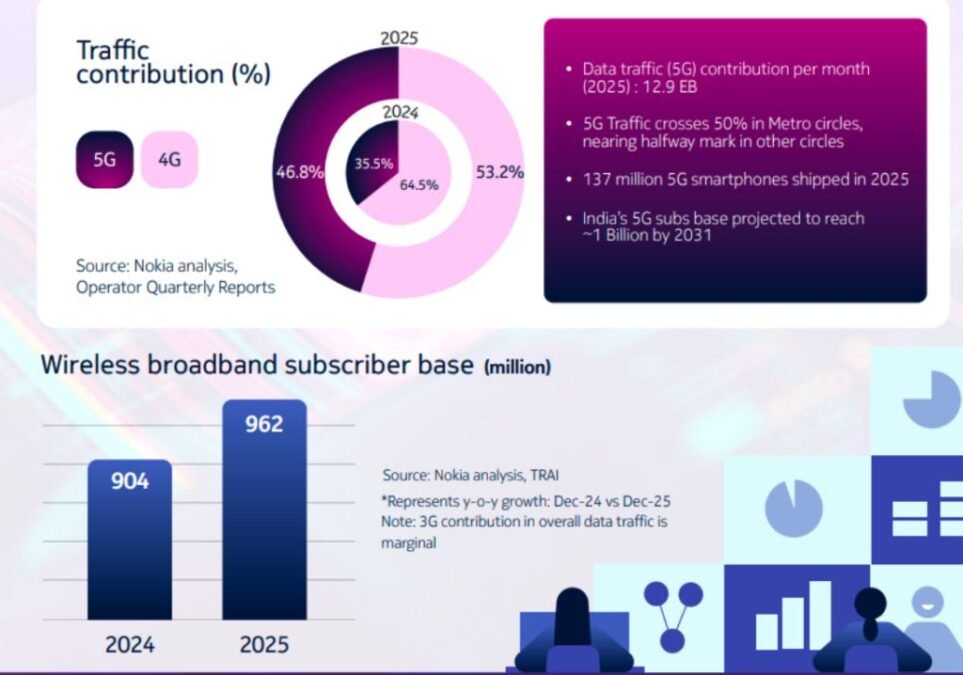
India’s total mobile data traffic climbed to 27.6 exabytes per month in 2025, reflecting a 28 percent increase, powered primarily by 5G. The surge in traffic is closely linked to expanding 5G coverage and the rapid penetration of affordable 5G smartphones in India.
5G traffic reached 12.9 exabytes per month, marking a 70 percent annual growth. 5G now contributes 47 percent of overall mobile data traffic nationwide, highlighting its transition from early adoption to mainstream usage. Metro markets remain at the forefront, where 5G accounts for 58 percent of total data consumption, but adoption is also accelerating across Category A, B and C circles, indicating deeper and more balanced nationwide penetration. Across all regions, 5G traffic has expanded by nearly 1.7 times, reinforcing its role as the primary engine of data growth.
India’s position in the global 5G industry continues to strengthen, with the country ranking as the second largest market in terms of 5G subscribers, data consumption and FWA adoption. This scale advantage is supported by a rapidly evolving device ecosystem.
The number of wireless broadband users has reached 962 million, while active 4G devices stand at 892 million, including 383 million devices already capable of supporting 5G. In 2025 alone, 137 million 5G smartphones were shipped, and more than 90 percent of new smartphone shipments were 5G-enabled, accelerating readiness for multi-band deployments.
Another major growth driver is 5G Fixed Wireless Access (FWA), which is emerging as a contributor to network traffic. FWA accounts for over 25 percent of total 5G data traffic and has recorded a two-fold increase in subscribers. Its impact on consumption patterns is significant, with FWA users generating nearly ten times higher data usage compared to average mobile users, further amplifying network demand.
At the user level, consumption trends continue to surge. Average monthly mobile data usage reached 31.1 GB per user in 2025, up from 17 GB in 2021, translating into an 18 percent compound annual growth rate. This means users are consuming more than 1 GB of data per day, driven by high-bandwidth applications such as 4K video streaming, cloud gaming and AI-powered services.
The report points to strong and consistent growth across regional markets, with data traffic increasing between 26 percent and 30 percent across telecom circles, and Category A markets showing the highest expansion. This indicates that 5G adoption is no longer limited to urban centers but is spreading rapidly across the broader digital ecosystem.
On the infrastructure side, India’s device and spectrum readiness is aligning well with future demand. There is near-universal support for key 5G bands such as n1, n3 and n5, along with strong adoption of capacity bands like n40, n41 and n78. This widespread compatibility ensures that networks can scale efficiently to meet rising traffic requirements.
A significant transformation is being driven by emergence of the AI supercycle. AI-enabled applications are beginning to alter traditional traffic patterns by increasing uplink demand, introducing variability in data flows and requiring ultra-low latency. Hybrid processing models, where workloads are split between devices and the cloud, are adding to overall traffic volumes. As a result, telecom networks are expected to evolve toward AI-native architectures capable of handling distributed computing and real-time data processing.
MBiT report projects that India’s 5G subscriber base could exceed 1 billion by 2031.
Total WAN traffic is expected to reach 2174 exabytes per month, with AI-driven traffic growing at a faster pace than traditional data flows.
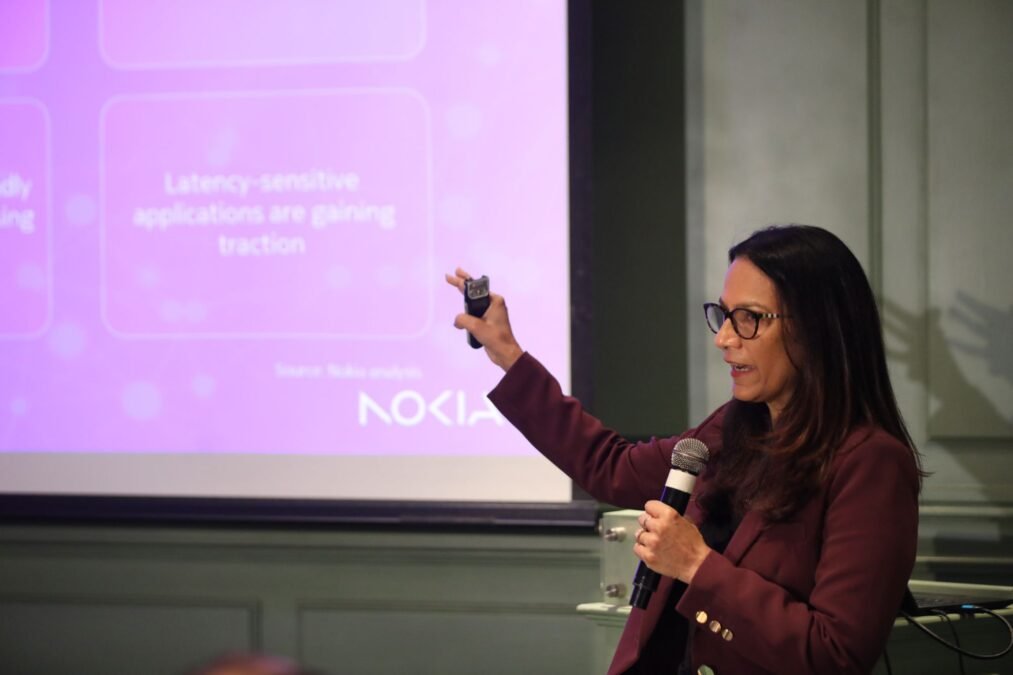
Vibha Mehra, Country Manager – Designate for India at Nokia, said that India is entering a new phase of mobile broadband evolution where 5G and AI are converging to redefine network capabilities. As data demand intensifies and new digital use cases emerge, telecom operators will need to invest in scalable, intelligent and high-performance infrastructure to support the next wave of innovation.
BABURAJAN KIZHAKEDATH

