
Malaysia’s smartphone market has become one of Southeast Asia’s most closely contested markets, with only six percentage points separating the five leading vendors in the second quarter of 2026. OPPO secured first place with a 19 percent shipment share, while Samsung and Xiaomi tied at 16 percent each. HONOR and vivo followed with 13 percent each.
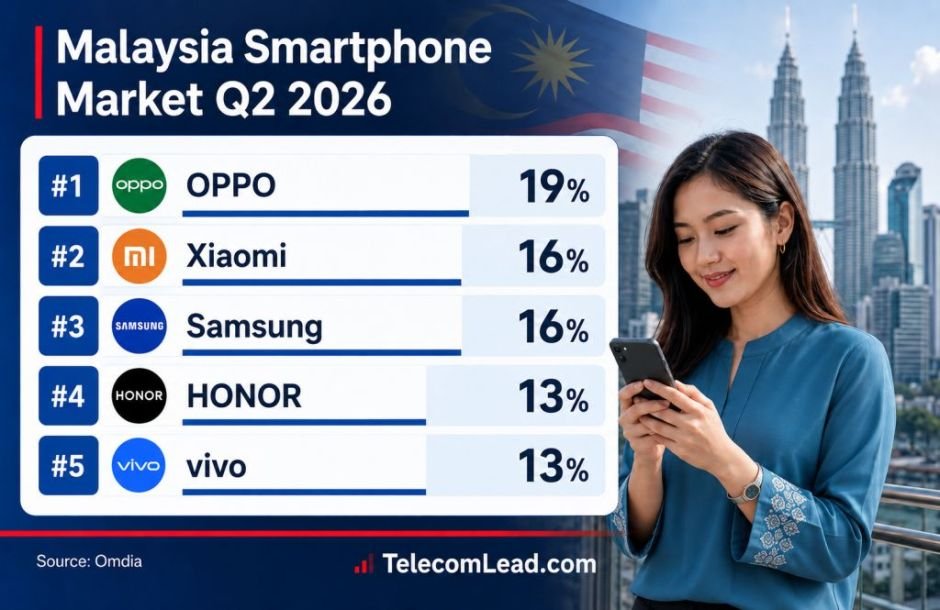
Omdia Southeast Asia smartphone market report indicated that the five brands collectively controlled 77 percent of Malaysian smartphone shipments, leaving 23 percent for Apple, Transsion, realme and other vendors. OPPO’s lead over Samsung and Xiaomi was only three percentage points, indicating that promotions, retail execution and new product launches could quickly alter the rankings.
OPPO Leads Malaysia Smartphone Market with 19 Percent Share
OPPO emerged as Malaysia’s leading smartphone vendor with a 19 percent shipment share in 2Q26. Its position was supported by a broad portfolio spanning affordable A-series devices, mid-range Reno smartphones and premium Find models.
However, OPPO’s Malaysian leadership contrasts with its wider regional performance. In 1Q26, OPPO’s Southeast Asian shipments fell 17 percent to 4.2 million units as the company adjusted operations following the integration of realme. OPPO nevertheless held second place regionally behind Samsung.
OPPO has responded to weakening entry-level demand by emphasizing smartphones with better cameras, AI features, larger batteries and higher memory configurations. The Reno16 family — including the Reno16 Pro 5G, Reno16 5G and Reno16 F 5G — supports this move into higher-value price segments.
The company is also using zero-interest instalments of up to 24 months, loyalty points and periodic online sales to reduce the immediate cost for Malaysian buyers without depending entirely on permanent price reductions.
Samsung and Xiaomi Tie for Second Place at 16 Percent
Samsung and Xiaomi each captured 16 percent of Malaysia’s smartphone shipments, placing them three percentage points behind OPPO.
Samsung has the stronger position at the regional and global levels. The company led Southeast Asia in 1Q26 with shipments of 4.6 million units, a 21 percent share and 4 percent annual growth. Samsung subsequently reached 23 percent of the global market in 2Q26 as shipments increased 9 percent, according to Counterpoint Research.
Samsung’s diversified portfolio offers protection from weakness in the affordable segment. Galaxy A-series devices generate volume, while the Galaxy S26 series supports premium revenue. In Malaysia, the Galaxy A57 5G was introduced at RM2,699 for the 12GB+512GB version, with a RM300 rebate reducing its launch price to RM2,399.
The Galaxy S26 starts at RM4,399, while trade-in savings of up to RM3,510 and instalment programmes help Samsung maintain premium pricing while improving affordability.
Xiaomi faces greater exposure to price-sensitive customers. Its Southeast Asian shipments declined 12 percent to 3.7 million units in 1Q26. Globally, Xiaomi suffered the steepest decline among the five largest vendors in 2Q26, with shipments falling 26 percent as rising memory prices affected entry-level and mid-range demand.
Xiaomi’s Malaysian pricing illustrates this pressure. The Redmi Note 15 4G entered the market at RM799, compared with RM699 for the previous generation — an increase of approximately 14 percent. The Redmi Note 15 Pro+ 12GB+512GB was priced at RM1,899, up RM300 or nearly 19 percent from the comparable previous model.
At the upper end, Xiaomi is using launch bundles to protect demand. The Xiaomi 17T was priced at RM2,399 for 12GB+256GB, with an introductory price of RM2,099, while the Xiaomi 17T Pro started at RM2,899.
HONOR Captures 13 Percent and Gains Ground in Foldables
HONOR held 13 percent of Malaysia’s smartphone market, matching vivo. Its overall share remains six percentage points below OPPO, but its growth indicators are stronger than those of several larger rivals.
In 1Q26, HONOR’s Southeast Asian shipments increased 28 percent to 1.2 million units, with growth recorded in six of the region’s eight major markets. During the first half of 2026, HONOR shipments increased 15 percent in Southeast Asia, and the company became one of the fastest-growing leading vendors in Malaysia and the Philippines.
HONOR also secured 53 percent of Malaysia’s foldable-smartphone shipments in 2Q26. For comparison, Samsung held 26 percent and OPPO captured 8 percent, giving HONOR a 27-percentage-point lead over Samsung in this premium category.
Its mainstream strategy includes devices such as the HONOR 600, offered at RM2,399 after an RM200 reduction. Instalment plans, discount vouchers and bundled accessories are helping the company compete with OPPO and Xiaomi in Malaysia’s crowded upper-mid-range segment.
vivo Holds 13 Percent as It Prioritises Higher-Value Devices
vivo captured 13 percent of Malaysian smartphone shipments, putting it level with HONOR and three percentage points behind Samsung and Xiaomi.
The company’s regional shipment performance has been weaker. vivo shipped 2.1 million smartphones in Southeast Asia during 1Q26, down 27 percent year on year. Despite the volume decline, vivo’s average selling price increased 28 percent — the strongest ASP growth among the region’s major vendors.
This suggests that vivo deliberately reduced its dependence on affordable devices and prioritised higher-value models. Its Malaysian V70 5G starts at RM2,199 for 8GB+256GB, increasing to RM2,499 for 12GB+256GB and RM2,999 for 12GB+512GB. Features include ZEISS-branded cameras, a 6,500mAh battery and 90W charging.
Discounting remains part of vivo’s competitive strategy. The V70 FE 5G has been listed at RM1,899, compared with RM1,999 previously, while the V60 5G has been offered at RM1,795, down from RM2,399—a reduction of RM604 or approximately 25 percent.
Rising Smartphone Prices Reshape Competition in Malaysia
Malaysia smartphone market declined 19 percent in Q1 2026, while shipments of devices priced below $200 fell by more than 30 percent. The contraction reflects a wider affordability problem: more than 60 percent of Southeast Asian smartphone shipments traditionally come from the sub-$200 category, according to Omdia.
The regional downturn intensified in 2Q26. Southeast Asian smartphone shipments fell 23 percent to 19.3 million units — the lowest quarterly result since 2014. However, market value reached $6.6 billion as the average selling price increased 31 percent to $342.
Compared with 1Q26 shipments of 21.6 million units, the 2Q26 total was 2.3 million units lower, representing a sequential decline of approximately 10.6 percent. The regional ASP eased slightly from the record $349 recorded in 1Q26 but remained substantially higher year on year.
Omdia expects Southeast Asian smartphone shipments to decline 25 percent to 75.3 million units in 2026. This implies an estimated 2025 market size of approximately 100.4 million units.
Malaysia’s 2Q26 rankings show three different competitive approaches. OPPO is combining broad retail coverage with Reno-led premiumisation; Samsung is balancing Galaxy A-series volume with S-series premium strength; and Xiaomi is using aggressive specifications and promotional bundles despite heavy exposure to price-sensitive categories. HONOR is gaining momentum through foldables and channel expansion, while vivo is accepting lower volume in pursuit of higher-value sales.
With OPPO, Samsung, Xiaomi, HONOR and vivo separated by just six percentage points, Malaysia is likely to remain one of Southeast Asia’s most competitive smartphone markets during the second half of 2026.
FASNA SHABEER

