Apple’s entry into the foldable smartphone market with the iPhone Duo could reshape a segment dominated by Samsung and Huawei. TrendForce estimates Apple will ship approximately 5 million foldable phones in 2026, capturing 24.8 percent market share and potentially becoming the world’s second-largest foldable smartphone brand in its first year.
Apple has positioned the iPhone Duo as an ultra-premium smartphone. It starts at $1,999 in the United States and ₹299,900 in India, combining a 7.6-inch folding OLED display, 5.4-inch outer display, A20 Pro processor and iOS 27.
The bigger question is whether Apple can help transform foldables from a premium niche into a larger category driven by multitasking, artificial intelligence and differentiated software experiences.
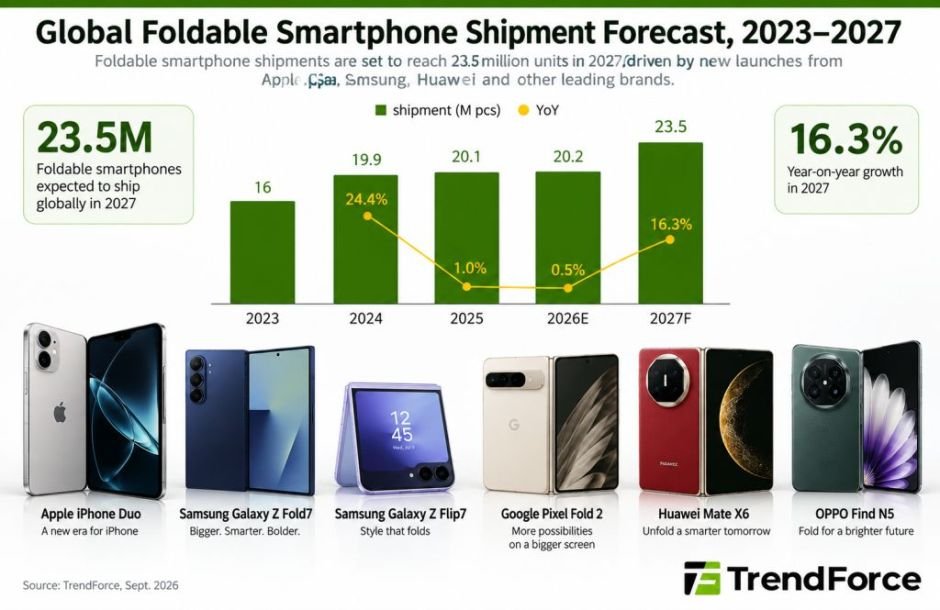
Foldable Smartphone Shipments Reach 20.2 Million in 2026
TrendForce forecasts global foldable smartphone shipments of approximately 20.2 million units in 2026, representing growth of just 0.5 percent year over year.
Apple’s arrival masks weaker underlying market conditions. Excluding the iPhone Duo, Android foldable brands are expected to ship around 15.2 million units, down more than 20 percent year over year, partly due to higher component costs.
Apple’s projected 5 million shipments are therefore primarily compensating for declining volumes among existing manufacturers rather than creating strong overall market growth.
Samsung Leads With 35.1%, Apple and Huawei Reach 24.8%
Samsung is expected to retain leadership with approximately 7.1 million foldable smartphone shipments and 35.1 percent market share.
Apple could immediately move into second position with 5 million units and 24.8 percent, while Huawei is also expected to ship around 5 million devices for a 24.8 percent share.
Together, Samsung, Apple and Huawei could control approximately 84.7 percent of the global foldable smartphone market in 2026.
Apple’s ability to potentially capture nearly one-quarter of the market during its first year illustrates how significantly its entry could alter the competitive landscape.
iPhone Duo Features 7.6-inch Foldable Display
Apple has adopted a book-style inward-folding design rather than the smaller flip-phone format.
The iPhone Duo specifications from Apple show a 7.6-inch Super Retina XDR folding OLED display with a resolution of 1878 x 2670 pixels at 430 ppi.
The outer 5.4-inch OLED display offers 1398 x 2034 pixels at 460 ppi.
Both displays support adaptive refresh rates of up to 120Hz and peak outdoor brightness of 3,000 nits. The inner display also supports Apple Pencil.
Apple says the 5.4-inch cover display provides more than 90 percent of the screen area of the iPhone 18 Pro, allowing the Duo to operate like a conventional smartphone when folded.
Apple Targets Foldable Crease With 10-Layer Display
Competition among foldable smartphone manufacturers is increasingly shifting toward thinner designs, lower weight, durability and less visible display creasing.
TrendForce says the iPhone Duo’s inner display uses a 10-layer stack of ultra-thin materials combined with nano-texture surface treatment.
Crease reduction requires manufacturers and suppliers to jointly optimize ultra-thin glass, optically clear adhesive, OLED components and supporting structures rather than relying exclusively on hinge improvements.
Apple’s iPhone Duo product information highlights a nano-texture display treatment and precision hinge, illustrating how display engineering has become a key competitive factor in premium foldables.
Apple’s specifications could also influence suppliers of UTG, OLED panels, hinges, adhesives and precision components as production volumes increase.
iPhone Duo Is 5.2mm Thick When Open
Thickness remains one of the biggest engineering challenges for book-style foldables because batteries, cameras, displays, processors and the hinge must fit into two thin halves.
Apple has kept the iPhone Duo at 5.2mm when unfolded and 11.3mm when folded, while the device weighs 254g.
It uses a Grade 5 titanium construction to balance structural strength and weight.
Apple has also made hardware compromises to achieve these dimensions.
The iPhone Duo does not include a dedicated periscope telephoto camera. Instead, its 48MP Fusion Main camera provides a 2x telephoto option, accompanied by a 48MP Fusion Ultra Wide camera.
Apple has also replaced Face ID with side-mounted Touch ID, freeing valuable internal space.
These decisions highlight the continuing trade-offs foldable manufacturers face among thickness, cameras, biometric hardware and battery capacity.
A20 Pro and iOS 27 Bring AI to Foldable iPhone
The iPhone Duo is powered by Apple’s 2-nanometer A20 Pro processor, incorporating a 6-core CPU, 7-core GPU with Neural Accelerators and dual 16-core Neural Engines.
A vapor-chamber thermal system supports performance within the thin chassis.
Software could be equally important to Apple’s foldable strategy.
iOS 27 provides enhanced multitasking and continuity between the inner and outer displays. Users can operate two applications simultaneously, potentially combining documents, messaging, web browsing and AI applications on the larger screen.
Apple Intelligence and Siri AI add natural-language interaction, contextual understanding and in-app actions.
This could give foldables a more compelling use case as generative and multimodal AI expands into translation, image editing, content creation and document summarization.
The larger screen allows users to display source information and AI-generated content simultaneously instead of repeatedly switching applications.
Apple’s Entry Could Push Samsung and Huawei to Respond
TrendForce views 2026 as a year of structural realignment rather than explosive foldable market growth.
Apple’s estimated 5 million shipments are largely offsetting weaker Android demand, resulting in total market growth of only 0.5 percent.
However, Apple’s longer-term impact could be greater.
Its requirements for OLED displays, UTG, hinges, adhesives and structural components could increase production scale across the foldable supply chain, potentially reducing component costs over time.
Apple’s entry could also push Samsung, Huawei and other Chinese smartphone manufacturers to improve pricing, thickness, durability, crease reduction and software differentiation.
These changes are important because high prices remain one of the biggest barriers preventing foldable smartphones from achieving mainstream volumes.
AI Could Become the Next Foldable Smartphone Battleground
Hardware specifications alone may not drive the next phase of foldable adoption.
Generative and multimodal AI could provide manufacturers with new ways to use the larger display. Consumers could simultaneously view documents and AI summaries, edit AI-generated images alongside source material or run translation and communication applications together.
The opportunity for Apple is to integrate Apple Intelligence, Siri and multitasking deeply enough that the foldable screen provides experiences unavailable or less practical on conventional smartphones.
Samsung and Chinese manufacturers are likely to pursue similar strategies, shifting competition from physical design toward AI-enabled user experiences.
iPhone Duo Reshapes Foldable Market in 2026
Apple’s immediate impact on foldable smartphones can be measured in three figures: 5 million shipments, 24.8 percent market share and potentially the number-two global ranking.
Samsung is expected to remain ahead with 7.1 million units and 35.1 percent share, while Huawei is projected at around 5 million units and 24.8 percent.
But the overall market remains challenging. Global foldable shipments of 20.2 million units represent growth of only 0.5 percent, while Android brands excluding Apple are expected to decline more than 20 percent.
The key question is therefore whether Apple can expand the market rather than simply redistribute existing demand.
Success will depend on reducing the industry’s major barriers — high prices, component costs, thickness, visible creases and durability — while demonstrating that foldable screens offer meaningful advantages for multitasking and AI.
If Apple, Samsung and Huawei can create AI and software experiences that conventional smartphones cannot easily replicate, foldables could finally move beyond their premium niche and become a more significant segment of the global smartphone market.
BABURAJAN KIZHAKEDATH