The global semiconductor foundry market reached another record in the second quarter of 2026 as booming demand for AI and high-performance computing (HPC), higher wafer prices and improving capacity utilization lifted revenue across most leading chipmakers.
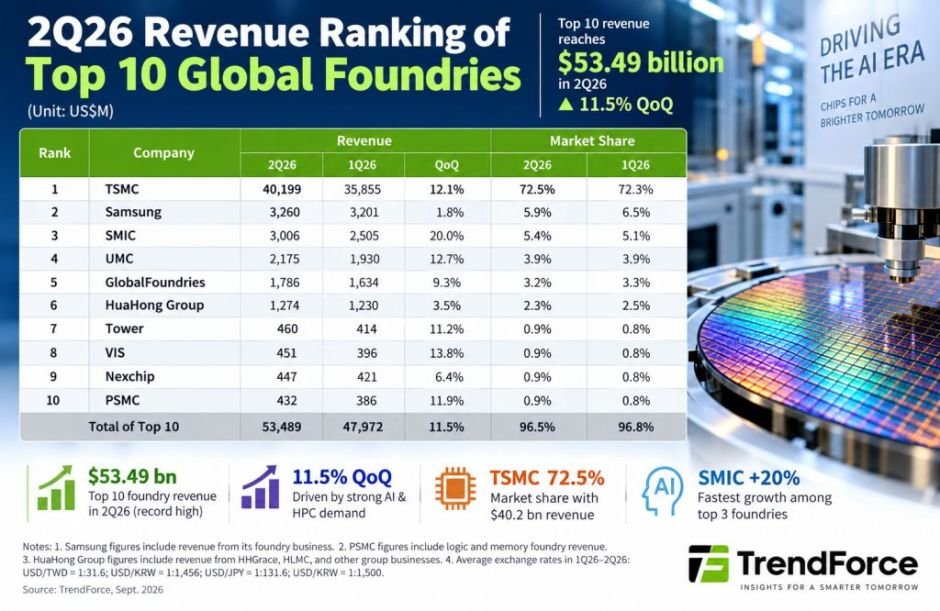
According to TrendForce, combined revenue of the world’s top 10 foundries increased 11.5 percent quarter over quarter to nearly $53.49 billion in Q2 2026.
Growth was led by supply constraints for advanced processes used in AI GPUs and XPUs. Demand also strengthened for AI infrastructure components including power management ICs (PMICs), power semiconductors, networking chips and optical components.
TSMC Revenue Jumps 12.1% to $40.2 Billion
TSMC strengthened its dominance with Q2 foundry revenue of nearly $40.2 billion, up 12.1 percent QoQ, and a 72.5 percent market share.
AI server GPU and XPU demand kept its 5/4nm and 3nm capacity fully booked, while new iPhone production contributed additional volume. TSMC’s 2nm process generated revenue for the first time, helping increase both wafer shipments and average selling prices (ASPs).
The company’s technology roadmap is also extending its AI advantage. TSMC recently unveiled its A13 process, which targets a 6 percent area reduction compared with A14, while N2U, planned for 2028, targets 3–4 percent higher performance or 8–10 percent lower power consumption than N2P. Its expanding CoWoS advanced packaging capacity is another important component of its AI strategy. TSMC’s advanced semiconductor technology roadmap shows how the company is preparing for increasingly compute-intensive AI chips.
Samsung Grows 1.8% as SMIC Narrows the Gap
Samsung Foundry remained second with revenue of $3.26 billion, up 1.8 percent QoQ, but its market share declined to 5.9 percent.
The company benefited from advanced-process orders including HBM base dies and higher pricing for 5/4nm and more advanced processes. Samsung is also expanding its 2nm ecosystem and advanced packaging capabilities, areas that will be critical as AI processors increasingly combine logic and high-bandwidth memory.
Samsung faces increasing pressure from SMIC, whose Q2 revenue surged 20 percent QoQ to more than $3 billion, making it the fastest-growing major foundry in the top three. SMIC’s market share increased to 5.4 percent, just 0.5 percentage points behind Samsung.
SMIC’s wafer shipments increased 14 percent QoQ to 2.9 million 8-inch-equivalent wafers, while ASP rose 5.7 percent and utilization reached 93.7 percent. The Chinese foundry invested around $3.4 billion during H1 2026 and expects Q3 revenue to rise another 2–4 percent QoQ.
Demand is being supported by PCs, notebooks, AI peripheral ICs and server networking products. Reuters reported on SMIC’s higher pricing amid strong AI-related demand, highlighting how tighter capacity is improving foundry economics.
UMC Revenue Rises 12.7% as AI Optical Demand Expands
UMC retained fourth place with a 3.9 percent market share after revenue climbed 12.7 percent QoQ to nearly $2.18 billion.
The company benefited from stronger PC and notebook procurement, server-related FPGA demand and a significant recovery in 8-inch capacity utilization.
UMC is increasingly targeting AI connectivity. In July, it delivered mass-produced silicon photonics wafers for SILITH’s 1.6T platform, designed for AI data-center optical interconnects.
The foundry is also adding capacity in Singapore and Tainan. Its production network includes 12 fabs with more than 400,000 12-inch-equivalent wafers of monthly capacity. The UMC capacity expansion strategy demonstrates its push to capture AI, edge-computing and specialty semiconductor opportunities.
GlobalFoundries Revenue Reaches $1.79 Billion
GlobalFoundries ranked fifth with revenue of approximately $1.79 billion, up 9.3 percent QoQ, and a 3.2 percent market share.
Both wafer shipments and ASPs increased as consumer procurement recovered and demand strengthened for AI and server peripheral components such as power ICs and TIAs/drivers.
GlobalFoundries is expanding its focus on intelligent edge, connectivity, silicon photonics and specialty technologies. Recent initiatives include a $375 million U.S. government R&D award supporting quantum technology and a proposed $300 million award aimed at accelerating U.S. silicon-photonics development. The company’s latest technology and investment announcements illustrate its growing emphasis on AI infrastructure and next-generation connectivity.
HuaHong, Tower and VIS Gain from AI Peripheral Chips
HuaHong Group remained sixth as revenue increased 3.5 percent QoQ to more than $1.27 billion. NOR Flash and AI-related PMIC demand, higher wafer pricing and additional HHGrace capacity supported performance.
Tower Semiconductor ranked seventh with revenue of $460 million, up 11.2 percent QoQ. Growth was driven by increased production of TIAs/drivers and photonic ICs for AI optical transceiver modules, giving Tower direct exposure to the rapid expansion of AI data-center connectivity.
VIS returned to eighth place after revenue increased 13.8 percent QoQ to $451 million, supported by AI peripheral chips and smartphone PMIC and power products.
Its broader Q2 performance showed wafer shipments increasing about 11 percent QoQ, while blended ASP improved 3 percent. VIS expects Q3 shipments to rise another 1–3 percent and ASP to increase 2–4 percent, suggesting pricing remains an important contributor to growth.
Nexchip and PSMC Complete Top 10
Nexchip slipped to ninth despite revenue increasing 6.4 percent QoQ to $447 million. Higher display driver IC orders and consumer procurement improved utilization, but its growth remained below AI-focused power semiconductor suppliers.
The company is expanding through a CNY35.5 billion Phase IV project in Hefei, including a 12-inch foundry line targeting 55,000 wafers per month for 40nm and 28nm processes.
PSMC ranked tenth with revenue of $432 million, up 11.9 percent QoQ. Previous price increases for memory and logic wafers helped revenue grow faster than shipment volumes.
AI Demand Could Push Foundry Revenue Higher in Q3
TrendForce expects foundry growth to continue during Q3 2026 as flagship smartphone production enters its seasonal ramp and next-generation AI and HPC platforms move into higher-volume manufacturing.
Mature processes could also remain tight as consumer chip companies maintain wafer starts amid concerns over capacity availability and potential price increases.
The key performance story is increasingly clear: TSMC controls 72.5 percent of the market, SMIC is rapidly closing the gap with Samsung, and AI demand is spreading beyond GPUs into PMICs, power chips, optical components, networking ICs and advanced packaging.
With top-10 revenue already at a record $53.49 billion, AI is driving growth across both advanced and mature foundry processes — while higher utilization and ASPs are providing an additional boost to industry revenue.
BABURAJAN KIZHAKEDATH