North America is emerging as the growth engine of the global broadband equipment market in 2026 as AT&T, Verizon, Comcast and Charter accelerate investments in fiber, DOCSIS 4.0, multi-gigabit broadband and Wi-Fi 7.
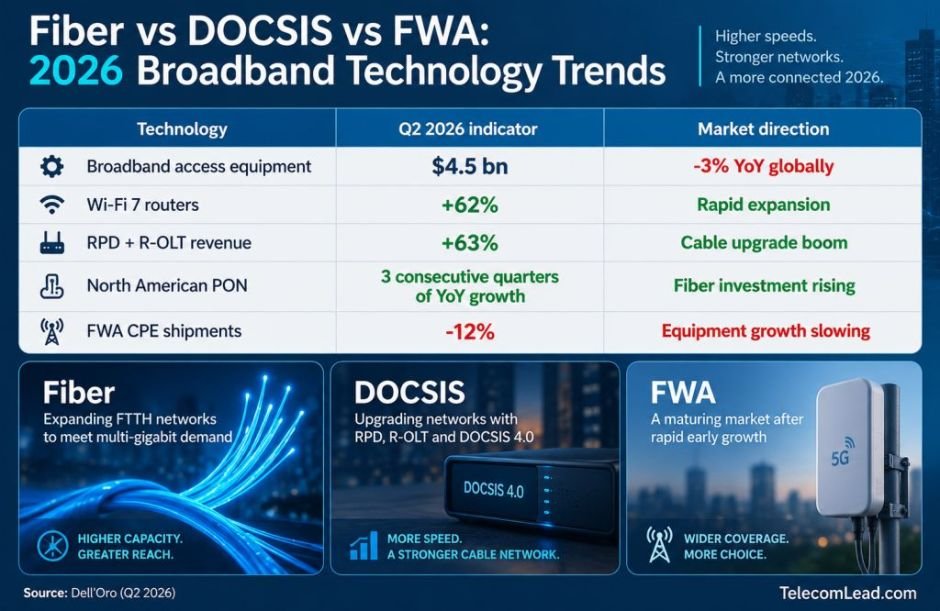
Worldwide Broadband Access equipment revenue reached $4.5 billion in Q2 2026, down 3 percent year over year, according to Dell’Oro Group. But North American telecom and cable operators moved in the opposite direction, increasing purchases of PON, Remote PHY, Remote OLT and next-generation home networking equipment.
The investment cycle is also creating a significant technology divergence. Residential Wi-Fi 7 router shipments jumped 62 percent year over year, while combined revenue from Remote PHY Devices and Remote OLT platforms surged 63 percent. In contrast, fixed wireless access CPE shipments dropped 12 percent.
The figures show that the next US broadband investment cycle is increasingly centered on fiber, DOCSIS 4.0 and Wi-Fi 7, even as fixed wireless remains an important subscriber-growth engine for Verizon and T-Mobile.
North American PON Spending Returns to Growth
Fiber is one of the biggest drivers of the current equipment cycle.
Dell’Oro says North American operators recorded their third consecutive quarter of growth in the PON equipment spending during Q2 2026, bringing investment momentum closer to levels last seen during the 2022 broadband expansion.
An important factor is equipment pricing.
Operators are accelerating purchases of optical line terminals (OLTs) and optical network terminals (ONTs) as shortages of memory and other components put upward pressure on equipment costs.
Dell’Oro Vice President Jeff Heynen said operators appear to be pulling purchases forward to stay ahead of increasing average selling prices for OLTs and ONTs.
That makes the current expansion more than a simple capacity upgrade. Operators are simultaneously expanding fiber coverage, preparing networks for multi-gigabit services and managing supply-chain and equipment-price risks.
AT&T Fiber Network Passes 36 Million Locations
AT&T remains one of the most important drivers of the US fiber equipment market.
Its fiber network now reaches more than 36 million locations, while the company is targeting approximately 40 million fiber locations by the end of 2026.
The longer-term ambition is considerably larger. AT&T is targeting around 60 million total fiber locations by the end of 2030 through its organic fiber construction and expanded fiber footprint.
The strategy received another boost from AT&T’s acquisition of substantially all of Lumen’s Mass Markets fiber business for $5.75 billion, expanding its access to millions of additional fiber locations.
AT&T’s fiber expansion strategy and 2030 network targets show how the operator is repositioning its fixed-network business around fiber rather than legacy copper infrastructure.
The operator is also increasingly connecting fiber access with the customer’s in-home network. Its Wi-Fi strategy includes Wi-Fi 7 gateways, allowing multi-gigabit fiber speeds to be extended more effectively to compatible devices throughout the home.
For equipment suppliers, AT&T’s expansion generates demand across several categories: fiber cable, OLTs, ONTs, optical components, access electronics and Wi-Fi gateways.
Verizon Combines Fiber Expansion With FWA
Verizon is pursuing a more diversified broadband strategy combining fiber and 5G fixed wireless access.
The operator added 155,000 fiber broadband customers in Q2 2026 and 193,000 fixed wireless access customers, taking total broadband net additions to 348,000.
Verizon ended the quarter with approximately 17.1 million total broadband connections across fiber and fixed wireless.
The Verizon Q2 2026 operating results demonstrate why declining industry FWA CPE shipments should not automatically be interpreted as declining fixed-wireless demand.
Dell’Oro recorded a 12 percent YoY decline in FWA CPE unit shipments, driven largely by weaker new-unit sales in North America. Yet Verizon continued adding almost 200,000 FWA customers during the quarter.
One explanation is that the FWA market is maturing. After several years of rapid customer acquisition and initial CPE deployment, equipment shipment growth can slow even while the installed subscriber base continues expanding.
Verizon’s fiber position is also becoming strategically more important as it expands its overall broadband footprint.
Comcast Pushes DOCSIS 4.0 Toward Multi-Gigabit Broadband
Cable operators are responding to fiber competition by upgrading their existing hybrid fiber-coax networks rather than replacing them entirely with fiber.
Dell’Oro reported that combined revenue from Remote PHY Devices and Remote OLT equipment increased 63 percent year over year in Q2 2026.
Comcast is one of the key operators behind the industry’s move toward DOCSIS 4.0.
DOCSIS 4.0 allows cable operators to increase downstream and upstream capacity while using much of their existing network infrastructure. This is particularly important as fiber operators increasingly promote symmetrical and multi-gigabit services.
Comcast has been deploying its next-generation network architecture to increase broadband speeds and improve upstream performance.
Technology development is already moving beyond the first generation of DOCSIS 4.0. Comcast, Charter and Broadcom have been working on a unified DOCSIS chipset architecture capable of supporting speeds of up to 25 Gbps.
The Broadcom, Comcast and Charter DOCSIS technology initiative illustrates how the cable industry is attempting to extend the competitive life of HFC networks while increasing capacity.
For Comcast, the objective is clear: reduce the performance gap with fiber without undertaking the cost and disruption of immediately replacing its entire cable access network.
Charter Expands Scale After Cox Deal
Charter Communications is another major source of cable-network equipment demand.
Its strategic position changed significantly after completion of the Charter-Cox Communications transaction in August 2026, creating a substantially larger US broadband and connectivity platform.
The combination increases the scale at which Charter can deploy network upgrades, customer-premises equipment and Wi-Fi technology.
The completion of the Charter and Cox transaction could also strengthen Charter’s purchasing power with broadband equipment suppliers as the combined company modernizes its infrastructure.
Charter has been pursuing distributed access architecture and network upgrades designed to increase broadband capacity while supporting higher upstream speeds.
The Dell’Oro finding that RPD and R-OLT revenue increased 63 percent therefore represents an important indicator for Charter, Comcast and their technology suppliers.
Wi-Fi 7 Router Shipments Surge 62%
The broadband upgrade is increasingly moving inside the customer’s home.
Residential Wi-Fi 7 router shipments increased 62 percent YoY in Q2 2026, making home networking one of the fastest-growing areas of the broadband equipment market.
Dell’Oro attributes the increase to two major factors.
Lower-cost dual-band Wi-Fi 7 products are expanding rapidly in China and Southeast Asia, while US broadband operators are pulling purchases forward to support multi-gigabit Internet services.
This is important because fiber and DOCSIS network upgrades alone cannot guarantee better customer experience.
A household receiving a 2 Gbps or 5 Gbps connection can still encounter performance limitations if the gateway, router or client device relies on older Wi-Fi technology.
Wi-Fi 7 addresses that bottleneck through higher capacity, wider channels and more efficient spectrum utilisation.
Operator deployment can also accelerate adoption far faster than retail router replacement because an ISP can introduce new technology across millions of customer gateways.
Fiber and Wi-Fi 7 Become Closely Linked
The simultaneous rise of PON and Wi-Fi 7 spending is therefore not coincidental.
AT&T and other fiber operators increasingly need gateways capable of delivering a larger proportion of advertised multi-gigabit speeds over wireless connections.
The same challenge applies to cable operators deploying DOCSIS 4.0.
This is creating a broader equipment opportunity spanning PON, DOCSIS, gateways, Wi-Fi chipsets, mesh systems and optical components.
It also changes broadband competition. Consumers increasingly judge broadband performance based on the speed experienced on smartphones, PCs and TVs over Wi-Fi rather than the theoretical capacity delivered to an ONT or cable modem.
DOCSIS Equipment Revenue Jumps 63%
The 63 percent increase in combined RPD and R-OLT revenue is particularly significant because it demonstrates that cable operators are still willing to invest heavily in their access networks despite aggressive fiber expansion.
Remote PHY moves physical-layer functionality closer to subscribers, while Remote OLT technology allows operators to introduce fiber services within distributed access architectures.
Both technologies provide cable companies with more flexibility when deciding whether a neighborhood should remain on upgraded HFC infrastructure or transition toward fiber.
This creates a mixed network model in which DOCSIS 4.0 and fiber can coexist rather than requiring cable operators to select one technology for their entire footprint.
FWA CPE Shipments Fall 12%
Fixed wireless was the major exception to the broadband equipment growth trends.
Global FWA CPE unit shipments declined 12 percent year over year in Q2 2026, largely because of slower new-unit sales in North America.
The decline contrasts sharply with the 62 percent increase in Wi-Fi 7 routers and 63 percent increase in RPD/R-OLT revenue.
However, it does not necessarily mean that 5G home broadband is losing relevance.
Verizon’s 193,000 FWA additions in Q2 demonstrate that operators can continue expanding subscribers while equipment shipment growth moderates.
The market may instead be shifting from the initial rapid CPE deployment phase toward a more mature replacement and subscriber-addition cycle.
Fiber investment is accelerating as operators expand FTTH footprints. Cable operators are spending on distributed architectures and DOCSIS upgrades to remain competitive. Wi-Fi 7 is emerging as the in-home technology needed to translate these access-network improvements into customer-visible performance.
FWA, meanwhile, is entering a different stage of its development after several years of aggressive expansion.
Which Equipment Vendors Could Benefit?
The investment cycle creates opportunities across the broadband supply chain.
Nokia and Adtran have significant exposure to fiber access and PON equipment. Calix combines broadband access technology with subscriber and managed Wi-Fi platforms.
Cable-network spending creates opportunities for suppliers involved in DOCSIS, distributed access and Remote PHY architectures, including CommScope, Harmonic and Vecima, while semiconductor suppliers such as Broadcom are important to both cable and Wi-Fi technology development.
Wi-Fi 7 growth broadens the opportunity further to gateway manufacturers and chipset companies as broadband operators replace customer-premises equipment.
The key question for vendors will be how long the current purchasing acceleration continues, particularly because Dell’Oro believes operators are bringing some orders forward to avoid higher future equipment prices.
US Broadband Investment Race Enters a New Phase
The 3 percent decline in the $4.5 billion global broadband access equipment market masks a much stronger investment environment in North America.
AT&T’s push toward 40 million fiber locations in 2026 and around 60 million by 2030 is supporting the PON equipment cycle. Verizon is combining fiber expansion with a broadband base of approximately 17.1 million fiber and FWA connections.
Comcast and Charter are responding through DOCSIS and distributed access upgrades, contributing to the 63 percent surge in RPD and R-OLT revenue.
At the same time, Wi-Fi 7 router shipments are growing 62 percent, showing that the investment battle is moving from the outside network into the customer’s home.
The result is a broadband market increasingly defined by four interconnected investment themes: fiber expansion, DOCSIS 4.0 modernization, Wi-Fi 7 adoption and a maturing FWA market.
For AT&T, Verizon, Comcast and Charter, the competitive question in 2026 is no longer simply who can advertise the highest broadband speed. It is who can deliver multi-gigabit capacity economically across the access network and consistently through Wi-Fi inside millions of US homes.
BABURAJAN KIZHAKEDATH