
Canada’s fixed broadband market is entering a new performance cycle as Wi-Fi 7, 6 GHz spectrum and fiber networks reshape competition among Bell, TELUS, Rogers, Cogeco and Videotron.
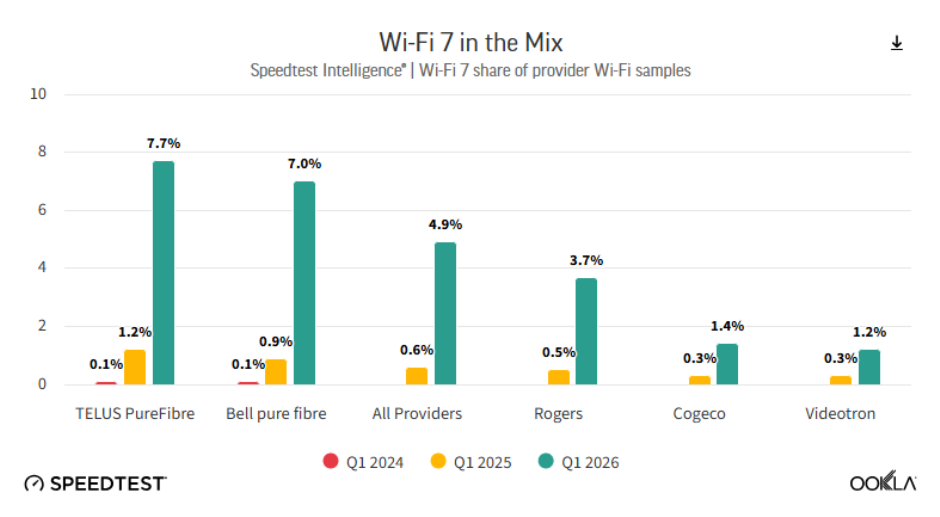
Wi-Fi 7 accounted for 4.9 percent of provider Wi-Fi samples in Q1 2026, up sharply from 0.6 percent a year earlier, while usage of the 6 GHz band reached 13.7 percent, according to Ookla’s analysis of Canada’s evolving Wi-Fi market.
The biggest competitive difference, however, is emerging in operator performance. Fiber providers Bell Pure Fibre and TELUS PureFibre are ahead in Wi-Fi 7 adoption and deliver much stronger upload speeds and lower latency than cable networks.
TELUS and Bell Lead Canada in Wi-Fi 7 Adoption
TELUS PureFibre recorded the highest Wi-Fi 7 adoption among the Canadian providers measured by Ookla, at 7.7 percent, followed closely by Bell Pure Fibre at 7.0 percent.
Cable operators were further behind. Cogeco recorded Wi-Fi 7 adoption of 1.4 percent, while Videotron reached 1.2 percent.
The overall Canadian Wi-Fi 7 adoption rate jumped from zero in Q1 2024 to 0.6 percent in Q1 2025 and 4.9 percent in Q1 2026, indicating that the replacement cycle for home gateways and connected devices is accelerating.
Bell, however, led in absolute Wi-Fi 7 sample share. Bell Pure Fibre generated 40.4 percent of all Wi-Fi 7 Speedtest samples in Canada during Q1 2026. Rogers was second with 26.3 percent, followed by TELUS PureFibre with 20.3 percent. Other providers accounted for the remaining 13.0 percent.
The figures suggest different strengths: TELUS led in the proportion of its own samples running Wi-Fi 7, while Bell’s larger 40.4 percent national sample share points to substantial Wi-Fi 7 usage across its customer footprint.
Bell Wi-Fi 7 Download Speed Approaches 1 Gbps
Performance improves significantly as Canadian customers move to newer Wi-Fi generations.
Wi-Fi 4 produced download speeds of only 35.77 Mbps to 46.19 Mbps across the operators measured. Wi-Fi 6 increased performance to approximately 364 Mbps to 462 Mbps.
Wi-Fi 7 moved speeds considerably higher.
Bell Pure Fibre delivered Wi-Fi 7 download speeds of 988.70 Mbps, putting in-home wireless performance close to the 1 Gbps threshold. At the other end of the measured operator range, Videotron recorded 554.38 Mbps.
The results demonstrate why operators increasingly need to coordinate fiber, DOCSIS, gateways and Wi-Fi upgrades. Faster access networks provide limited customer benefit if older Wi-Fi equipment becomes the bottleneck inside the home.
Bell and TELUS Dominate Wi-Fi Upload Performance
Upload speed represents an even clearer dividing line between fiber and cable operators.
On Wi-Fi 7, Bell Pure Fibre recorded upload speeds of 828.32 Mbps, while TELUS PureFibre achieved 725.79 Mbps.
Rogers reached 192.47 Mbps, Cogeco recorded 94.61 Mbps, and Videotron delivered 52.74 Mbps.
Bell’s Wi-Fi 7 upload result was therefore more than four times Rogers’ level, nearly nine times Cogeco’s and more than 15 times Videotron’s.
Ookla also found that on Wi-Fi 6, fiber upload speeds were 4.2 times faster than cable.
This advantage is increasingly important as broadband usage shifts beyond video streaming and web browsing toward cloud applications, remote work, content creation, online backup, gaming and AI-enabled services that can generate more upstream traffic.
Fiber Networks Deliver Much Lower Latency
Bell and TELUS also performed strongly on latency.
Bell Pure Fibre recorded Wi-Fi latency of approximately 7-12 milliseconds, while TELUS PureFibre ranged from 8-11 ms.
Rogers, Cogeco and Videotron generally recorded substantially higher latency of around 20-27 ms.
The results underline an important competitive issue for Canadian broadband operators: upgrading the home to Wi-Fi 7 alone does not eliminate differences created by the underlying access network.
Fiber’s combination of high upload capacity and lower latency gives Bell and TELUS an advantage for applications such as cloud gaming, video conferencing and other interactive services.
Bell Has One of Canada’s Most Modern Wi-Fi Footprints
Bell Pure Fibre also stands out in the transition away from older Wi-Fi generations.
Nearly 30 percent of its samples were already running Wi-Fi 6E or Wi-Fi 7 in Q1 2026, including 22.6 percent Wi-Fi 6E and 7.0 percent Wi-Fi 7.
Cable providers retained a larger proportion of legacy equipment. Videotron recorded 10.9 percent Wi-Fi 4 and 40.2 percent Wi-Fi 5, while Cogeco had 12.2 percent Wi-Fi 4 and 37.7 percent Wi-Fi 5.
Wi-Fi 6 remained the largest generation across the major providers, representing approximately 45-49 percent of samples.
Canada as a whole recorded 57.1 percent Wi-Fi 6 adoption, almost matching the United States at 57.5 percent. However, Canada trailed the U.S. on Wi-Fi 7, with 4.9 percent adoption compared with 7.2 percent south of the border.
6 GHz Usage Jumps to 13.7%
Another significant change is occurring in spectrum usage.
The 6 GHz band represented virtually 0 percent of Canadian Wi-Fi connections in Q1 2022, but increased to 2.6 percent in Q1 2024, 9.5 percent in Q1 2025 and 13.7 percent in Q1 2026.
That represented 44 percent year-over-year growth in Q1 2026.
At the same time, legacy 2.4 GHz usage declined from 31.9 percent in Q1 2022 to 17.8 percent in Q1 2026. The 5 GHz band remained dominant at 68.5 percent.
The transition toward 6 GHz should provide additional capacity for operators deploying Wi-Fi 6E and Wi-Fi 7, particularly in homes with growing numbers of connected devices.
Bell Adds 45,271 Fiber Customers
Bell’s Wi-Fi performance is supported by continued expansion and adoption of its fiber network.
Bell recorded 45,271 residential FTTH Internet net additions in Canada during Q2 2026, compared with 47,920 a year earlier. Total high-speed Internet net additions, after including losses in copper areas, reached 11,601, up from 4,612 in Q2 2025.
The BCE Q2 2026 results also show capital expenditures reaching C$1.08 billion, up 41.5 percent from C$763 million a year earlier. Part of the increase was associated with Bell AI Fabric infrastructure in Canada and Ziply Fiber’s U.S. FTTP expansion.
Bell’s broadband position is therefore supported by both access-network investment and a comparatively modern in-home Wi-Fi base. Its 7.0 percent Wi-Fi 7 adoption, 40.4 percent national Wi-Fi 7 sample share, 988.70 Mbps Wi-Fi 7 download speed and 828.32 Mbps upload speed make it one of the strongest performers in Ookla’s Canadian analysis.
TELUS Combines Wi-Fi 7 Leadership With PureFibre Growth
TELUS led the operators measured by Ookla in Wi-Fi 7 adoption at 7.7 percent, while its 725.79 Mbps Wi-Fi 7 upload performance was second only to Bell.
The operator also continued adding broadband customers in Q2.
According to TELUS Q2 2026 financial and operational results, the company generated 20,000 Internet net additions during the quarter. TELUS recorded C$678 million in Q2 capital expenditures and updated its full-year 2026 capital expenditure forecast to approximately C$2.6 billion.
TELUS has more than 17 million customer connections across its broader portfolio, while its PureFibre network remains central to its Canadian broadband strategy.
For TELUS, the Ookla results indicate that investment in fiber is translating into a strong in-home experience, particularly for latency and upstream performance.
Rogers Leads Cable Operators in Wi-Fi 7 Scale
Rogers presents a different performance profile.
Although its cable network does not match Bell and TELUS on Wi-Fi 7 upload speeds, Rogers generated 26.3 percent of Canada’s Wi-Fi 7 samples, second only to Bell. Its 192.47 Mbps Wi-Fi 7 upload speed was also significantly higher than Cogeco and Videotron.
Rogers’ Q2 operating performance reinforces its scale in the broadband market. The company added 17,000 retail Internet customers during the quarter and ended June with 4.862 million customer relationships.
According to the Rogers Q2 2026 results, Cable revenue increased 1 percent to C$1.984 billion, while Cable adjusted EBITDA increased 1 percent to C$1.158 billion. The Cable EBITDA margin reached 58.4 percent.
Rogers invested C$695 million in company-wide capital expenditures during Q2, down 16 percent year over year. Cable capital expenditure was C$367 million, down 9 percent. Its overall capital intensity fell to 12.4 percent, the lowest since Q1 2008.
The operator expects C$2.5 billion-C$2.7 billion in 2026 capital expenditures.
Rogers therefore combines a large installed broadband base and significant Wi-Fi 7 sample share with a key technical challenge: narrowing the upload and latency gap with fiber competitors.
Cogeco Expands Network While Canadian Business Grows
Cogeco’s Wi-Fi 7 adoption remained relatively low at 1.4 percent, and its Wi-Fi 7 upload performance of 94.61 Mbps was well below Bell and TELUS.
However, its latest financial performance shows continuing investment in the Canadian network.
Cogeco Communications’ Canadian telecommunications revenue increased 0.5 percent to C$376.7 million in its fiscal Q3 2026, while adjusted EBITDA increased 3.9 percent to C$203.9 million.
Canadian telecom net capital expenditure reached C$69.4 million, up 2.3 percent.
Across Cogeco Communications, network expansion capital expenditure increased to C$21.6 million, compared with C$13.3 million a year earlier — an increase of 62.6 percent.
That expansion provides a foundation for gradually increasing the penetration of newer gateways and Wi-Fi generations.
Videotron Internet Revenue Rises 3.1%
Videotron’s Wi-Fi 7 adoption stood at 1.2 percent, while its Wi-Fi 7 download speed reached 554.38 Mbps and upload speed was 52.74 Mbps.
Its parent Quebecor nevertheless reported growth in telecommunications operations during Q2 2026.
Telecommunications revenue increased 4.0 percent, while adjusted EBITDA rose 5.3 percent. Internet access revenue increased by C$9.6 million, or 3.1 percent, while mobile service revenue expanded 9.2 percent.
The results indicate that Videotron continues growing its telecom business while facing an opportunity to accelerate replacement of legacy Wi-Fi equipment: 10.9 percent of its measured Wi-Fi footprint remained on Wi-Fi 4 and 40.2 percent on Wi-Fi 5.
Canada Broadband Competition Shifts to In-Home Performance
Canada’s broadband competition is increasingly becoming a battle over the entire connection between the network and the customer’s device.
Bell and TELUS currently hold a significant performance advantage because their fiber networks combine high-capacity broadband access with faster Wi-Fi 7 uploads and lower latency.
Bell Pure Fibre stands out with 988.70 Mbps Wi-Fi 7 download, 828.32 Mbps upload and 40.4 percent of national Wi-Fi 7 samples. TELUS PureFibre leads adoption at 7.7 percent and delivers 725.79 Mbps upload performance.
Rogers has established meaningful Wi-Fi 7 scale with 26.3 percent of national samples and continues adding Internet customers, but its upload performance highlights the continuing difference between cable and fiber.
Cogeco and Videotron have a larger legacy Wi-Fi footprint, creating both a competitive weakness and an upgrade opportunity as customers replace gateways and Wi-Fi 7 devices become more widely available.
With Canadian Wi-Fi 7 adoption already at 4.9 percent and 6 GHz usage at 13.7 percent, the next stage of broadband competition will be driven not simply by advertised Internet speeds, but by Wi-Fi 7 penetration, fiber availability, upload performance, latency and the quality customers experience throughout the home.
FASNA SHABEER