Apple has entered the premium foldable smartphone market with its first folding iPhone, putting the company directly against Huawei and Xiaomi in one of the fastest-growing segments of the handset industry.
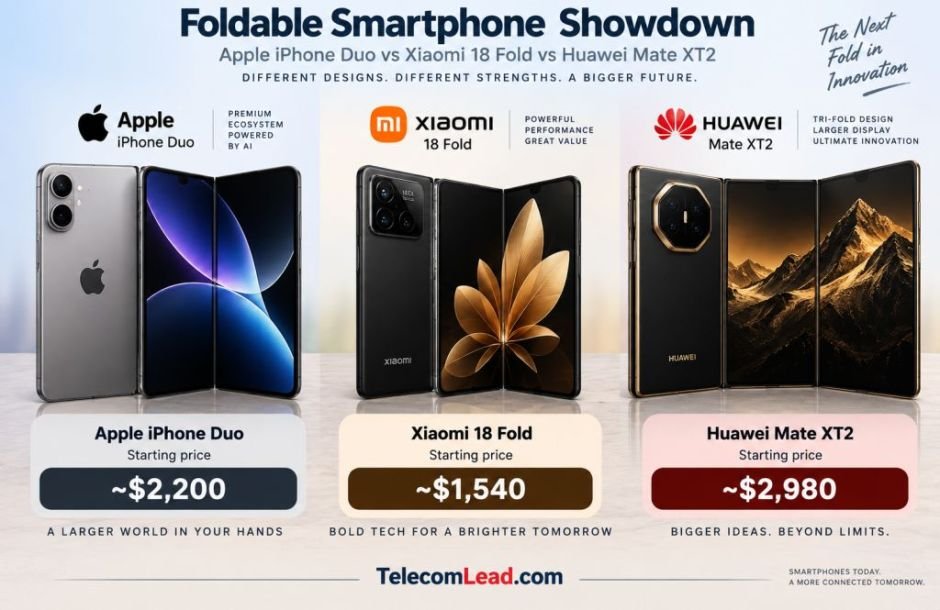
Apple iPhone Duo is expected to start at around $2,200, positioning it substantially above Xiaomi’s latest foldable but below Huawei’s flagship tri-fold phone. Apple’s strategy is focused less on competing through specifications alone and more on combining a large folding display, premium materials, artificial intelligence and its iOS ecosystem.
The timing could be significant.
Omdia report on foldable smartphone market said shipments will be exceeding 22 million units in 2026, an increase of more than 22 percent. Shipment of foldable smartphones are forecast to reach 36 million units by 2028, more than double the 18.2 million units shipped in 2025.
IDC said foldable smartphone shipments are forecast to increase 30 percent in 2026, even as traditional smartphone demand remains under pressure. IDC predicts that Apple could capture almost one-third of the global foldable market in 2026 and 40 percent in 2027.
iPhone Duo Price: Apple Targets Ultra-Premium Buyers
Price will be one of the biggest factors separating Apple, Huawei and Xiaomi.
The Apple iPhone Duo starts at about $2,200, according to reports following Apple’s September 9 product event. By comparison, the Xiaomi 18 Fold starts at 10,999 yuan, or about $1,540, and reaches 14,999 yuan, or approximately $2,100.
Huawei is pushing even further into luxury territory. Its Mate XT2 starts at 19,999 yuan, equivalent to about $2,980, while the top configuration costs 24,999 yuan, or roughly $3,725.
Xiaomi therefore undercuts Apple by about $660, while Apple’s entry price is roughly $780 below Huawei’s Mate XT2.
Apple iPhone Duo Features: 7.6-inch Folding Display
Apple has selected a passport-style book design rather than following Huawei into the more complicated tri-fold format.
The iPhone Duo has a 5.4-inch external display and opens to reveal a 7.6-inch internal display, making the inner panel the largest screen yet offered on an iPhone. The unfolded screen is around 50 percent larger than the iPhone 18 Pro Max display and about 80 percent larger than the iPhone 18 Pro screen.
The approach gives users a conventional smartphone-sized screen for quick tasks while providing a larger tablet-like workspace for video, reading and multitasking.
Apple is using titanium reinforced internally with ceramic fibres, while Ceramic Shield protects the exterior surfaces. The iPhone Duo also carries an IP68 dust- and water-resistance rating, an important specification because durability has historically been one of the biggest weaknesses of foldable smartphones.
Apple Bets on AI and iOS Ecosystem
Apple’s broader 2026 smartphone strategy places artificial intelligence at the centre of the user experience.
Its new iPhone generation uses Apple’s A20 Pro processor, with the company emphasizing on-device AI processing and privacy. Apple’s upgraded Siri can interact with around 300,000 apps, potentially giving the company an important software advantage as AI assistants become more deeply integrated into smartphones.
For the iPhone Duo, the larger display also creates opportunities for running multiple applications simultaneously, productivity workflows, entertainment and AI-assisted applications.
Apple’s biggest advantage may therefore be less about display size and more about bringing a foldable device into its existing ecosystem of iPhone apps, Macs, Apple Watches, AirPods and services.
Huawei Mate XT2 Offers a Much Larger Tri-Fold Screen
Huawei is taking a fundamentally different approach.
The Huawei Mate XT2 folds twice rather than once, allowing the device to transform into a tablet-sized screen. Its folding OLED display reaches approximately 10.2 inches, considerably larger than Apple’s 7.6-inch internal screen.
Huawei has also introduced the Kirin 9050 Pro processor, a redesigned hinge, improved water resistance and a privacy display designed to prevent people beside the user from easily viewing the screen.
Huawei says its new processor architecture, called LogicFolding, provides greater computing performance while reducing electricity consumption.
The technological ambition comes at a substantial price. At $2,980-$3,725, the Mate XT2 is aimed at buyers willing to pay laptop-level prices for an unusually large folding smartphone.
Huawei nevertheless has a powerful home-market position. The company accounted for about 68 percent of China’s foldable smartphone shipments in Q2 2026. Huawei also held 22.6 percent of China’s overall smartphone market, compared with Apple’s 18.1 percent and Xiaomi’s 12.4 percent, according to figures cited by Reuters.
Xiaomi 18 Fold Challenges Apple on Price and Performance
Xiaomi presents a different threat to Apple because it combines premium foldable hardware with a considerably lower starting price.
The Xiaomi 18 Fold costs 10,999-14,999 yuan ($1,540-$2,100), meaning even its highest-priced configuration is around the starting level of Apple’s foldable.
Xiaomi’s device weighs just 219 grams and measures 5.02 mm thick when unfolded. CEO Lei Jun highlighted its low weight as an advantage over Apple’s conventional iPhone Pro Max.
The 18 Fold uses Xiaomi’s own XRing O3 AI processor, which the company claims delivers better responsiveness than Apple’s previous-generation A19 Pro. It also supports three applications running side by side when the phone is unfolded.
Xiaomi is therefore positioning the 18 Fold as a productivity and AI device while maintaining aggressive pricing.
Apple vs Huawei vs Xiaomi: Foldable Strategies Compared
The three companies are effectively pursuing different interpretations of the premium foldable smartphone.
Apple is betting on a relatively compact passport design, premium construction, software integration, AI and its enormous installed base.
Huawei is emphasizing engineering innovation with a tri-fold architecture and roughly 10.2-inch display, but its starting price approaches $3,000.
Xiaomi is attacking from the value-performance side, offering its flagship foldable from about $1,540, along with an in-house AI processor and three-app multitasking.
Apple’s biggest challenge will be convincing consumers that its software, ecosystem and user experience justify paying roughly 43 percent more than the starting price of Xiaomi’s 18 Fold.
Huawei faces a different issue: its Mate XT2 costs about 35 percent more than Apple’s estimated starting price, placing it in an exceptionally narrow ultra-premium segment.
Foldable Smartphone Market Could Accelerate in 2026
Apple is arriving late. Samsung, Huawei, Xiaomi and other Android vendors have spent years addressing problems involving hinges, screen creases, durability, cameras, battery life and device thickness.
Samsung currently accounts for around 40 percent of global foldable shipments, followed by Huawei at roughly 30 percent, according to industry figures cited by Reuters.
But Apple’s arrival could expand the market rather than simply redistribute existing sales.
IDC expects Apple to secure nearly one-third of foldable shipments during 2026, rising to approximately 40 percent in 2027. Foldable shipments overall are expected to grow nearly 30 percent this year.
The pricing battle is now particularly interesting. Xiaomi offers the lowest entry point at about $1,540, Apple occupies the middle at roughly $2,200, and Huawei stretches the category to as much as $3,725.
For Apple, success will depend on whether buyers see the iPhone Duo as simply a folding version of an iPhone or as a new category combining the portability of a smartphone with the productivity and viewing advantages of a small tablet. With Huawei pushing display innovation and Xiaomi competing aggressively on specifications and price, 2026 could become the year foldable smartphones finally move beyond their niche status.
BABURAJAN KIZHAKEDATH