Apple has delivered a major price shock to Indian smartphone buyers, raising prices of existing iPhones by as much as 41 percent just as consumers would normally expect older models to become cheaper following the arrival of a new generation.
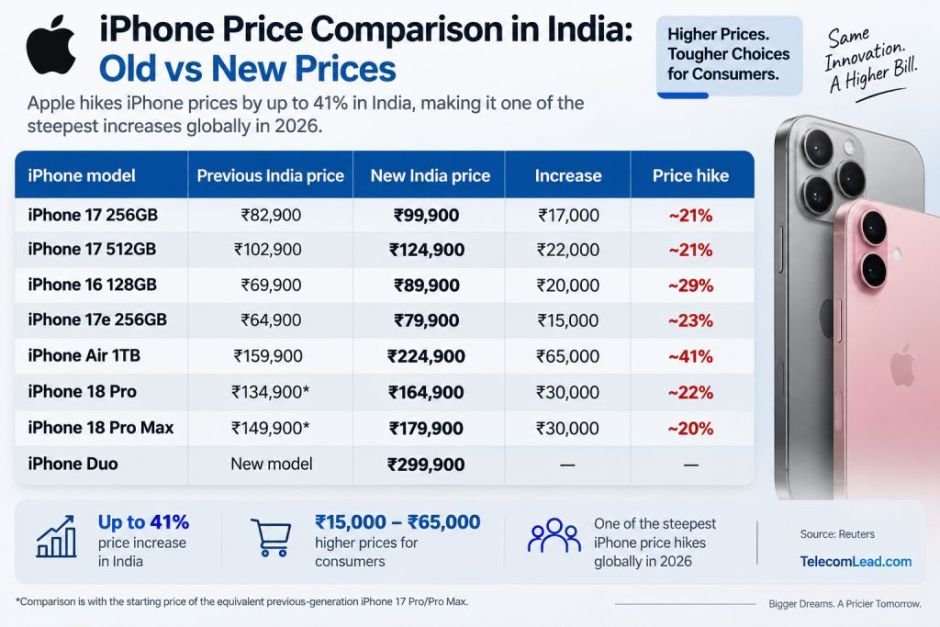
The sharp increase makes India one of the markets facing the steepest iPhone price hikes globally in 2026. The timing is particularly significant for consumers because the revision comes ahead of India’s important festive shopping season, when smartphone makers and retailers typically compete aggressively through discounts, exchange offers and financing schemes.
According to Reuters’ report on Apple’s India price increases, the increases in India are substantially higher than the 10 percent to 21 percent increases introduced in the United States.
For Indian consumers, the biggest question is whether an iPhone still offers sufficient value when even previous-generation devices are moving deeper into premium territory.
iPhone 17 Price Jumps ₹17,000 to ₹99,900
The most visible change is the iPhone 17.
Apple has increased the starting price of the 256GB iPhone 17 from ₹82,900 to ₹99,900, representing an increase of ₹17,000, or nearly 21 percent.
The 512GB version has risen from ₹102,900 to ₹124,900, meaning consumers must spend another ₹22,000, an increase of more than 21 percent.
Apple’s official India store currently lists the iPhone 17 at ₹99,900 for 256GB and ₹124,900 for 512GB.
This represents an unusual change in Apple’s product cycle. Consumers who deliberately postponed an iPhone 17 purchase expecting its price to decline after the introduction of newer devices are instead facing a substantially higher bill.
For a buyer considering the entry-level iPhone 17, the ₹17,000 increase alone is equivalent to the price of an entire budget Android smartphone.
iPhone Air 1TB Gets Massive 41% Price Increase
The biggest percentage shock is at the higher end of Apple’s existing portfolio.
The 1TB iPhone Air, previously priced at ₹159,900, now costs ₹224,900. That is a massive ₹65,000 increase, equivalent to approximately 41 percent.
The increase fundamentally changes the positioning of the device.
At ₹224,900, the 1TB iPhone Air is no longer simply a premium smartphone purchase. Its price puts it into a category where consumers are likely to compare the purchase against laptops, tablets and other high-end electronics rather than only competing smartphones.
Apple currently lists the iPhone Air range in India from ₹149,900.
Even iPhone 16 and iPhone 17e Buyers Pay More
The price pressure is not limited to Apple’s most expensive phones.
The iPhone 16 128GB has reportedly moved from ₹69,900 to ₹89,900, adding ₹20,000 to the cost of the device. The iPhone 17e 256GB has increased from ₹64,900 to ₹79,900, a ₹15,000 increase.
Apple’s official store confirms current starting prices of ₹89,900 for the iPhone 16 and ₹79,900 for the iPhone 17e.
That is important because these devices are supposed to provide relatively more accessible entry points into Apple’s ecosystem.
The iPhone 17e crossing close to the ₹80,000 level and the iPhone 16 approaching ₹90,000 could make the value equation considerably more difficult for price-sensitive Indian consumers.
iPhone 18 Pro Starts at ₹164,900
Apple’s new premium models also arrive at substantially higher prices.
The iPhone 18 Pro starts at ₹164,900, compared with the ₹134,900 starting price of the previous iPhone 17 Pro — an increase of ₹30,000, or roughly 22 percent.
The iPhone 18 Pro Max starts at ₹179,900, compared with ₹149,900 for the iPhone 17 Pro Max, another ₹30,000 increase, or approximately 20 percent.
Consumers therefore face higher prices at both ends of Apple’s portfolio: older devices have become more expensive, while the latest premium models have entered the market at significantly higher price points.
iPhone Duo Takes Apple to ₹3 Lakh
Apple’s first foldable smartphone pushes pricing into an entirely different category.
The iPhone Duo starts at ₹299,900 in India, making it one of Apple’s most expensive mainstream consumer devices.
Apple’s India store confirms the nearly ₹3 lakh starting price, with pre-orders scheduled for October 16.
The international price difference is particularly striking. Reuters reports that the Indian price of Apple’s foldable is around $1,100 higher than its U.S. price.
Why Are iPhones Getting So Expensive?
One of the biggest drivers is the global increase in memory and storage costs.
Apple had previously signalled plans to increase iPhone prices globally because memory and storage chips are becoming more expensive.
India faces additional structural pricing disadvantages.
Despite becoming a major iPhone manufacturing and assembly location, Indian retail prices remain affected by taxes and imported components. Reuters notes that 18 percent Goods and Services Tax (GST) and duties associated with imported components continue to contribute to higher Indian prices.
This creates an uncomfortable situation for consumers: Apple’s manufacturing presence in India is expanding, but the benefits are not necessarily translating directly into lower retail prices.
Indian Consumers May Become More Price Sensitive
The new prices could change purchasing behaviour across Apple’s customer base.
Consumers who previously bought an iPhone immediately after launch may increasingly rely on bank discounts, no-cost EMI, trade-ins and retailer promotions to make purchases affordable.
Apple itself is emphasizing financing. Its online store, for example, currently shows the ₹99,900 iPhone 17 with monthly payment options starting at ₹16,483, subject to its applicable cashback and no-cost EMI conditions.
The bigger challenge may be consumers upgrading from older iPhones.
An owner of an iPhone 14, 15 or 16 who does not urgently require a new phone could simply extend the replacement cycle rather than absorb a 20 percent or higher price increase.
That could make trade-in values and festive-season discounts increasingly important to Apple’s India sales strategy.
Android Flagships Could Benefit
Apple’s price increase also creates an opportunity for Samsung, Google, OnePlus, Vivo, Oppo and other premium Android smartphone brands.
When an entry-level previous-generation iPhone approaches ₹1 lakh, consumers have a much wider range of alternatives.
The decision becomes particularly relevant for buyers who are not deeply locked into Apple’s ecosystem through products and services such as the Apple Watch, AirPods, iCloud and Mac.
India remains highly price sensitive, and Apple’s latest increases are considerably steeper than those introduced in the United States. The iPhone 17 rising nearly 21 percent, the iPhone Air 1TB jumping 41 percent, and the new iPhone Duo reaching ₹299,900 significantly raise the financial barrier to joining or upgrading within Apple’s ecosystem.
BABURAJAN KIZHAKEDATH