India’s smartphone market recorded its sharpest quarterly shipment decline since Q4 2022 as rising memory chip costs pushed average selling prices (ASPs) to a record $371 in Q3 2026. Samsung gained market leadership, while Apple maintained its premium position and budget smartphone brands suffered substantial shipment losses.
India’s smartphone market shipments declined 23.3 percent year-on-year to 36.8 million units in the third quarter of 2026, as smartphone prices increased sharply and festive discounts became less attractive to consumers.
According to the IDC Worldwide Quarterly Mobile Phone Tracker, the average smartphone selling price increased 26.1 percent to a record $371, compared with approximately $294 in Q3 2025.
This represents an increase of approximately $77 per smartphone within one year, reflecting higher memory chip prices, supply constraints and the growing concentration of shipments in mid-range and premium devices.
Despite the increase in smartphone prices, India’s smartphone market value declined 3.3 percent year-on-year as lower shipment volumes outweighed the benefits of higher ASPs.
The July–September quarter also marked India’s weakest festive smartphone market in a decade, with vendors reducing promotional discounts and channel partners limiting inventory purchases ahead of further price increases.
India Smartphone Prices Reach Record $371 as Memory Costs Rise
The sharp increase in smartphone prices was primarily driven by record-high memory chip costs, partly reflecting growing demand for memory used in artificial intelligence infrastructure.
Smartphone manufacturers faced higher component procurement costs and limited availability, reducing their ability to absorb inflation or offer aggressive discounts.
The average smartphone selling price of $371 in Q3 2026 represents a 26.1 percent increase from approximately $294 a year earlier.
Price increases were particularly damaging in India’s entry-level smartphone market, where buyers are highly sensitive to relatively small changes in retail prices.
The market’s shift toward more expensive devices also contributed to the increase in overall ASP, meaning the 26.1 percent rise does not represent an identical price increase for every smartphone model.
IDC expects pricing pressure to continue into Q4 2026 as memory shortages and higher component costs affect smartphone production and promotional strategies.
Smartphones Priced Below $100 Record 90.9% Shipment Decline
India’s cheapest smartphone segment experienced the most severe contraction in Q3 2026.
Shipments of smartphones priced below $100 plunged 90.9 percent year-on-year to just 0.7 million units.
The segment’s market share collapsed from 16.2 percent in Q3 2025 to 1.9 percent in Q3 2026.
Higher memory and component costs made it increasingly difficult for smartphone vendors to manufacture and sell devices profitably below $100.
The decline highlights a significant affordability challenge for first-time smartphone buyers and consumers upgrading from feature phones.
The $100–200 smartphone category also experienced a 21.3 percent shipment decline, although it remained India’s largest price segment with a 40.6 percent market share.
Together, these developments indicate that smartphone demand is increasingly shifting away from the lowest price categories.
$200–600 Smartphones Gain Market Share as Buyers Shift to Higher Prices
The strongest relative performance came from smartphones priced between $200 and $600.
Shipments in the $200–400 segment remained almost unchanged, increasing 0.1 percent year-on-year despite the overall market contraction.
The $400–600 category recorded a substantial 79.8 percent increase in shipments, making it the fastest-growing major smartphone price segment.
Combined, smartphones priced between $200 and $600 accounted for 42.9 percent of total shipments, compared with 29.9 percent a year earlier.
Financing options helped narrow the immediate affordability gap between price categories, allowing some consumers to purchase higher-priced smartphones through installment payments.
However, the shift toward more expensive devices also reflects the sharp decline in low-cost smartphone availability.
India Smartphone Market: Price Segment Performance in Q3 2026
| Smartphone price segment | Shipment growth YoY | Q3 2026 market share |
| Below $100 | −90.9% | 1.9% |
| $100–200 | −21.3% | 40.6% |
| $200–400 | +0.1% | Not separately reported |
| $400–600 | +79.8% | Not separately reported |
| $200–600 combined | — | 42.9% |
| $600–800 | −52.4% | Approximately 3.6% |
| $800 and above | −0.4% | 11.0% |
Source: IDC Worldwide Quarterly Mobile Phone Tracker, November 2026. The $200–600 combined segment includes the two component price bands; its share should not be added again to their individual shares.
Premium Smartphones Above $800 Remain Resilient Despite Higher Prices
India’s premium smartphone market demonstrated greater resilience than lower-priced categories.
Shipments of smartphones priced above $800 declined just 0.4 percent year-on-year, significantly outperforming the overall smartphone market.
The segment’s market share increased from 8.5 percent to 11 percent.
In contrast, smartphones priced between $600 and $800 experienced a 52.4 percent shipment decline.
Limited availability of previous-generation premium smartphones and reduced promotional discounts contributed to weaker demand in this category.
Combined, smartphones priced above $600 represented approximately 14.6 percent of total shipments.
The contrasting performance suggests that consumers purchasing the most expensive smartphones were less affected by rising prices than buyers seeking discounted premium devices.
Samsung Leads India Smartphone Market as Rivals Face Price Pressure
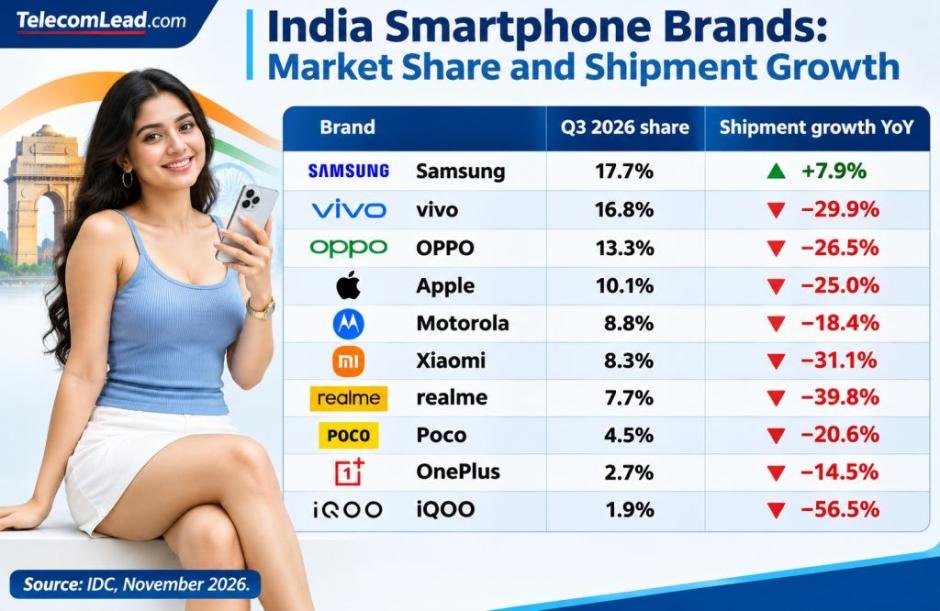
Samsung returned to the top position in India’s smartphone market after 10 quarters, increasing its market share from 12.6 percent to 17.7 percent.
Samsung was the only brand among the top 10 smartphone vendors to record shipment growth, with volumes increasing 7.9 percent year-on-year.
The company’s relatively controlled price increases during the first half of 2026, combined with its extensive smartphone portfolio, supported its competitive position.
vivo slipped to second place with a 16.8 percent market share as shipments declined 29.9 percent.
OPPO ranked third with a 13.3 percent share, recording a 26.5 percent shipment decline.
Apple regained fourth position with a 10.1 percent share despite a 25 percent decline in shipments.
Apple’s performance was affected by supply shortages involving the iPhone 15, iPhone 16 and iPhone 17, alongside reduced discounts on older-generation devices.
However, the higher-priced iPhone 18 Pro and Pro Max models accounted for more than 30 percent of Apple’s quarterly shipments, demonstrating continued demand at the premium end of the market.
Motorola secured fifth position with an 8.8 percent market share, despite an 18.4 percent decline in shipments.
Chinese smartphone brands faced significant pricing pressure because of their dependence on affordable and entry-level devices.
Xiaomi shipments declined 31.1 percent, while realme recorded a 39.8 percent contraction.
iQOO suffered the sharpest decline among the top 10 brands, with shipments falling 56.5 percent.
These declines indicate that vendors heavily exposed to price-sensitive consumers faced greater challenges in protecting sales volumes.
Higher Smartphone Prices Weaken Offline Retail Sales
India’s offline smartphone distribution channel recorded a 26.7 percent year-on-year shipment decline in Q3 2026.
Offline retail’s market share decreased from 56.4 percent to 53.9 percent.
Online smartphone shipments declined 18.9 percent, but their market share increased from 43.6 percent to 46.1 percent.
The offline channel faced pressure from unsold inventory accumulated during the first half of 2026, fewer festive discounts and concerns about further smartphone price increases.
Retail partners also reduced new inventory purchases as demand weakened.
The decline in promotional activity was particularly significant because India’s festive quarter traditionally benefits from aggressive discounts, financing schemes and inventory replenishment.
India Smartphone Prices Expected to Remain Under Pressure in Q4 2026
IDC expects smartphone pricing challenges to persist during the final quarter of 2026 as manufacturers continue to face elevated memory costs and constrained component supplies.
Aditya Rampal, senior research analyst, Devices Research at IDC Asia Pacific, highlighted the impact of the memory crisis on India’s smartphone market economics.
Although ASPs increased 26.1 percent, the market’s overall value declined 3.3 percent because of the substantial contraction in shipments.
India-based smartphone vendors such as AI+, Mivi and Boltt recorded strong shipment growth by offering lower-priced 4G and 5G devices.
However, their relatively small shipment volumes were insufficient to offset the broader market decline.
Their ability to maintain affordable prices will depend on component sourcing, supply availability and how effectively they manage further cost increases.
The latest IDC smartphone market research indicates that affordability has become a critical challenge for India’s smartphone industry, with the sub-$100 segment shrinking dramatically, the $400–600 segment expanding 79.8 percent and the industry’s average selling price reaching an unprecedented $371.
BABURAJAN KIZHAKEDATH