SpaceX’s adoption of Qualcomm Dragonwing 5G chipsets could significantly reduce the cost of deploying base stations across the United States by lowering equipment integration expenses, simplifying multi-vendor interoperability and reducing dependence on traditional telecom equipment suppliers Ericsson and Nokia.
SpaceX is preparing to expand its terrestrial 5G infrastructure through a multi-year chipset supply agreement with Qualcomm, adopting a standardized Open Radio Access Network (Open RAN) architecture designed to lower network deployment costs and accelerate commercial rollout.
According to TrendForce’s November 17, 2026 analysis, Qualcomm’s Dragonwing 5G base station chipset platform could help SpaceX reduce the cost of integrating radio units (RUs), distributed units (DUs) and centralized units (CUs) from multiple equipment suppliers.
The partnership is particularly significant because SpaceX is pursuing a large-scale U.S. mobile network rollout, supported by spectrum acquisitions and access to approximately 80,000 base station sites through tower leasing arrangements.
Unlike conventional telecom networks built around integrated equipment portfolios from Ericsson and Nokia, SpaceX intends to use standardized chipsets and interoperable equipment to increase flexibility in selecting network infrastructure suppliers.
How Qualcomm Dragonwing Chipsets Reduce 5G Base Station Deployment Costs
The biggest cost-saving opportunity comes from shifting equipment integration and interoperability testing from individual network deployment sites to a standardized, pre-integrated chipset platform.
Traditional mobile operators frequently purchase radio access network equipment from established vendors offering tightly integrated hardware and software. While this approach simplifies vendor accountability, it can limit equipment sourcing flexibility and create long-term dependence on individual suppliers.
SpaceX’s strategy introduces a different equipment procurement model.
Qualcomm’s Dragonwing platform supports Open RAN architectures, allowing equipment manufacturers to develop compatible radio and baseband products using standardized interfaces.
Qualcomm will complete radio unit and distributed unit fronthaul integration and interoperability testing before equipment leaves the factory, according to TrendForce.
This could reduce repeated field integration work, shorten commissioning schedules and lower engineering expenses when SpaceX deploys thousands of similar base station configurations.
The cost advantages could come from five areas:
Lower equipment procurement costs: SpaceX could source compatible radio equipment from multiple manufacturers rather than depending on a single end-to-end RAN supplier.
Reduced integration expenses: Pre-tested RU-DU interfaces could minimize engineering work required to connect equipment from different vendors.
Faster base station installation: Standardized equipment configurations could reduce testing and troubleshooting during site commissioning.
Lower vendor dependency: Open interfaces could allow SpaceX to change component suppliers without replacing the entire radio access network.
Economies of scale: Reusing validated chipset designs and network configurations across tens of thousands of sites could reduce engineering costs per deployment.
These savings remain prospective. Neither SpaceX nor Qualcomm has disclosed the expected cost per base station, the percentage reduction in capital expenditure or the total investment required for the terrestrial network.
Why Pre-Integrated Open RAN Matters for 80,000 Tower Sites
SpaceX has secured access to approximately 80,000 base station sites through leasing arrangements with independent tower operators, according to TrendForce.
The availability of tower infrastructure could reduce the need to construct entirely new physical sites, although SpaceX would still face costs associated with radio equipment, antennas, installation, power, transport connectivity and site leasing.
The most important financial advantage of Qualcomm’s approach is its potential to reduce the engineering and integration expenditure associated with a large, geographically distributed network.
For example, the following scenarios illustrate how relatively small savings per site could accumulate at scale.
Potential Cost Savings Across Tens of Thousands of 5G Base Stations
Illustrative scenarios, not SpaceX forecasts or disclosed cost reductions.
| Savings per base station | 30,000 sites | 50,000 sites |
| $2,000 | $60 million | $100 million |
| $5,000 | $150 million | $250 million |
| $10,000 | $300 million | $500 million |
| $20,000 | $600 million | $1 billion |
These calculations show the financial sensitivity of a large-scale deployment to per-site cost reductions. They do not establish the actual savings SpaceX will achieve.
The O-RAN Alliance’s testing and integration framework explains that standardized interoperability certification can reduce the complexity and duration of pre-deployment testing. This supports the technical rationale behind SpaceX’s procurement strategy.
Qualcomm’s 64T64R Massive MIMO Technology Could Lower Network Cost per Unit of Capacity
SpaceX will deploy Qualcomm’s Dragonwing QRU100 and QDU100 platforms, combining radio processing, baseband processing and commercial-grade Layer 1 software.
According to Qualcomm’s November 4 announcement, Starlink Mobile will use 64-transmit, 64-receive (64T64R) Massive MIMO radio units to improve network capacity, coverage and spectral efficiency.
The QRU100 provides integrated radio processing for Massive MIMO equipment, while the QDU100 handles latency-sensitive Layer 1 baseband processing.
Qualcomm has also developed 64T64R Massive MIMO technology for frequencies around 2 GHz, rather than concentrating solely on higher-frequency bands commonly associated with large antenna arrays.
Improved spectral efficiency could allow SpaceX to carry more mobile traffic using its available spectrum. Greater processing efficiency could also lower electricity and cooling requirements per unit of traffic.
The Qualcomm QRU100 platform specifications identify energy efficiency, Open RAN compatibility and integrated radio processing as central features of the chipset.
However, these capabilities do not automatically translate into fewer towers. Actual site requirements will depend on spectrum holdings, traffic demand, geographic coverage and radio propagation.
SpaceX Combines Satellite and Terrestrial Networks to Reduce Coverage Costs
SpaceX’s investment strategy differs from conventional terrestrial-only mobile networks because it can combine its existing Starlink satellite constellation with ground-based 5G infrastructure.
Terrestrial base stations will serve high-density urban traffic and improve indoor coverage, while low Earth orbit satellites can extend connectivity to remote regions and areas with limited cellular infrastructure.
TrendForce estimates that Starlink’s existing direct-to-cell service faces technical constraints, including 5–10 MHz of partner spectrum, satellite payload throughput of approximately 10–20 Mbps and typical user speeds of around 1–4 Mbps.
By introducing high-capacity terrestrial 5G base stations, SpaceX could offload bandwidth-intensive traffic from satellite links and reserve satellite capacity for locations where conventional terrestrial infrastructure is economically difficult to deploy.
The resulting space-terrestrial heterogeneous network could reduce the need to achieve equivalent terrestrial coverage in every sparsely populated region, although satellite capacity and indoor signal limitations would remain important constraints.
Spectrum and Tower Leasing Remain Major Cost Factors
TrendForce reports that SpaceX has acquired a combined 65 MHz of mid-band spectrum from EchoStar since 2025 and added 800 MHz spectrum through a transaction with Grain Management in October 2026.
These spectrum investments are important because Qualcomm’s radio platform can support a multi-band network rolled out in successive phases.
Tower leasing could also reduce initial construction requirements. Existing tower sites may provide access to structures, electricity and supporting infrastructure, subject to technical suitability and commercial agreements.
Nevertheless, tower leasing creates recurring operating expenses, and not all available sites will necessarily be activated.
An Axios report on SpaceX’s nationwide cellular strategy cited an industry analyst’s estimate that the combined satellite and terrestrial network, including spectrum acquisition, could require at least $100 billion. This is an external estimate, not a disclosed SpaceX investment budget.
Qualcomm, Amphenol, Qorvo and Tower Operators Could Benefit
SpaceX’s infrastructure procurement strategy could create opportunities for several companies across the 5G equipment supply chain.
| Company | Potential opportunity |
| Qualcomm | Dragonwing QRU100 and QDU100 chipsets, Layer 1 software |
| Amphenol | Base station antennas and related components |
| Qorvo | Radio-frequency power amplifiers |
| American Tower | Tower leasing and site infrastructure |
| Crown Castle | Tower leasing and site infrastructure |
TrendForce identifies these companies as potential beneficiaries, but this does not confirm that each has received a SpaceX supply contract.
The partnership could also increase competition for traditional telecom infrastructure suppliers Ericsson and Nokia as SpaceX expands its use of Open RAN-compatible equipment.
SpaceX Targets 2027 Rollout as 5G Infrastructure Market Approaches $55 Billion
Qualcomm confirmed that the nationwide terrestrial 5G rollout is scheduled to begin in 2027, with tens of thousands of sites expected under its multi-year agreement with SpaceX.
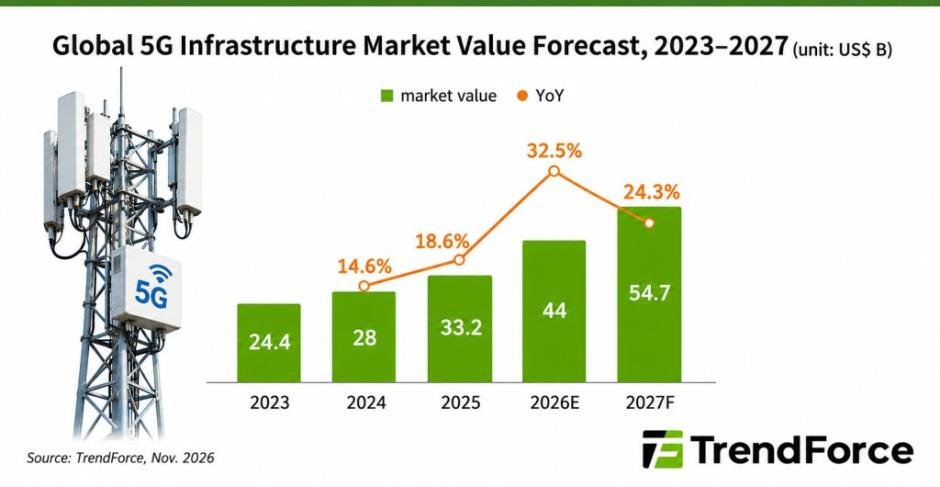
TrendForce forecasts that the global 5G infrastructure market will reach $55 billion in 2027, representing 24.3 percent year-on-year growth, supported by expanding 5G applications, subscriber adoption and fixed wireless access demand.
The commercial significance of the SpaceX–Qualcomm agreement lies in its combination of standardized radio hardware, pre-integrated software, open interfaces, large-scale tower access and satellite connectivity.
The decisive financial question is how much SpaceX can reduce the total cost per operational 5G site, including equipment, integration, power, installation, transport connectivity and recurring leasing expenses.
Qualcomm’s technology could reduce several of these costs, but the companies have not yet disclosed a quantified savings target or a network-wide capital expenditure forecast.
The initial deployment beginning in 2027 will provide the first meaningful evidence of whether SpaceX can translate its Open RAN architecture into lower network construction costs at nationwide scale.
BABURAJAN KIZHAKEDATH