Malaysia’s smartphone market recorded a major shift in vendor rankings during the third quarter of 2026, with Xiaomi securing the top position with a 21 percent market share, followed by HONOR at 18 percent and Samsung at 16 percent. Apple and vivo each captured 11 percent of shipments, as rising memory costs and smartphone price increases affected sales across Southeast Asia.
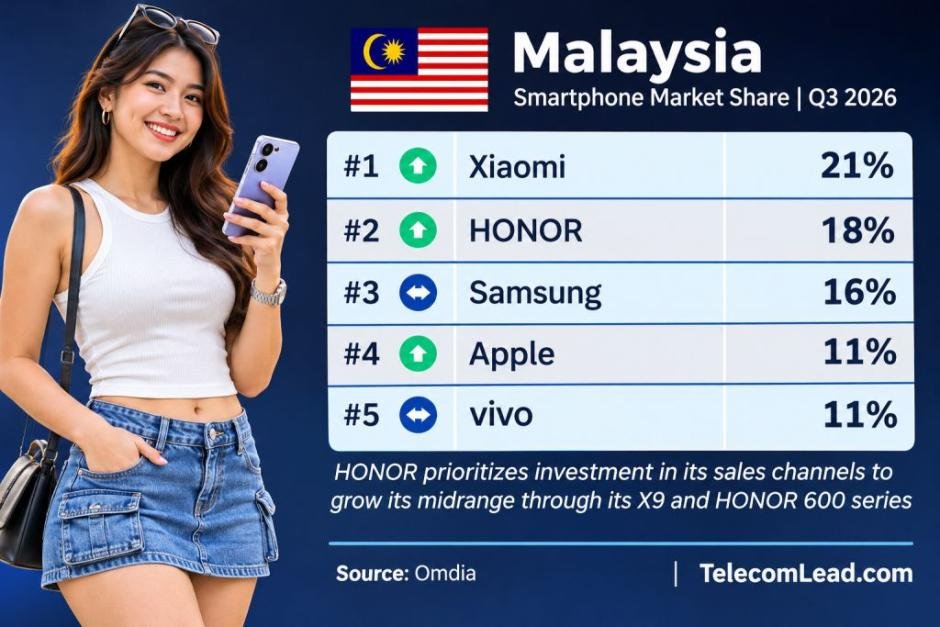
According to Omdia smartphone market research, Malaysia’s smartphone shipments declined by more than 30 percent year-on-year in Q3 2026, reflecting the wider slowdown across Southeast Asia, where shipments plunged 36 percent to 16.5 million units.
Despite the sharp decline in shipment volumes, Southeast Asia’s smartphone market value decreased only 1 percent, while average selling prices (ASPs) increased 53 percent. The figures indicate a significant shift toward higher-priced smartphones as manufacturers reduce their exposure to entry-level devices.
Xiaomi’s leadership, HONOR’s rise to second position and Samsung’s third-place ranking demonstrate how smartphone vendors are competing for market share in Malaysia.
Xiaomi Leads Malaysia Smartphone Market With 21% Share
Xiaomi emerged as Malaysia’s largest smartphone vendor in Q3 2026, capturing 21 percent of total shipments.
The company outperformed HONOR, Samsung, Apple and vivo despite facing a 24 percent year-on-year shipment decline across Southeast Asia.
Xiaomi’s regional retail ASP increased 55 percent, indicating a shift in pricing and product mix as the company responded to higher memory and component costs.
The company’s performance varied significantly between Southeast Asian markets. Xiaomi recorded 50 percent shipment growth in Vietnam, securing the leading position there for the first time with a 27 percent market share.
In Malaysia, Xiaomi’s 21 percent share placed it three percentage points ahead of HONOR and five percentage points ahead of Samsung.
Although Xiaomi led the Malaysian market, its year-on-year shipment growth rate in the country was not disclosed in the supplied Omdia figures.
HONOR Overtakes Samsung to Become Malaysia’s Second-Largest Smartphone Vendor
HONOR secured second position in Malaysia with an 18 percent smartphone market share in Q3 2026, overtaking Samsung and marking its first appearance in the country’s second-place ranking by shipments.
HONOR also reached third position in Singapore for the first time, demonstrating its growing presence in Southeast Asia’s more developed smartphone markets.
The company’s strategy focuses on premium mid-range smartphones rather than entry-level devices priced below $200, where higher memory costs have created significant pricing pressure.
HONOR has also strengthened its telecommunications operator distribution channels, helping the company expand smartphone sales through operator partnerships.
In Malaysia, HONOR’s 18 percent share placed it two percentage points ahead of Samsung and seven percentage points ahead of Apple.
Its improved ranking suggests that premium mid-range smartphones and operator-led distribution are becoming increasingly important competitive factors in Malaysia.
However, Omdia did not disclose HONOR’s Malaysian shipment volume or year-on-year growth rate in the figures provided.
Samsung Slips to Third Position in Malaysia With 16% Market Share
Samsung ranked third in Malaysia’s smartphone market with a 16 percent share during Q3 2026, behind Xiaomi and HONOR.
The company’s performance in Malaysia contrasts with its leadership across Southeast Asia, where Samsung remained the largest smartphone manufacturer by shipments.
Samsung shipped 3.7 million smartphones across Southeast Asia during the quarter, representing a 20 percent year-on-year decline.
Memory supply constraints and Samsung’s greater emphasis on premium foldable smartphones affected its regional shipment volumes.
However, Samsung’s Galaxy Z8 series outperformed its predecessor, supported by more than 40 percent growth in book-style foldable shipments following the introduction of the Galaxy Z Fold8.
Samsung’s 16 percent share in Malaysia indicates that the company faces stronger competition from Xiaomi and HONOR than its regional leadership position might suggest.
The company remains a major player in premium smartphones, but the Malaysian rankings show that its competitors have secured larger shares of overall shipments.
Apple Captures 11% Share in Malaysia as Regional Shipments Grow 4%
Apple ranked fourth in Malaysia’s smartphone market with an 11 percent shipment share in Q3 2026, matching vivo’s market share.
Unlike most major smartphone vendors, Apple achieved positive shipment growth across Southeast Asia.
Apple’s regional smartphone shipments increased 4 percent year-on-year, making it the only top-five vendor to record growth during the quarter.
Stronger smartphone sales in Malaysia and Vietnam contributed to Apple’s regional performance.
Apple’s premium-focused smartphone portfolio helped limit its exposure to memory cost pressures affecting manufacturers heavily dependent on smartphones priced below $200.
Consumer financing options, including installment payments and buy now, pay later services such as SPayLater, also supported purchases of higher-priced smartphones.
Apple’s regional shipment growth demonstrates the relative resilience of premium smartphones despite the overall 36 percent contraction in Southeast Asian shipments.
vivo Holds 11% Malaysia Smartphone Market Share as Regional Shipments Decline
vivo secured fifth position in Malaysia with an 11 percent smartphone market share, matching Apple.
However, vivo faced significant shipment pressure across Southeast Asia during 2026.
According to Omdia, vivo’s regional smartphone shipments declined 33 percent during the first nine months of 2026, while its ASP increased 37 percent.
The company’s shift away from smartphones priced below $100 contributed to the decline in shipment volumes and increase in average selling prices.
Rising memory costs have made ultra-low-cost smartphones increasingly difficult to manufacture and sell profitably.
vivo’s Malaysian market share indicates that it remains among the country’s five largest smartphone vendors, although the available figures do not establish whether its local shipments increased or declined year-on-year.
The five leading smartphone vendors accounted for 77 percent of Malaysia’s smartphone shipments in Q3 2026.
Xiaomi, HONOR and Samsung together controlled 55 percent of the market, while Apple and vivo accounted for a combined 22 percent.
Southeast Asia Smartphone Vendor Performance: Samsung Leads, OPPO Drops 62%
Malaysia’s smartphone market developments occurred against a sharp contraction in Southeast Asia’s overall smartphone shipments.
Samsung retained regional leadership despite declining shipments, while Xiaomi, TRANSSION and OPPO recorded steeper contractions.
| Smartphone vendor | Regional shipment change | Key performance indicator |
| Samsung | −20% | 3.7 million shipments |
| Xiaomi | −24% | Retail ASP +55% |
| TRANSSION | −42% | 16% regional market share |
| OPPO, including realme | −62% | 2.2 million shipments |
| Apple | +4% | Only top-five vendor with growth |
| vivo | −33% YTD | ASP +37% YTD |
Source: Omdia. Changes refer to Q3 2026 year-on-year unless marked YTD, which refers to the first nine months of 2026.
OPPO experienced the steepest shipment decline among the leading regional smartphone vendors, with volumes falling 62 percent to 2.2 million units.
The company reduced its presence in smartphones priced below $100 as rising memory costs weakened entry-level product economics.
OPPO’s A6c 4G starts at approximately $140 in most Southeast Asian markets, while shipments of its smartphones priced above $400 increased more than 50 percent, supported by the Reno 16 series.
TRANSSION recorded a 42 percent regional shipment decline but retained a 16 percent market share. The company is simplifying its smartphone portfolio and reducing the number of new variants to manage component costs.
These developments show that vendors dependent on affordable smartphones are experiencing greater shipment pressure than premium-focused competitors.
Memory Shortages Push Smartphone Prices Higher Across Malaysia and Southeast Asia
Memory supply shortages and higher component prices affected smartphone manufacturers across Southeast Asia during Q3 2026.
The region’s smartphone ASP increased 53 percent, even as shipments declined 36 percent and market value fell only 1 percent.
Omdia Senior Analyst Sheng Win Chow indicated that smartphone manufacturers can continue supplying devices across most price segments above $100, but maintaining previous RAM and storage specifications at unchanged prices has become increasingly difficult.
Manufacturers are responding by increasing prices, reducing specifications, simplifying product portfolios and withdrawing from unprofitable entry-level segments.
OPPO and vivo have reduced their exposure to smartphones priced below $100, while TRANSSION is limiting product variants.
Samsung, Apple and HONOR have greater exposure to premium and mid-range devices, where higher selling prices can provide more flexibility to absorb component cost increases.
Xiaomi’s 55 percent regional ASP increase also reflects the changing pricing environment.
Malaysia Smartphone Market Declines While Vietnam Records 1% Growth
Malaysia was among four major Southeast Asian smartphone markets that recorded shipment declines exceeding 30 percent in Q3 2026.
Indonesia, the Philippines and Thailand also experienced declines of more than 30 percent.
Vietnam was the only market to record growth, with smartphone shipments increasing 1 percent year-on-year.
Xiaomi led Vietnam with a 27 percent market share and 50 percent shipment growth, while Samsung also captured 27 percent. Apple ranked third with 19 percent, followed by OPPO at 16 percent and vivo at 6 percent.
The differences between Malaysia and Vietnam demonstrate that smartphone vendor performance varies substantially across individual Southeast Asian markets.
Xiaomi leads both markets, but HONOR’s second-place position in Malaysia contrasts with Samsung’s stronger ranking in Vietnam.
Apple also maintained a significant presence in both countries, supported by demand for premium smartphones.
Malaysia Smartphone Market Outlook: Xiaomi, HONOR and Samsung Face Intensifying Competition
Malaysia’s Q3 2026 smartphone rankings highlight the changing competitive positions of major manufacturers.
Xiaomi leads with a 21 percent share, while HONOR has strengthened its position to 18 percent, overtaking Samsung at 16 percent. Apple and vivo remain important competitors, each holding 11 percent.
At the regional level, Samsung continues to lead shipments despite a 20 percent decline, while Apple has achieved 4 percent growth. Xiaomi, TRANSSION, OPPO and vivo face greater pressure from declining volumes and rising component costs.
The 53 percent increase in Southeast Asia’s smartphone ASP indicates that vendors are increasingly prioritizing higher-priced devices over ultra-low-cost smartphones.
For Xiaomi, maintaining its leadership in Malaysia will depend on defending its position against HONOR’s growing premium mid-range presence and Samsung’s established product portfolio.
HONOR’s rise to second position represents one of the most significant changes in Malaysia’s smartphone vendor rankings, while Apple’s regional growth highlights the continued strength of premium devices.
With Malaysia’s smartphone shipments declining more than 30 percent, competition among Xiaomi, HONOR, Samsung, Apple and vivo will increasingly depend on product pricing, memory availability, portfolio positioning and distribution strength.
FASNA SHABEER