
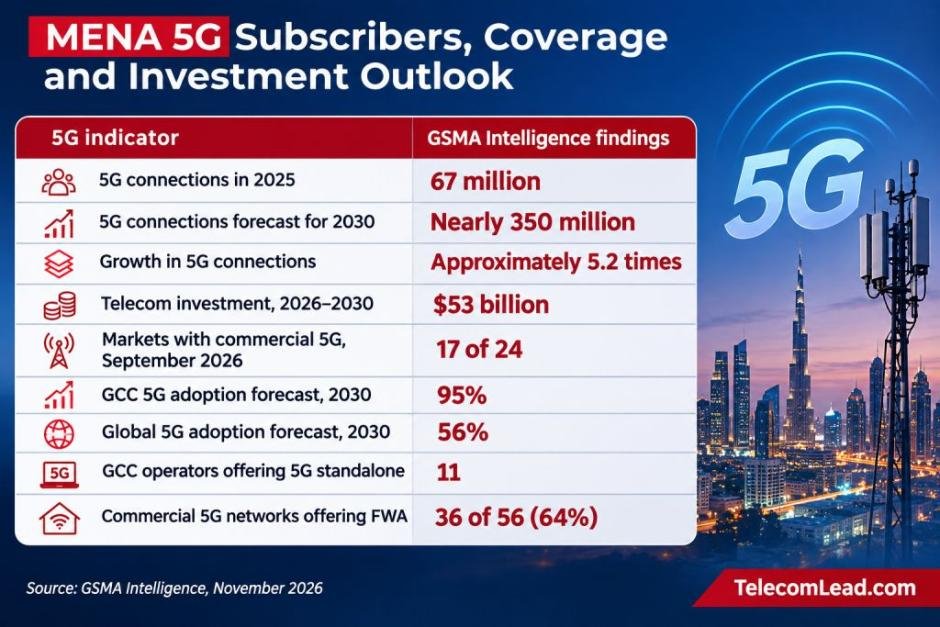
Telecom operators in the Middle East and North Africa (MENA) are expected to invest $53 billion between 2026 and 2030 in 5G network expansion, standalone 5G infrastructure and 5G-Advanced technology, as regional 5G connections are forecast to increase from 67 million in 2025 to nearly 350 million by 2030, according to a November 2026 report from GSMA Intelligence.
GSMA’s report on 5G Monetisation in MENA highlights the growing challenge facing telecom operators including STC, e&, Du, Ooredoo, Zain and Turkcell: converting substantial network investments and rising 5G adoption into sustainable revenue and higher average revenue per user (ARPU).
Despite significant capital expenditure on spectrum, coverage and network modernisation, mobile ARPU across MENA has remained broadly flat since the first commercial 5G launches in 2019.
GCC 5G Adoption to Reach 95% by 2030
The Gulf Cooperation Council (GCC) markets, comprising Saudi Arabia, the UAE, Qatar, Kuwait, Bahrain and Oman, lead MENA in 5G deployment, coverage and commercial adoption.
GSMA Intelligence forecasts average 5G adoption across the GCC will reach 95 percent by 2030, significantly higher than the global average of 56 percent.
Kuwait, the UAE and Qatar occupy the first three positions, respectively, among 46 countries assessed in the GSMA 5G Connectivity Index.
By September 2026, 11 operators across the six GCC markets were offering commercial 5G standalone services. These networks support advanced commercial applications including network slicing, private 5G, enterprise connectivity and differentiated service quality.
Commercial 5G services were available in 17 of MENA’s 24 markets by September 2026. However, coverage and adoption remain uneven, with North African markets generally at an earlier deployment stage than GCC countries.
Türkiye launched commercial 5G in April 2026. At launch, Turkcell reported that approximately 30 percent of devices on its network were 5G-compatible, illustrating the importance of handset availability in expanding the addressable subscriber base.
$53 Billion Investment to Support 5G Coverage and Network Upgrades
Telecom operators across MENA are expected to invest another $53 billion during 2026–2030 to expand 5G coverage, deploy standalone cores, introduce 5G-Advanced capabilities and reduce dependence on legacy 4G infrastructure.
The investment programme follows several years of substantial spending on spectrum acquisition and radio access networks.
Türkiye’s 2025 spectrum auction raised more than $3 billion, demonstrating the scale of capital commitments associated with the region’s next phase of 5G development.
The investment challenge is particularly significant because operators must finance network upgrades while revenue growth and ARPU remain relatively subdued.
GSMA Intelligence identifies the transition from non-standalone 5G to standalone architecture as a major requirement for generating additional revenue from network slicing, private wireless networks, industrial connectivity and managed enterprise services.
5G Fixed Wireless Access Becomes Major Revenue Opportunity
Fixed wireless access (FWA) is emerging as one of the strongest 5G monetisation opportunities for MENA telecom operators.
By September 2026, 36 of the region’s 56 commercial 5G networks, representing 64 percent, offered FWA services.
Saudi Arabia is among the region’s leading FWA markets, with fixed wireless accounting for approximately 20 percent of broadband connections.
STC offers 5G home broadband packages with speeds of up to 1,000 Mbps, targeting households and businesses seeking alternatives to fibre and copper connections.
In the UAE, Du reported 18 percent year-on-year growth in its FWA business and aims to capture 40 percent of the broadband market by 2027.
FWA allows operators to generate additional broadband revenue from existing 5G network infrastructure, particularly in locations where fibre deployment is expensive or unavailable.
Private 5G Investments Expand Enterprise Revenue Opportunities
Enterprise 5G is becoming an important component of operator monetisation strategies, particularly in energy, manufacturing, logistics and industrial automation.
In the UAE, ADNOC partnered with e& in 2024 to develop a private 5G network covering approximately 11,000 square kilometres across its onshore and offshore operations.
The network is designed to connect sensors across more than 12,000 wells and pipelines, supporting industrial monitoring and AI-enabled operations.
In Morocco, Inwi, China Mobile and Huawei announced the country’s first private industrial 5G network in April 2026, covering a 52-hectare manufacturing facility at the Nador West Med industrial hub.
These projects demonstrate the scale of industrial coverage that private 5G can support. However, GSMA Intelligence notes that most operators do not disclose private 5G revenue separately, making it difficult to quantify the commercial returns.
5G Monetisation Remains Challenging Despite Subscriber Growth
The expected increase to nearly 350 million 5G connections by 2030 will substantially expand the addressable market for premium mobile and enterprise services.
However, GSMA Intelligence finds that increasing 5G subscriptions has not automatically translated into higher ARPU.
Traditional data-volume pricing remains dominant, while unlimited plans and competitive tariffs restrict the ability to charge additional premiums for 5G connectivity.
In the GCC, average monthly mobile data consumption reached 30 GB per active connection in 2025, compared with 13.5 GB globally, and is forecast to reach 54 GB by 2030.
The report identifies differentiated broadband, content bundles, guaranteed network performance and enterprise services as alternatives to charging customers solely for 5G access.
Operators are also experimenting with speed-based tariffs, gaming packages and network slicing to generate additional revenue from existing subscribers.
MENA Operators Focus on Returns from 5G Investment
GSMA Intelligence expects the next phase of 5G monetisation to depend on the commercial use of network infrastructure rather than subscriber growth alone.
The GCC is positioned to lead this transition because of its extensive 5G coverage, projected 95 percent adoption rate and expanding standalone network infrastructure.
For STC, e&, Du, Ooredoo, Zain and other regional operators, the main opportunities include expanding FWA subscriptions, securing private 5G contracts and selling differentiated network services.
The central challenge remains generating sufficient additional revenue from these services to support the region’s projected $53 billion investment programme through 2030.
BABURAJAN KIZHAKEDATH

