
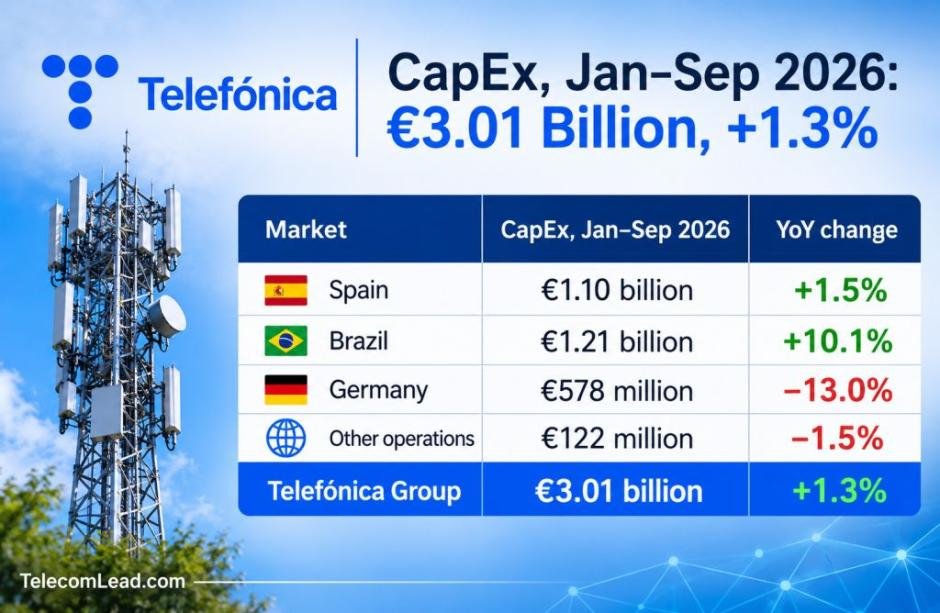
Telefonica reported 4.8 percent revenue growth to €8.43 billion in the third quarter of 2026, supported by its operations in Spain and Brazil, expansion of fiber and 5G networks, and growing demand for enterprise digital services. The Spanish telecom group invested €3.01 billion in capital expenditure during the first nine months of 2026, while its global subscriber base increased 5.2 percent to 302.1 million.
Telefonica’s Q3 2026 financial results highlight its strategy of expanding high-value mobile and broadband services, increasing network automation, deploying artificial intelligence and improving customer revenue through its Transform & Grow program.
The company has accelerated investment in 5G standalone networks, fiber broadband infrastructure, enterprise cybersecurity, sovereign cloud and AI-enabled network operations.
Telefonica Revenue Reaches €24.83 Billion in Nine Months
Telefonica generated revenue of €24.83 billion during January–September 2026, representing reported growth of 2.8 percent compared with the corresponding period in 2025.
Third-quarter revenue increased 4.8 percent to €8.43 billion, including constant-currency growth of 2.2 percent.
Service revenue increased 1.8 percent in the third quarter on a constant basis, while handset revenue rose 7.4 percent.
Consumer business revenue reached €4.99 billion, accounting for 59 percent of group revenue, and increased 3.9 percent year over year in constant terms.
Enterprise B2B revenue reached €2 billion, representing 24 percent of group revenue, and increased 5.6 percent on a constant basis.
Digital services accounted for 49 percent of Telefonica’s B2B revenue, reflecting the growing contribution from enterprise cloud, cybersecurity, connectivity and digital transformation solutions.
Telefonica revised its 2026 revenue growth guidance to 1–1.5 percent from the earlier target of 1.5–2.5 percent, while introducing a service revenue growth target of approximately 1.5 percent.
The company continues to target annual revenue growth of 1.5–2.5 percent during 2025–2028, accelerating to 2.5–3.5 percent during 2028–2030.
Telefonica CapEx Reaches €3.01 Billion, With Investment in 5G and Fiber
Telefonica’s capital expenditure reached €3.01 billion during the first nine months of 2026, increasing 1.3 percent year over year in reported terms.
Third-quarter CapEx reached €1.10 billion, representing growth of 1.1 percent.
The company reported a Capex-to-revenue ratio of approximately 12 percent during January–September 2026 on a constant basis and expects to maintain this investment intensity through 2028.
Brazil accounted for the largest share of group network investment, with expenditure directed primarily toward 5G coverage and fiber broadband expansion.
In Spain, capital expenditure supported XGS-PON fiber infrastructure and 5G+ network development.
Germany reduced Capex while continuing mobile network expansion and modernization.
Telefonica Fiber Network Reaches 77.6 Million Premises
Telefonica expanded its fiber-to-the-home infrastructure to 77.6 million premises passed by September 2026, representing 7 percent annual growth.
The company’s ultrabroadband network footprint reached 164.1 million premises passed, increasing 1 percent year over year.
Fiber infrastructure companies contributed 22.4 million FTTH premises passed, an increase of 5 percent.
The group’s connected FTTH access base reached 14.51 million, growing 7.9 percent compared with September 2025.
Telefonica is also preparing its fiber infrastructure for XGS-PON technology, which supports higher broadband speeds and increased network capacity.
In Brazil, Vivo expanded its FTTH footprint to 32.4 million premises passed, adding 1.9 million premises over the previous year.
Vivo’s connected fiber customer base increased 10.8 percent to 8.4 million, while fiber penetration reached 26 percent.
In Spain, fixed broadband accesses increased 2.2 percent year over year, including 46,000 net additions during the third quarter.
Germany recorded 13,000 fixed broadband net additions during the quarter, marking its fifth consecutive quarter of broadband subscriber growth.
Telefonica 5G Coverage Reaches 99% in Germany and 96% in Spain
Telefonica continued expanding 5G network coverage across its principal European and Latin American markets.
Telefonica 5G Coverage — September 2026
Germany
99%
Spain
96%
United Kingdom
88%
Brazil
73%
Source: Telefonica Q3 2026 results. Coverage figures reflect the company’s reported market footprints.
Telefonica reported average 5G coverage of 83 percent across its core markets, an increase of five percentage points year over year.
The company stated that 5G standalone coverage now matches its entire 5G footprint in Spain, Brazil and Germany.
In the United Kingdom, Virgin Media O2 reported 86 percent population coverage for 5G standalone services.
Brazil’s Vivo expanded 5G availability to 1,012 municipalities, with 29 million accesses using 5G services.
Vivo also reached an agreement with Starlink Mobile to expand mobile connectivity toward nearly 100 percent geographic coverage of Brazil.
Telefonica Subscribers Increase to 302.1 Million
Telefonica’s total access base increased 5.2 percent year over year to 302.1 million as of September 2026.
The group reported 104.78 million mobile contract accesses, increasing 0.2 percent, and 22.79 million wholesale accesses, representing growth of 3.6 percent.
Subscriber performance differed across the group’s principal markets.
Spain: ARPU Reaches €90.4 as Churn Falls to 0.7%
Telefonica España reported 134,000 mobile contract net additions during the third quarter.
Its fixed broadband business added 46,000 connections, while convergent services gained 20,000 customers.
Convergent ARPU increased 1.2 percent to €90.4.
Convergent customer churn declined to 0.7 percent, improving by 0.1 percentage points year over year.
The company attributed its customer performance to converged mobile, fiber, television and digital services.
Brazil: Vivo Adds 900,000 Contract Customers
Telefonica Brasil added approximately 900,000 mobile contract subscribers during the third quarter, its highest quarterly contract net additions in 11 quarters.
The company added 2.5 million contract customers during the first nine months of 2026.
Its contract subscriber base increased 6 percent year over year.
Mobile contract churn declined to 1 percent, improving by 0.1 percentage points.
Mobile ARPU increased 3.3 percent compared with the third quarter of 2025.
Vivo Total, its converged fiber and mobile offering, reached 4 million customers, increasing 28 percent year over year.
The converged service generated customer ARPU of €39 during January–September 2026, representing growth of 8.2 percent.
Germany: O2 Contract Subscribers Reach 18.1 Million
Telefonica Deutschland reported 18.1 million mobile contract customers, excluding third-party mobile network operator accesses, an increase of 2 percent.
The company added 49,000 contract subscribers during the third quarter, compared with 30,000 in the preceding quarter.
O2 contract churn stood at 1.1 percent, increasing 0.1 percentage points year over year.
Mobile contract ARPU declined 3.1 percent, while fixed broadband ARPU increased 1.8 percent.
Telefonica Deutschland is shifting its commercial strategy toward higher-value customers through O2 Mobile Plus bundles, which carry a minimum bundle price of €30.
Telefonica Spain Revenue Rises 2.6%, Brazil Grows 7.2%
Telefonica’s regional revenue performance showed continued growth in Spain and Brazil, offsetting weakness in Germany.
| Market | Q3 2026 revenue | Reported YoY growth |
| Spain | €3.32 billion | +2.6% |
| Brazil | €2.71 billion | +15.4% |
| Germany | €1.90 billion | −2.9% |
| Group | €8.43 billion | +4.8% |
Spain’s service revenue increased 2.6 percent during the quarter, supported by higher mobile and broadband accesses, customer ARPU and enterprise digital services.
Brazil’s revenue increased 7.2 percent in constant-currency terms, with mobile service revenue growing 7.4 percent and fixed business revenue rising 2.7 percent.
Vivo’s new digital businesses recorded 17.4 percent growth over the trailing 12 months and accounted for 12.5 percent of revenue during that period.
Germany’s revenue declined 2.9 percent, although fixed business revenue increased 5.7 percent, supported by improving customer value.
Telefonica Expands AI, Cloud and Autonomous Network Strategy
Artificial intelligence is becoming a central component of Telefonica’s network operations, customer services and enterprise digital business.
The company is developing AI-enabled network management through its Autonomous Network Journey program, targeting an average network autonomy level of 3.75 by 2028.
Telefonica has already deployed Level 4 autonomous network use cases across its operations.
In Spain, AI-based base station management adjusts network resources during periods of lower traffic.
In Germany, AI-driven mobile network operations have achieved Level 4 autonomy in selected processes.
In Brazil, automated network management predicts capacity constraints and provisions resources before customers experience service degradation.
Telefonica is also developing agentic AI environments, zero-trust security architectures and generative AI capabilities.
Its enterprise strategy includes sovereign cloud infrastructure, cybersecurity, edge computing and AI Gigafactory opportunities.
In Brazil, Vivo partnered with Palo Alto Networks to introduce an agentic Security Operations Center that integrates AI agents into threat detection, prevention and response.
Telefonica is restructuring its Spanish operations into three business units — B2B, B2C and Wholesale — to simplify management and expand digital services.
Virgin Media O2 Adjusts Fiber Investment and 5G Strategy
Telefonica’s UK joint venture, Virgin Media O2, is changing its network investment strategy to prioritize capital efficiency and customer retention.
The operator reported 18.8 million ultrabroadband premises passed and 86 percent population coverage for 5G standalone.
Virgin Media O2 plans to halt further fiber upgrades beyond existing commitments while introducing a lower-cost upgrade designed to deliver 2 Gbps broadband speeds to most of its hybrid fiber-coaxial network during 2027.
The operator recorded a net loss of 27,000 mobile contract customers during the third quarter, compared with a loss of 63,000 in the previous quarter.
Mobile contract ARPU increased 2 percent year over year.
Fixed broadband connections declined by 29,000 during the quarter, while consumer fixed ARPU fell 5 percent.
Virgin Media O2’s wholesale customer base reached 10.5 million, compared with 10.2 million a year earlier.
The company also introduced an AI voice agent for selected broadband fault enquiries as part of its digital customer service transformation.
Telefonica Strategy Targets 5G, Fiber, AI and Higher-Value Customers
Telefonica’s Transform & Grow strategy is centered on network modernization, fiber broadband adoption, 5G standalone expansion and higher-value consumer and enterprise services.
The company is prioritizing four core markets — Spain, Brazil, Germany and the United Kingdom — while simplifying its international operating structure.
Its investment strategy targets a CapEx-to-revenue ratio of approximately 12 percent through 2028, alongside increased use of AI and automation to improve network efficiency.
Spain is focusing on fiber broadband, 5G+ and convergent customer revenue. Brazil is investing in 5G coverage, FTTH expansion and enterprise digital services. Germany is emphasizing customer value, mobile network modernization and cost-efficient expansion. Virgin Media O2 is adjusting its broadband investment strategy while extending 5G standalone coverage.
With 302.1 million accesses, 77.6 million FTTH premises passed and 83 percent average 5G coverage across its core markets, Telefonica is positioning its connectivity infrastructure to support revenue growth from mobile, broadband, cybersecurity, cloud and AI services.
BABURAJAN KIZHAKEDATH


