
SpaceX’s Starlink is expanding its presence in the US broadband market, competing with cable operators Comcast and Charter Communications, DSL providers including AT&T and regional telephone companies, and 5G fixed wireless access (FWA) services from T-Mobile, Verizon and AT&T.
According to Ookla Speedtest data covering Q4 2025 through Q3 2026, approximately 90 percent of new US Starlink customers switched from non-fiber broadband connections, including cable, DSL and FWA.
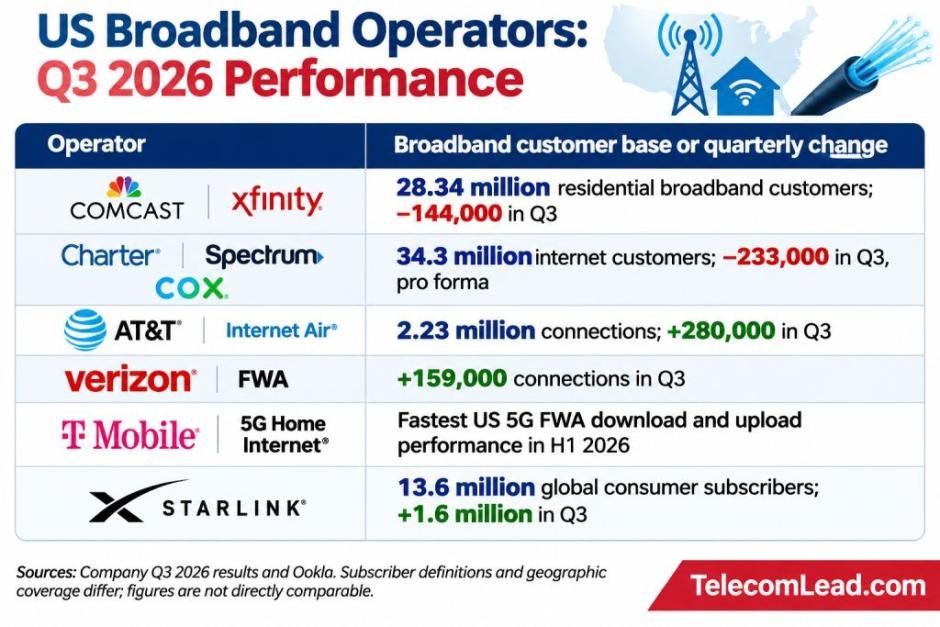
Starlink’s global consumer subscriber base reached 13.6 million in Q3 2026, an increase of 1.6 million from the previous quarter. Its US median download speed increased 12 percent to 119.71 Mbps in H1 2026, while median upload speed jumped 42 percent to 20.73 Mbps, Ookla’s analysis of Speedtest data indicated.
However, Starlink’s download speed remained below those of all three major US 5G FWA providers, highlighting the competitive challenge facing satellite broadband.
Comcast Xfinity Loses 144,000 Broadband Customers in Q3 2026
Comcast, one of the largest cable broadband providers in the United States, lost 144,000 domestic residential broadband customers during Q3 2026, compared with a loss of 91,000 in the corresponding quarter of 2025.
According to Comcast’s Q3 2026 financial results, its domestic residential broadband subscriber base declined to 28.34 million from 28.90 million a year earlier.
Comcast’s residential connectivity and platforms revenue declined 3.5 percent year-over-year to $17.02 billion. The company attributed pressure on domestic broadband revenue to lower average rates and customer losses.
Comcast is responding to competition from fiber broadband providers, 5G FWA operators and alternative internet services through pricing changes and bundled connectivity offerings.
Starlink’s expansion adds another competitive option for households dissatisfied with traditional cable broadband, although Ookla’s switching data does not establish how many former Comcast customers moved specifically to Starlink.
Charter Spectrum and Cox Lose 233,000 Internet Customers
Charter Communications, which operates the Spectrum broadband brand and acquired Cox Communications in August 2026, reported a combined pro forma loss of 233,000 internet customers during Q3 2026.
Legacy Charter lost 156,000 internet customers, while legacy Cox lost 77,000.
According to Charter’s Q3 2026 earnings filing, the combined business served 34.3 million internet customers at September 30, 2026.
Charter’s revenue declined 1.5 percent to $16.5 billion, while quarterly capital expenditure decreased to $3.2 billion from $3.6 billion a year earlier. The company also expanded Spectrum pricing and products across the legacy Cox footprint, covering more than 11 million homes and businesses.
The decline in cable broadband subscribers reflects growing competition from fiber and wireless broadband alternatives. Starlink is participating in this competitive market, particularly where customers have limited high-speed terrestrial broadband choices.
AT&T, CenturyLink and Other DSL Providers Face Technology Migration
Traditional DSL broadband providers in the United States include AT&T, CenturyLink, Frontier’s legacy networks and smaller regional telephone operators.
DSL services use copper telephone infrastructure and generally face speed and upload-capacity disadvantages compared with modern fiber broadband networks.
The FCC broadband deployment assessment identifies AT&T, CenturyLink and Frontier as providers with significant copper-based broadband infrastructure alongside fiber networks.
AT&T is increasingly emphasizing fiber and 5G FWA rather than legacy copper broadband.
During Q3 2026, AT&T added 442,000 fiber connections and 327,000 fixed wireless connections across consumer and business services.
Its fiber connection base reached 13.31 million, while fixed wireless connections totaled 2.94 million. AT&T plans to extend fiber coverage beyond 40 million locations by the end of 2026 and more than 60 million by the end of 2030.
According to AT&T’s third-quarter 2026 results, the operator invested $5.1 billion in capital expenditure during the quarter.
Starlink offers another migration option for DSL customers, especially in areas where fiber deployment remains limited and 5G FWA coverage or capacity is insufficient.
T-Mobile, Verizon and AT&T Expand 5G FWA Broadband
The three major US 5G FWA providers represent important competitors to Starlink’s satellite broadband service.
T-Mobile maintained its lead in US 5G FWA download and upload performance during H1 2026, according to Ookla data cited in the operator’s Q3 2026 earnings announcement. Its median FWA download speed was nearly twice Starlink’s 119.71 Mbps.
Verizon reported 159,000 FWA net additions in Q3 2026, alongside 155,000 fiber broadband net additions. Its total broadband net additions reached 314,000, according to Verizon’s Q3 2026 financial results.
AT&T Internet Air, the company’s consumer 5G FWA service, added 280,000 customers during Q3 2026, taking its connection base to 2.23 million, up 74.8 percent year-over-year.
Starlink Faces Competition From Cable, Fiber and 5G FWA
The US broadband market is experiencing two simultaneous trends: traditional cable providers are losing subscribers, while fiber and 5G FWA operators are expanding their customer bases.
Starlink is attracting users from the non-fiber segment, supported by promotional pricing, improved satellite capacity and broader geographic availability.
However, Ookla’s finding that approximately 90 percent of new Starlink customers previously used non-fiber connections should not be interpreted as evidence that 90 percent came from cable or DSL alone. The analysis includes FWA customers and does not provide an operator-level breakdown.
The latest quarterly results also do not establish that Comcast’s or Charter’s customer losses were directly caused by Starlink. Fiber expansion, 5G FWA competition, pricing and customer migration are additional factors.
The competitive challenge for Starlink is to sustain broadband performance as its subscriber base expands, while cable providers improve their networks and T-Mobile, Verizon and AT&T continue adding 5G FWA capacity.
BABURAJAN KIZHAKEDATH


