Charter Communications, the US telecom and broadband operator behind Spectrum, reported a 1.5 percent decline in revenue to $16.5 billion in the third quarter of 2026, as fiber broadband competition, fixed wireless expansion and continued Internet subscriber losses affected its business.
Charter Communications Q3 2026 results indicated that capital expenditure declined 11.2 percent to $3.2 billion, while its Internet subscriber base fell 2.5 percent to 34.3 million. In contrast, Spectrum Mobile connections increased 15 percent to 13.5 million, supported by continued adoption of bundled mobile and broadband services.
The company is restructuring its operating model to strengthen broadband customer acquisition, improve network reliability and accelerate network upgrades following its acquisition of Cox Communications.
Charter completed its Cox and Liberty Broadband transactions on August 19, 2026. The company is reporting pro forma results to provide comparable performance figures for the combined operations.
Charter Capex Declines 11.2 Percent to $3.2 Billion
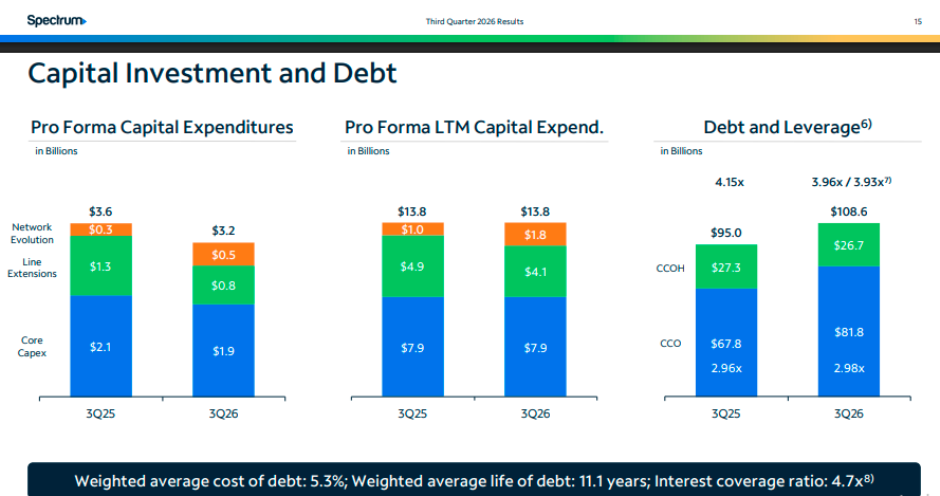
Charter Communications’ capital expenditure declined to $3.2 billion in Q3 2026, compared with $3.6 billion in the corresponding quarter of 2025.
Core capital expenditure decreased to $1.9 billion from $2.1 billion, while investment in network line extensions declined to $800 million from $1.3 billion.
However, spending on network evolution increased to $500 million from $300 million, reflecting continued investment in network upgrades.
For the trailing 12 months, Charter reported capital expenditure of $13.8 billion, unchanged from the previous comparable period.
The composition of annual investment shifted significantly. Network evolution capex increased to $1.8 billion from $1 billion, while line-extension expenditure declined to $4.1 billion from $4.9 billion.
Core capital expenditure remained at $7.9 billion.
The figures indicate that Charter is directing a larger proportion of investment toward upgrading existing infrastructure rather than expanding network reach through new line extensions.
Spectrum Broadband Subscribers Decline to 34.3 Million
Spectrum’s Internet subscriber base declined to 34.3 million in Q3 2026, compared with 35.2 million in Q3 2025, representing a 2.5 percent annual reduction.
The combined Charter and Cox operations lost 233,000 Internet subscribers during the quarter, compared with a loss of 171,000 in Q3 2025.
Broadband subscriber losses were particularly significant during Q2 2026, when the combined company lost 275,000 Internet customers.
Legacy Charter reported 29.2 million Internet subscribers, down 1.9 percent from 29.8 million a year earlier.
Legacy Charter lost 156,000 Internet subscribers in Q3 2026, compared with a loss of 109,000 in Q3 2025.
Legacy Cox reported approximately 5.1 million residential Internet subscribers, down 6.1 percent from 5.4 million a year earlier.
Cox lost 77,000 Internet subscribers during Q3 2026, compared with a loss of 62,000 in the corresponding quarter of 2025.
The larger percentage decline at Cox highlights the competitive challenges facing Charter’s newly expanded broadband business.
Charter Faces Fiber and Fixed Wireless Broadband Competition
Charter identified fiber broadband and fixed wireless access competition as major factors affecting its Internet customer performance.
The company highlighted weaker housing-related customer activity, including fewer new homes and household moves, as additional challenges to broadband subscriber growth.
Fiber-to-the-home providers are competing with Charter’s existing broadband network, while wireless operators continue expanding fixed wireless broadband alternatives.
Charter is responding by strengthening its core Internet offering, improving customer acquisition and upgrading its broadband infrastructure.
The operator has introduced a new operating model focused on returning to Internet subscriber growth and improving operational efficiency.
Charter is also targeting $2 billion in annualized operating expense savings over the next 18 months, in addition to more than $1 billion in previously announced Cox transaction synergies.
These changes are intended to support a more competitive broadband offering across the expanded Spectrum footprint.
Spectrum Fiber-Powered Network Spans 1.3 Million Miles
Charter operates a fiber-powered gigabit broadband network spanning approximately 1.3 million miles across its service territory.
Following the Cox acquisition, Spectrum’s combined network covers approximately 70.7 million serviceable passings across 45 US states.
The company serves 36.7 million customer relationships across its combined operations.
Charter’s expanded geographic footprint includes markets such as Phoenix, Las Vegas, Virginia, Kansas, Oklahoma and Rhode Island.
The Cox acquisition also strengthens Charter’s service coverage in Los Angeles, San Diego, New Orleans and Florida.
Charter’s infrastructure includes more than 1,000 network hubs and data centers supporting its broadband and connectivity services.
The company is continuing network upgrades to meet demand for higher broadband speeds, improved reliability and lower latency.
The reported 1.3 million-mile network figure describes Charter’s fiber-powered infrastructure and should not be interpreted as a standalone fiber-to-the-home network measurement.
Spectrum Mobile Subscribers Increase 15 Percent to 13.5 Million
Spectrum Mobile reached 13.5 million mobile lines in Q3 2026, compared with 11.7 million a year earlier, representing 15 percent annual growth.
The combined company added 508,000 mobile lines during the quarter, compared with 514,000 in Q3 2025.
Legacy Charter reported approximately 13 million mobile lines, increasing 14 percent from 11.3 million a year earlier.
Legacy Charter added 440,000 mobile lines in Q3 2026, compared with 482,000 during the corresponding quarter of 2025.
Legacy Cox reported approximately 500,000 mobile lines, representing 48 percent annual growth.
Cox added 68,000 mobile lines during the quarter, compared with 32,000 in Q3 2025.
Mobile subscriber growth continues to contrast with Charter’s declining fixed broadband subscriber base.
The company is positioning mobile services as a central component of its converged broadband and wireless strategy.
Spectrum Network Coverage Includes 45 Million Wi-Fi Access Points
Charter operates approximately 45 million national wireless access points, supporting Spectrum Mobile’s Wi-Fi offloading strategy.
The company reported that 87 percent of Spectrum Mobile customer data traffic is offloaded onto Charter’s own network infrastructure.
This approach reduces reliance on cellular network capacity and supports the integration of fixed broadband and mobile services.
Charter also reported that approximately 19 million households use its Advanced WiFi and Invincible WiFi services with near-real-time network telemetry.
These capabilities allow Charter to monitor network performance and identify potential connectivity issues.
The operator’s converged network strategy combines its broadband infrastructure, Wi-Fi coverage and mobile services to improve the customer experience.
Charter Uses AI to Improve Network Reliability
Charter is incorporating artificial intelligence capabilities into its network management strategy following the Cox acquisition.
The company highlighted Cox Communications’ AI-based network reliability expertise as an important benefit of the transaction.
Charter plans to use these capabilities to improve service reliability across its expanded network footprint.
AI-enabled monitoring and near-real-time network telemetry are intended to support more proactive identification and management of connectivity problems.
The company’s network also supports increasing demand from AI-enabled devices, electric vehicles and connected equipment.
Charter reported average monthly household data consumption of approximately 875 GB among legacy Charter residential Internet customers without traditional video services.
The company expects increasing connectivity requirements from physical AI applications and connected devices to support demand for higher-capacity broadband infrastructure.
However, Charter did not disclose a separate AI investment budget, AI-related revenue or quantified network performance improvements attributable to AI deployment.
Spectrum Network Issues and Service Reliability
Charter identified customer experience, network reliability and competitive service quality as important priorities in its new operating model.
The company is focusing on improving Internet customer retention through stronger service offerings and network upgrades.
Its approximately 19 million Advanced WiFi and Invincible WiFi households provide a substantial base for network telemetry and connectivity monitoring.
The integration of Cox’s AI network reliability capabilities is expected to support service improvements across the combined network.
Spectrum 5G Strategy Focuses on Mobile and Wi-Fi Convergence
Spectrum Mobile’s continued subscriber growth reflects Charter’s strategy of combining mobile connectivity with its existing fixed broadband network.
The company reported 13.5 million mobile lines and approximately 45 million Wi-Fi access points across its national wireless network.
With 87 percent of Spectrum Mobile customer data traffic offloaded to Charter’s network, Wi-Fi remains a central element of its mobile connectivity strategy.
Charter Revenue Declines 1.5 Percent to $16.5 Billion
Charter reported pro forma revenue of $16.5 billion in Q3 2026, compared with $16.8 billion in Q3 2025.
Residential revenue declined 4.1 percent to $12.2 billion from $12.7 billion.
Commercial revenue remained approximately $2.7 billion, representing 0.3 percent annual growth.
Excluding advertising revenue and programmer application allocation, total revenue declined 1 percent year on year.
Residential revenue declined 2.6 percent after excluding programmer application allocation.
The revenue performance reflects continued pressure on Charter’s residential business, particularly from declining Internet subscribers.
The company reported trailing 12-month pro forma revenue of approximately $66.5 billion.
Charter ARPU and Customer Churn
The combined company lost 233,000 Internet subscribers during the quarter, while its overall customer relationships declined by 238,000.
Total customer relationships decreased 2.6 percent to 36.7 million from 37.7 million a year earlier.
Legacy Charter customer relationships declined 2 percent to 31.3 million, while legacy Cox residential customer relationships fell 5.9 percent to 5.4 million.
Charter’s new operating model prioritizes improved customer service and stronger Internet offerings to address these subscriber trends.
Charter’s Digital Strategy Supports Converged Connectivity
Charter is expanding digital connectivity services through its integrated Spectrum platform.
The company reported approximately 15 million devices streaming the Spectrum TV application monthly across legacy Charter operations.
Its Advanced WiFi and Invincible WiFi offerings support approximately 19 million households with near-real-time network telemetry.
Charter’s digital strategy increasingly combines fixed broadband, mobile connectivity, Wi-Fi and streaming services.
The company is also using AI-enabled network management capabilities to strengthen service reliability and improve operational efficiency.
Charter’s Broadband Recovery Depends on Network Upgrades and Subscriber Growth
Charter’s third-quarter performance highlights a widening difference between its broadband and mobile businesses.
The company lost 233,000 Internet subscribers while adding 508,000 mobile lines, demonstrating that wireless expansion is not yet reversing broadband customer losses.
Its decision to increase network evolution investment from $300 million to $500 million during the quarter indicates a stronger emphasis on improving existing network capabilities.
With approximately 70.7 million serviceable passings, 34.3 million Internet subscribers and 13.5 million mobile lines, Charter has a substantial network footprint from which to pursue customer growth.
BABURAJAN KIZHAKEDATH