
Singapore has emerged as the Asia-Pacific leader in Wi-Fi 6 and Wi-Fi 7 adoption, while India, Indonesia and the Philippines continue to face challenges related to outdated home routers, slower broadband connections and limited use of the 6 GHz spectrum band.
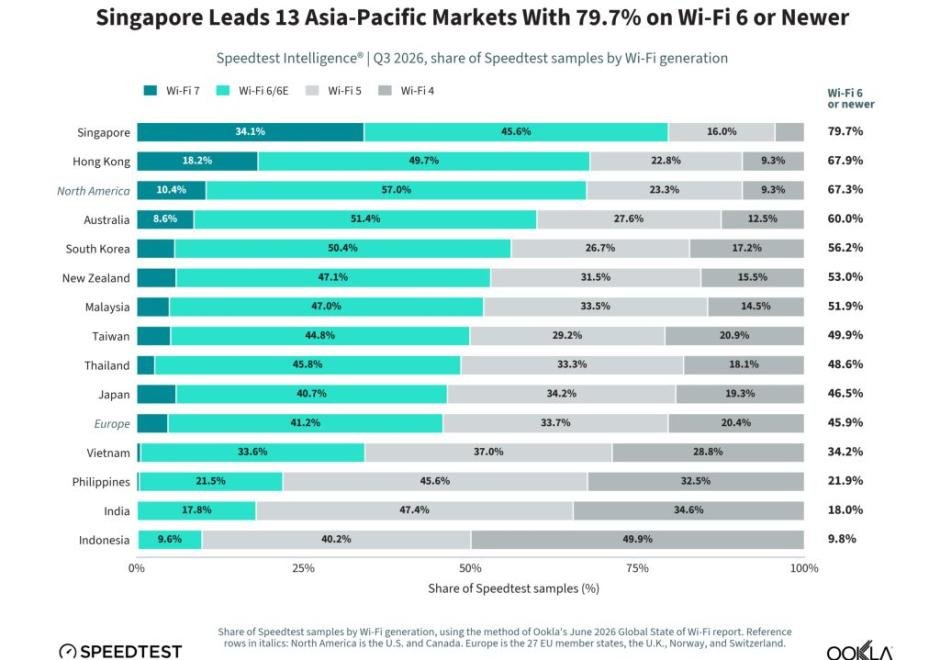
According to Ookla’s Speedtest Intelligence data for the third quarter of 2026, Singapore recorded 79.7 percent of Speedtest samples on Wi-Fi 6 or newer technologies, compared with 67.3 percent in North America, 45.9 percent in Europe and just 18 percent in India.
The study, covering 13 Asia-Pacific markets, highlights significant differences in broadband infrastructure, router modernization, spectrum availability and consumer adoption of next-generation wireless technologies.
Singapore Leads Wi-Fi 6 Adoption Across Asia-Pacific
Singapore topped the regional rankings with 79.7 percent of Speedtest samples using Wi-Fi 6 or newer technologies during Q3 2026. Hong Kong followed with 67.9 percent, while Australia recorded 60 percent.
South Korea, New Zealand and Malaysia also exceeded 50 percent adoption, with Malaysia reaching 51.9 percent.
Taiwan reported 49.9 percent, Thailand 48.6 percent and Japan 46.5 percent.
However, adoption remained considerably lower in the Philippines at 21.9 percent, India at 18 percent and Indonesia at 9.8 percent.
Indonesia continued to depend heavily on older wireless infrastructure, with 49.9 percent of Speedtest samples using Wi-Fi 4 technology.
Singapore’s leadership reflects investments in high-speed broadband networks and customer equipment upgrades.
In 2024, Singapore’s Infocomm Media Development Authority committed up to S$100 million, approximately $74 million, to support the introduction of 10 Gbps residential broadband services.
Telecom operators subsequently bundled Wi-Fi 7 routers with premium broadband packages, accelerating adoption of newer wireless technologies.
India Faces Router Upgrade Challenges Despite Wi-Fi 6 Smartphone Availability
India presents a significant opportunity for broadband operators and router manufacturers because many consumers already own smartphones supporting Wi-Fi 6 but continue connecting through older home networking equipment.
Ookla found that 72.7 percent of Wi-Fi 6-capable smartphones in India connected to Wi-Fi 5 or older home networks during Q3 2026.
The corresponding figure reached 79.9 percent in Indonesia and 54.4 percent in the Philippines.
Singapore reported just 9.7 percent, indicating a much stronger alignment between smartphone capabilities and home router infrastructure.
India’s relatively low adoption of Wi-Fi 6 also reflects limitations in broadband connection speeds.
The country’s median fixed broadband download speed stood at 63.96 Mbps in Q3 2026, compared with 52.62 Mbps in Indonesia and 476.02 Mbps in Singapore.
Even Wi-Fi 5 connections delivered median download speeds of only 92.19 Mbps in India and 95.88 Mbps in Indonesia.
These figures suggest that upgrading routers alone may not significantly improve customer experience unless telecom operators simultaneously increase broadband speeds.
Wi-Fi Router Upgrades Deliver Significant Speed Improvements
Ookla’s analysis indicates that replacing older Wi-Fi 4 routers can substantially improve broadband performance.
Indian households migrating from Wi-Fi 4 to Wi-Fi 5 recorded a 99 percent increase in median download speeds between Q3 2025 and Q3 2026.
Indonesia reported a 192.9 percent improvement, while the Philippines achieved a 245.2 percent increase.
However, these improvements cannot be attributed entirely to router upgrades because some households also migrated to faster broadband plans.
The benefits were considerably smaller when Indian households upgraded from Wi-Fi 5 to Wi-Fi 6.
India recorded a marginal 0.2 percent decline in median download speeds following this migration.
By comparison, Singapore reported a 131.3 percent improvement, reflecting the greater benefits of advanced routers when combined with faster broadband subscriptions.
Ookla found that 72.4 percent of Indian home broadband connections tested below 100 Mbps, compared with just 15.5 percent in Singapore.
For Indian broadband operators, the findings suggest that upgrading customers from Wi-Fi 4 to newer routers may deliver more immediate improvements than promoting Wi-Fi 6 equipment without increasing broadband plan speeds.
Wi-Fi 6 Adoption Accelerates Across Asia-Pacific
Wi-Fi 6 adoption increased across all 13 Asia-Pacific markets between Q1 2024 and Q3 2026.
Singapore’s adoption increased by 32.4 percentage points to 79.7 percent, while Australia’s share rose by 27.3 percentage points to 60 percent.
Vietnam recorded significant growth, with adoption increasing from 8.9 percent to 34.2 percent.
India’s share increased from just 2.2 percent in Q1 2024 to 18 percent in Q3 2026, representing an improvement of 15.8 percentage points.
Indonesia experienced slower progress, rising from 3.5 percent to 9.8 percent during the same period.
During the latest 12-month period, Malaysia recorded the largest increase at 9.2 percentage points, followed by Australia at 9.1 percentage points and Singapore at 8.6 percentage points.
Wi-Fi 7 Adoption Reaches 34.1 Percent in Singapore
Singapore also maintained its leadership in Wi-Fi 7 adoption.
The technology accounted for 34.1 percent of Speedtest samples in Q3 2026, compared with 18.2 percent a year earlier.
Hong Kong’s Wi-Fi 7 share increased from 10.4 percent to 18.2 percent during the same period.
North America recorded 10.4 percent Wi-Fi 7 adoption, compared with 3.8 percent in Q3 2025.
Australia, New Zealand, Japan, South Korea, Taiwan, Malaysia and Thailand also experienced rapid growth, with Wi-Fi 7 adoption reaching between 2.7 percent and 8.6 percent.
These developments indicate growing demand for premium routers capable of supporting faster broadband connections and multiple connected devices.
India Records Minimal 6 GHz Wi-Fi Usage
Despite regulatory developments supporting next-generation wireless connectivity, actual usage of the 6 GHz spectrum band remains limited across much of Asia-Pacific.
Singapore recorded 17 percent of Speedtest samples on 6 GHz during Q3 2026, compared with 10.7 percent a year earlier.
Hong Kong followed with 5.9 percent, Japan with 5 percent and Australia with 4.5 percent.
South Korea, which opened the entire 6 GHz band in 2020, recorded only 2.5 percent usage.
India, Indonesia, Vietnam and the Philippines each recorded 0.1 percent or less.
India opened the lower portion of the 6 GHz band for Wi-Fi in January 2026, but adoption remained negligible eight months later.
The findings demonstrate that spectrum availability alone does not guarantee widespread adoption without compatible routers, smartphones and suitable broadband packages.
Wi-Fi 7 also delivers stronger performance when using the 6 GHz band.
In Singapore, Wi-Fi 7 connections operating on 6 GHz achieved median download speeds of 1,275.13 Mbps, compared with 657.82 Mbps on the 2.4 GHz and 5 GHz bands.
However, differences in broadband subscriptions may also contribute to the performance gap.
Opportunities for Broadband Operators and Router Manufacturers
The findings highlight opportunities for telecom operators, internet service providers and networking equipment manufacturers across India and Southeast Asia.
For Indian broadband providers, including Reliance Jio, Bharti Airtel and BSNL, router modernization represents a potential strategy to improve customer experience and support premium broadband services.
Bundling advanced routers with faster fiber broadband packages could help operators differentiate their services and encourage upgrades to higher-speed plans.
However, the report suggests that operators should prioritize replacing outdated Wi-Fi 4 equipment before promoting more expensive Wi-Fi 6 and Wi-Fi 7 routers to customers whose broadband plans cannot fully utilize their capabilities.
The findings are also relevant for networking technology suppliers such as Qualcomm, Broadcom and MediaTek, which demonstrated Wi-Fi 8 chip technologies during CES and Mobile World Congress in 2026.
The IEEE expects to finalize the Wi-Fi 8 standard in 2028.
As the industry prepares for another wireless technology transition, Asia-Pacific continues to show substantial differences in broadband readiness.
Singapore is moving rapidly toward Wi-Fi 7 and multi-gigabit residential broadband, while India, Indonesia and the Philippines still have significant opportunities to improve connectivity by replacing older routers and expanding access to faster broadband services.
BABURAJAN KIZHAKEDATH