Samsung Electronics reported record revenue of KRW 195.3 trillion in the third quarter of 2026, an increase of 127 percent, as booming demand for AI semiconductors powered extraordinary growth in its memory business. Operating profit surged 783 percent to KRW 107.4 trillion, although its smartphone, television and home appliance businesses faced profitability challenges.
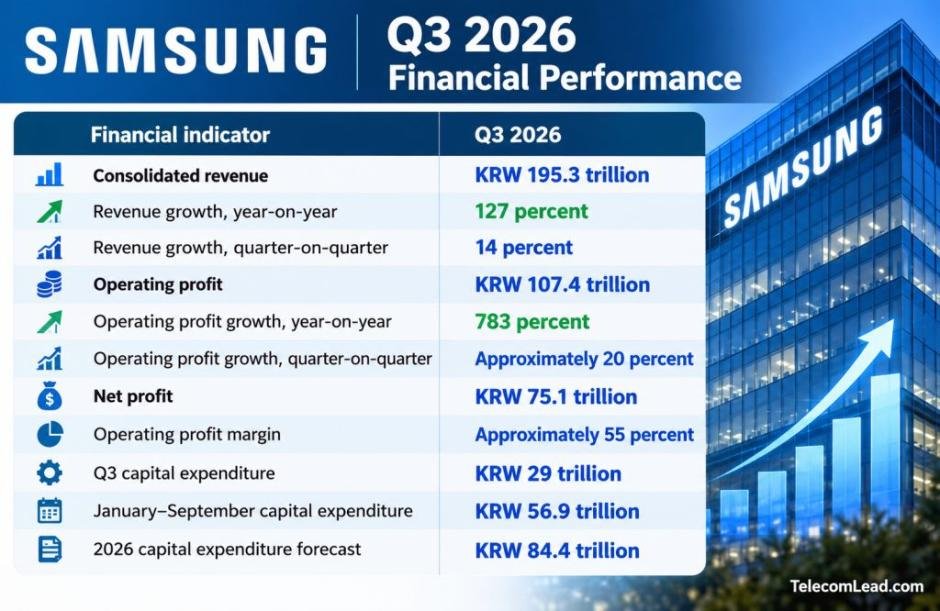
Samsung’s Q3 2026 result indicated that the South Korean technology giant achieved a 14 percent sequential increase in quarterly revenue and approximately 20 percent growth in operating profit compared with the second quarter of 2026.
Samsung became the first global technology company to report quarterly operating profit exceeding KRW 100 trillion, reflecting higher memory semiconductor prices, expanding high-bandwidth memory (HBM) shipments and strong demand from AI infrastructure providers.
However, Samsung’s quarterly performance revealed a significant difference between its semiconductor operations and consumer electronics businesses. While the Device Solutions division generated almost all the company’s operating profit, the Device eXperience division reported losses amid rising component and operating costs.
Samsung’s consolidated operating profit margin reached approximately 55 percent, supported by the exceptional profitability of its semiconductor business.
The company’s financial performance also highlighted the increasing importance of AI infrastructure investment to its revenue and earnings growth.
Samsung Semiconductor Revenue Reaches KRW 147.1 Trillion, Operating Profit Hits KRW 106.5 Trillion
Samsung’s Device Solutions (DS) division, which includes memory semiconductors and foundry operations, generated revenue of KRW 147.1 trillion in the third quarter of 2026.
The division reported operating profit of KRW 106.5 trillion, representing approximately 99 percent of Samsung Electronics’ consolidated operating profit.
Semiconductor revenue increased 15 percent quarter-on-quarter, driven by strong demand for AI memory products, server DRAM and enterprise solid-state drives.
The Memory Business achieved record quarterly revenue and operating profit as AI infrastructure expansion continued to create supply constraints across the semiconductor industry.
Samsung increased shipments of HBM4 products while expanding sales of server SSDs and other high-performance memory solutions.
Demand from hyperscale cloud providers and AI infrastructure operators supported higher semiconductor prices across multiple product categories.
The semiconductor division’s operating profit margin reached approximately 72 percent, demonstrating the exceptional profitability associated with the current AI memory investment cycle.
Samsung Memory Business Growth Forecast for Q4 2026 and 2027
Samsung expects demand for AI semiconductors to remain strong during the fourth quarter of 2026.
The company anticipates further growth in high-bandwidth memory, server DRAM and SSD demand as technology companies introduce new CPU and GPU platforms.
Samsung also expects demand for quad-level cell (QLC) SSDs to increase as personal AI agent applications expand.
For 2027, Samsung forecasts historically high AI infrastructure capital expenditure across the technology industry.
The company expects AI-related memory demand growth to exceed available industry supply by a wider margin than in 2026.
Samsung plans to capitalize on this environment by expanding shipments of HBM, server DDR5, high-performance DRAM and enterprise SSD products.
The company did not provide a specific percentage forecast for semiconductor revenue growth in 2027.
Samsung Foundry Targets Double-Digit Revenue Growth in Q4 2026
Samsung’s semiconductor foundry business reported improved revenue and profitability during the third quarter.
Growth was supported by increased HBM base-die production, higher advanced-node semiconductor sales and new customer orders.
Samsung secured additional business involving its 2-nanometer manufacturing technology, including orders from hyperscale customers developing high-performance computing applications.
The company expects double-digit foundry revenue growth in the fourth quarter of 2026, supported by new mobile products, expanded memory-related production and increased manufacturing of 4-nanometer neural processing units.
For 2027, Samsung expects its foundry revenue growth to benefit from rising demand for 4-nanometer and 2-nanometer manufacturing technologies.
The company also plans to strengthen its global manufacturing capabilities through the commencement of operations at its new semiconductor fabrication facility in Taylor, Texas.
AI accelerators, high-performance computing processors and advanced semiconductor packaging are expected to remain important growth opportunities.
Samsung Smartphone and Networks Revenue Reaches KRW 37.7 Trillion, but Division Reports Loss
Samsung’s Mobile eXperience (MX) and Networks businesses generated combined revenue of KRW 37.7 trillion in the third quarter of 2026.
Revenue increased both sequentially and year-on-year, supported by new flagship smartphone launches and stronger sales of premium foldable devices.
However, the combined businesses reported an operating loss of KRW 0.6 trillion.
Although profitability improved compared with the preceding quarter, earnings declined year-on-year because of higher costs.
Samsung’s smartphone operations faced increasing pressure from rising memory component prices, even as demand for premium devices remained relatively strong.
The latest Omdia report indicated that Samsung retained its position as the world’s largest smartphone vendor in Q3 2026, capturing 23 percent of global shipments, up from 19 percent a year earlier. Despite a year-on-year decline in shipments, Samsung gained market share as the overall smartphone market contracted 20 percent.
Samsung’s diversified product portfolio, extensive distribution network and August launch of the Galaxy Z Fold8 and Flip8 strengthened its competitive position. Samsung maintained a narrow lead over Apple, which secured 22 percent market share.
“Rising memory and storage costs are expected to increase pressure on smartphone profitability, making premium devices, higher average selling prices and portfolio optimization central to Samsung’s growth strategy,” Hayden Hou, Principal Analyst at Omdia, said.
Samsung’s Networks Business experienced lower earnings compared with both the previous quarter and the year-earlier period.
Samsung attributed the decline in network equipment profitability to weaker North American sales and reduced revenue from higher-margin software products.
Samsung Smartphone Growth Strategy for 2027
Samsung expects its smartphone business to benefit from year-end seasonal demand during the fourth quarter of 2026.
The company plans to prioritize sales of the Galaxy S26 series, Galaxy Z Fold8 Ultra, Galaxy Z Fold8 and connected ecosystem products.
For 2027, Samsung intends to strengthen its premium smartphone portfolio through hardware innovation, new form factors and differentiated customer experiences.
The company will also focus on operational efficiency and cost management to protect profitability.
Samsung’s Networks Business expects revenue opportunities in North America, South Korea and Japan during the fourth quarter.
For 2027, Samsung aims to secure additional telecom network equipment contracts despite challenging capital expenditure conditions among mobile operators.
The company did not disclose a numerical revenue growth target for its smartphone or network equipment businesses.
Samsung Display Revenue Hits KRW 8 Trillion, Operating Profit Reaches KRW 1.1 Trillion
Samsung Display Corporation reported revenue of KRW 8 trillion and operating profit of KRW 1.1 trillion in the third quarter of 2026.
The display business achieved an operating profit margin of approximately 13.8 percent.
Improved earnings in the small and medium-sized display segment reflected solid demand for premium smartphones.
Samsung’s large display operations also benefited from higher gaming monitor shipments and revenue.
The company expects seasonal demand and new product launches to support display sales during the fourth quarter, although external market conditions could limit profitability improvements.
For 2027, Samsung anticipates continued uncertainty in the display market.
The company plans to increase sales of premium foldable smartphone displays and expand its IT display business through production ramp-up at its new 8.6-generation manufacturing line.
Samsung will also prioritize higher-value display products to strengthen margins.
Samsung TV and Home Appliance Revenue Reaches KRW 13.9 Trillion, Operating Loss at KRW 0.2 Trillion
Samsung’s Visual Display (VD) and Digital Appliances (DA) businesses generated combined revenue of KRW 13.9 trillion during the third quarter.
The businesses reported an operating loss of KRW 0.2 trillion.
Television revenue declined following the conclusion of major sporting events, while higher costs affected profitability.
Samsung’s home appliance business experienced rising raw material and logistics expenses.
However, growth in business-to-business sales and subscription services provided some support to the appliances business.
Samsung expects stronger seasonal demand for premium televisions during the fourth quarter of 2026.
The company plans to increase premium product sales, strengthen distribution partnerships and expand marketing activities.
For 2027, Samsung expects the global television market to remain broadly flat or experience a slight decline.
Consequently, Samsung intends to focus on premium televisions, digital services and platform businesses rather than relying exclusively on hardware sales growth.
The home appliance business will prioritize AI-enabled products, premium appliances and higher-margin B2B opportunities.
Samsung Capital Expenditure to Reach KRW 84.4 Trillion in 2026
Samsung increased its investment in semiconductor manufacturing capacity and advanced technologies during the third quarter.
Capital expenditure reached KRW 29 trillion, representing an increase of KRW 12.2 trillion from the previous quarter and KRW 19.8 trillion from the year-earlier period.
The semiconductor division accounted for KRW 27.2 trillion of quarterly capital expenditure.
Samsung Display invested KRW 1.1 trillion.
For the first nine months of 2026, Samsung’s total capital expenditure reached KRW 56.9 trillion, an increase of KRW 24.7 trillion year-on-year.
The semiconductor division accounted for KRW 52.8 trillion of investment during the January–September period.
Samsung expects full-year 2026 capital expenditure to reach approximately KRW 84.4 trillion.
Of this amount, KRW 76.8 trillion is allocated to semiconductor operations, while KRW 3.9 trillion is earmarked for Samsung Display.
The forecast implies approximately KRW 27.5 trillion in additional capital expenditure during the fourth quarter.
The semiconductor investments will support new manufacturing facilities, advanced production technologies and infrastructure required to meet AI and high-performance computing demand.
Samsung Q3 2026 Business Division Performance
| Business division | Q3 2026 revenue | Operating profit/loss |
| Device Solutions — Semiconductors | KRW 147.1 trillion | KRW 106.5 trillion profit |
| Samsung Display | KRW 8.0 trillion | KRW 1.1 trillion profit |
| Mobile eXperience and Networks | KRW 37.7 trillion | KRW 0.6 trillion loss |
| Visual Display and Digital Appliances | KRW 13.9 trillion | KRW 0.2 trillion loss |
| Harman | Not separately disclosed | Improved earnings |
Note: Business-division revenue figures should not be added together to calculate consolidated revenue because of intercompany transactions and consolidation adjustments.
Samsung 2027 Growth Forecast: AI Semiconductors Lead Expansion
Samsung’s outlook for 2027 indicates that semiconductor operations will remain the primary growth engine.
The company expects AI infrastructure investment to reach record levels, supporting demand for HBM, server DRAM, enterprise SSDs and advanced foundry services.
Samsung’s memory business expects demand growth to exceed available supply, creating opportunities to increase sales of higher-value products.
The foundry business is targeting growth through 2-nanometer and 4-nanometer technologies, while the Taylor, Texas manufacturing facility is expected to strengthen production capabilities.
Samsung Display will prioritize premium OLED products, foldable smartphone displays and IT display manufacturing expansion.
The smartphone business will focus on premium devices, product innovation and operating efficiency to address margin pressure.
BABURAJAN KIZHAKEDATH