South Africa’s telecom market is undergoing significant changes as Vodacom, MTN, Telkom, Cell C, Rain and fiber network providers expand 5G coverage, invest in network resilience and increase broadband connectivity. However, slower 4G and 5G speeds, limited rural coverage, declining mobile service revenue and weak customer satisfaction remain major challenges.
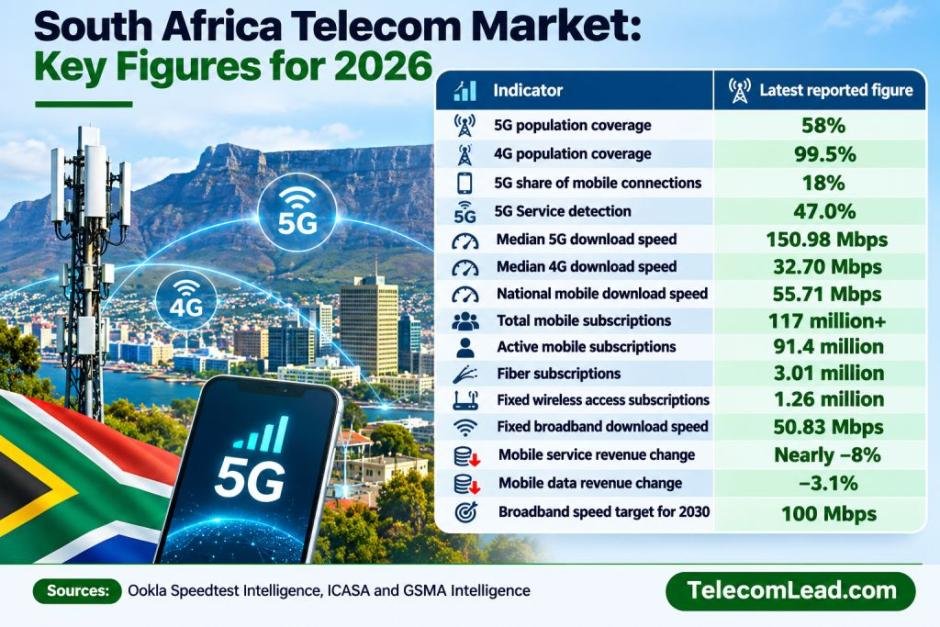
According to the latest analysis from Ookla, South Africa’s 5G population coverage reached 58 percent in 2025, while the proportion of surveyed locations with detected 5G service increased from 14.4 percent in 2023 to 47 percent by October 2026.
Despite expanding network coverage, 5G accounted for only 18 percent of mobile connections in the third quarter of 2026. National median mobile download speeds increased 6.5 percent to 55.71 Mbps, although both 4G and 5G download performance deteriorated.
Here are the ten major developments shaping South Africa’s telecom investment, 5G network expansion, fiber broadband and service performance.
1. South Africa’s 5G Coverage Reaches 58%, but Adoption Remains at 18%
South Africa’s 5G population coverage increased from 38.4 percent in 2023 to 58 percent in 2025, according to the Independent Communications Authority of South Africa (ICASA).
Ookla’s 5G Service metric, which measures the share of surveyed locations where 5G is detected, increased from 14.4 percent in 2023 to 47 percent during January–October 2026.
The corresponding 4G Service metric increased from 94.5 percent to 99.1 percent.
However, GSMA Intelligence estimates that 5G represented only 18 percent of South Africa’s mobile connections in Q3 2026, compared with approximately 80 percent for 4G.
This represents a substantial gap between 5G population coverage and actual adoption, although the two metrics use different measurement bases.
Among users with 5G-capable devices, Ookla’s 5G Availability metric increased from 25.5 percent in 2023 to 43.9 percent by October 2026. The corresponding 4G Availability increased from 91.5 percent to 94.9 percent.
2. Mobile Network Investment Focuses on Power Backup, Security and 5G Expansion
South African telecom operators have redirected significant capital expenditure toward network resilience following electricity supply instability, infrastructure vandalism and theft of copper cables, diesel and backup batteries.
Vodacom, MTN and other mobile operators have invested in backup power systems, physical security and infrastructure protection to maintain network availability during electricity disruptions.
These investments have improved service continuity but reduced the capital available for rural base station expansion and 5G network densification.
The March 2022 spectrum auction enabled Vodacom, MTN and Telkom to expand their 5G networks using newly assigned frequencies.
ICASA’s IMT Roadmap 2026 identifies additional spectrum opportunities in the 700 MHz, 800 MHz, 1.5 GHz, 2.3 GHz, 3.3 GHz and 3.5 GHz bands, alongside upper 6 GHz and millimeter-wave frequencies.
The analysis does not disclose individual operator capex amounts, making it difficult to quantify how much investment has shifted from network expansion to resilience.
3. 5G Download Speeds Decline 26.4% to 150.98 Mbps
South Africa’s 5G network performance deteriorated significantly between Q3 2024 and Q3 2026 despite expanding coverage.
Ookla Speedtest Intelligence data shows that median 5G download speeds declined 26.4 percent from 205.19 Mbps to 150.98 Mbps.
Median 5G upload speeds declined from 16.66 Mbps to 13.94 Mbps, while latency increased from 33.73 milliseconds to 35.83 milliseconds.
4G performance also weakened, with median download speeds declining 11 percent to 32.70 Mbps.
| Network metric | 5G | 4G |
| Median download speed | 150.98 Mbps | 32.70 Mbps |
| Median upload speed | 13.94 Mbps | 7.43 Mbps |
| Download speed change | −26.4% | −11.0% |
Source: Ookla Speedtest Intelligence, Q3 2024–Q3 2026.
The decline in 5G throughput may reflect increased network loading as more customers migrate to 5G services.
Nevertheless, 5G continues to deliver approximately 4.6 times the download speed of 4G and nearly twice its upload speed.
4. National Mobile Internet Speeds Increase 6.5% to 55.71 Mbps
Despite declining speeds within individual network technologies, South Africa’s national median mobile download speed increased from 52.31 Mbps in Q3 2024 to 55.71 Mbps in Q3 2026.
The 6.5 percent improvement reflects a greater proportion of users accessing faster 5G networks.
National median upload speeds remained between 8.7 Mbps and 9.5 Mbps, while multi-server latency remained around 39–40 milliseconds.
South Africa ranked 66th globally in the September 2026 Speedtest Global Index for mobile internet performance.
The country ranked first in Sub-Saharan Africa and second across Africa, behind Algeria, which ranked 59th globally.
Morocco ranked 68th, while Kenya occupied 86th position.
These results demonstrate that national mobile performance can improve through greater 5G adoption even when speeds within 4G and 5G networks are declining.
5. Rural 5G Coverage Falls to Just 7% in Eastern Cape
South Africa continues to experience substantial geographic disparities in 5G coverage.
The Western Cape recorded 89 percent 5G population coverage, followed by Gauteng at 74 percent and Mpumalanga at 63 percent.
National rural 5G coverage averaged 30.7 percent, while the Eastern Cape recorded only 7 percent rural coverage.
The Free State recorded 38 percent 5G coverage in urban areas.
Ookla’s January–October 2026 measurements also reveal differences in 5G adoption across provinces.
Gauteng and the Western Cape each recorded a 48 percent share of 5G Speedtest samples, compared with 34 percent in Free State and 29 percent in Limpopo.
Gauteng and the Western Cape have urban household shares of 97.1 percent and 92.7 percent, respectively, compared with 18.1 percent in Limpopo.
The data indicates that 5G usage is concentrated in highly urbanized provinces, while network availability, device penetration and operator investment influence adoption elsewhere.
6. Fiber Broadband Subscribers Grow 22% to 3.01 Million
South Africa’s fiber broadband market continues to expand despite relatively modest improvements in fixed internet speeds.
ICASA reported more than 3.26 million fixed broadband subscribers as of September 2025, representing 19.3 percent year-on-year growth.
Fiber-to-the-home and fiber-to-the-building subscriptions increased 22 percent to 3.01 million.
DSL subscriptions declined 6 percent as customers migrated from legacy copper networks to fiber infrastructure.
Fixed wireless access subscriptions, which are reported separately from the fixed broadband base, increased 39 percent to 1.26 million.
| Broadband segment | Subscribers | YoY growth |
| Fixed broadband | 3.26 million+ | +19.3% |
| FTTH/FTTB | 3.01 million | +22.0% |
| Fixed wireless access | 1.26 million | +39.0% |
| DSL | Not specified | −6.0% |
Source: ICASA, September 2025.
South Africa’s fiber market includes open-access infrastructure providers such as Openserve, Vumatel, Frogfoot and MetroFibre.
Their wholesale network models allow multiple retail internet service providers to deliver services over shared fiber infrastructure.
7. Vodacom’s 30% Maziv Investment Expands Fiber Access to 2.8 Million Homes
Vodacom completed its acquisition of a 30 percent stake in fiber infrastructure provider Maziv in 2025.
The transaction provides Vodacom access to an open-access fiber network covering more than 2.8 million homes passed.
The investment strengthens Vodacom’s position in fixed broadband infrastructure alongside its existing mobile network operations.
The development also highlights the growing convergence between mobile operators and fiber infrastructure providers.
Fiber networks are important for residential broadband, enterprise connectivity and the transmission capacity required to support mobile network expansion.
Meanwhile, South Africa’s fixed broadband median download speed increased from 47.75 Mbps in Q3 2024 to 50.83 Mbps in Q3 2026, representing approximately 6.5 percent growth.
Median upload speeds increased from 38.44 Mbps to 41.31 Mbps, while latency remained between 13 and 14 milliseconds.
Despite fiber subscriber growth, South Africa ranked only 116th globally and eighth in Africa for fixed broadband speeds in September 2026.
8. Half of Fixed Broadband Speed Tests Remain Below 50 Mbps
South Africa’s fixed broadband market continues to face limitations related to entry-level broadband packages and uneven fiber infrastructure coverage.
Ookla reports that approximately half of fixed broadband Speedtest samples recorded download speeds below 50 Mbps.
Only 8.6 percent of samples exceeded 250 Mbps.
Higher-speed broadband connections are concentrated in Johannesburg, Pretoria, Cape Town and Durban, while many rural and non-metropolitan areas record download speeds below 25 Mbps.
Broadband pricing also influences customer adoption.
Entry-level fiber packages offering approximately 20–40 Mbps typically cost ZAR 300–500 per month.
Mainstream 50 Mbps packages cost approximately ZAR 500–700 per month, while higher-speed packages are generally more expensive.
Premium fiber services offer speeds ranging from 100 Mbps to 500–1,000 Mbps, but the low adoption of higher-speed packages limits national broadband performance.
The findings suggest that fiber infrastructure expansion alone has not been sufficient to increase average customer download speeds substantially.
9. Mobile Subscribers Reach 117 Million as Data Revenue Declines 3.1%
South Africa had more than 117 million total mobile subscriptions at the end of September 2025, according to ICASA.
The number of active mobile subscriptions, measured over a 90-day period, stood at 91.4 million.
The country also recorded approximately 3.3 million fixed broadband subscriptions.
Mobile data subscriptions increased 6.7 percent to 45 million during 2025.
However, mobile data revenue declined 3.1 percent, indicating that subscriber and usage growth did not translate into higher revenue.
Total mobile service revenue fell nearly 8 percent year-on-year in 2025.
The revenue decline reflects increased competition and migration from traditional voice and messaging services to internet-based applications.
Active mobile subscriber numbers also declined, while smartphone user growth stagnated.
For Vodacom, MTN, Telkom and other operators, these trends increase the importance of customer retention, network efficiency and monetizing existing broadband demand.
10. South Africa Targets 100 Mbps Broadband by 2030 as Operators Plan Rural Network Sharing
South Africa’s national broadband programme, SA Connect, targets an average download speed of 100 Mbps nationwide by 2030, with 100 Mbps broadband access for 80 percent of the population.
However, the programme’s second phase, which began in 2023/2024 and ended in 2025/2026, did not fully achieve its targets because of funding and implementation delays.
The government is prioritizing maintenance of deployed connectivity rather than launching a further nationwide build-out phase.
Private-sector investment, fixed wireless access and satellite broadband are therefore expected to play an important role in expanding connectivity.
In August 2026, the Association of Comms and Technology, representing Vodacom, MTN, Telkom, Cell C, Rain and Liquid Intelligent Technologies, applied for a five-year competition exemption.
The proposed arrangement would allow operators to coordinate investment in shared infrastructure, including towers, masts, ducts and backup power systems, to improve rural connectivity economics.
ICASA is also examining additional spectrum assignments and potential new network licences.
Operators are expected to retire 3G networks before 2G, potentially within one to two years, to reuse spectrum for 4G and 5G services.
Satellite connectivity is another emerging investment area. Herotel plans to launch its Amazon Leo-powered evry broadband service in 2027, while Avanti is supporting Eutelsat OneWeb-based connectivity through Q-KON.
These initiatives could expand broadband availability in regions where conventional fiber and mobile network deployment remains expensive.
South Africa’s next phase of telecom development will depend on translating 5G coverage and fiber infrastructure investments into higher network performance and greater customer adoption.
Although 5G population coverage has reached 58 percent and fiber subscriptions have crossed 3 million, declining 5G download speeds, limited rural access and falling mobile service revenue show that infrastructure expansion has not yet delivered consistent improvements across the market.
Customer satisfaction is another concern. Ookla reports that mobile Net Promoter Score declined from a 2024 peak of −15.2 to −23.9, while fixed broadband NPS fell from approximately −13.4 to −20.5.
For South African telecom operators, investment priorities are increasingly shifting toward improving network capacity, expanding rural 4G and 5G access, strengthening fiber connectivity and delivering affordable broadband services.
BABURAJAN KIZHAKEDATH