
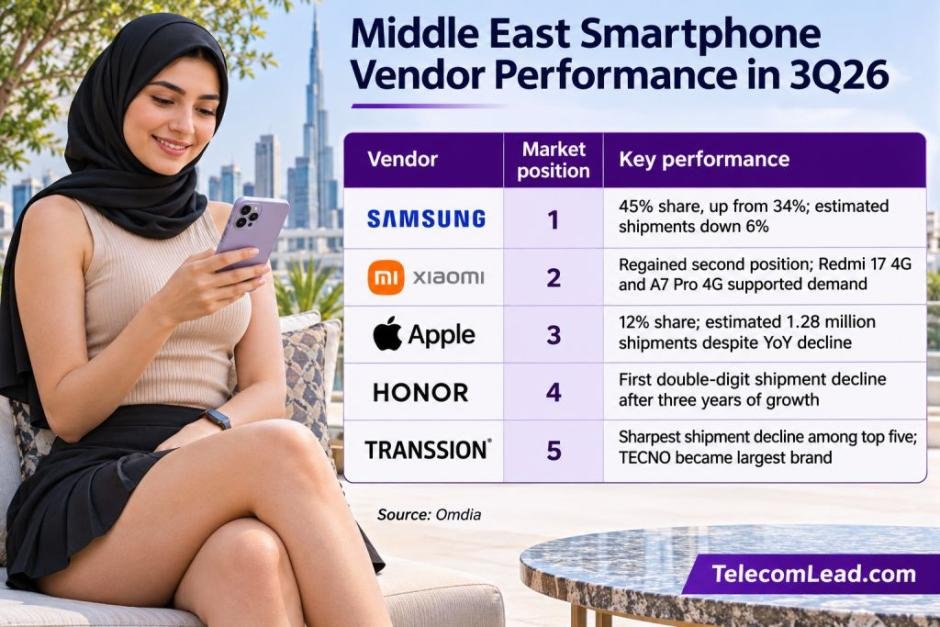
Samsung strengthened its leadership in the Middle East smartphone market during the third quarter of 2026, increasing its market share to 45 percent from 34 percent a year earlier, while Xiaomi regained second position ahead of Apple. HONOR and TRANSSION suffered shipment declines as rising component costs and weaker demand pushed regional smartphone shipments down 29 percent to 10.7 million units.
Smartphone shipments in the Middle East, excluding Turkey, declined 29 percent to 10.7 million units in 3Q26, reflecting weaker retail demand, rising smartphone prices and reduced availability of affordable devices, Omdia report on Middle East smartphone market indicated.
The market contraction affected major smartphone vendors differently, with Samsung gaining significant market share, Xiaomi improving its competitive position, Apple maintaining its premium-market presence, and HONOR and TRANSSION facing pressure on shipment volumes.
Samsung, Xiaomi, Apple, HONOR and TRANSSION remained the five leading smartphone vendors in the region, but their performance reflected significant differences in product portfolios, component availability, pricing and distribution strategies.
Samsung Expands Middle East Smartphone Market Share to 45%
Samsung emerged as the strongest performer among the leading smartphone vendors in the Middle East during 3Q26, increasing its market share by 11 percentage points to 45 percent from 34 percent in 3Q25.
Samsung maintained its leadership with 4.8 million shipments, down 6 percent, while its market share increased to 45 percent from 34 percent.
This indicates that Samsung’s shipments declined approximately 6 percent YoY, significantly outperforming the overall Middle East smartphone market, which contracted 29 percent.
Samsung’s performance was supported by demand for the Galaxy A17 and Galaxy A07 4G smartphones, particularly among consumers seeking affordable devices from established brands.
The company’s relatively stable component supply and broad smartphone portfolio helped it maintain availability across multiple price segments while competitors reduced their exposure to entry-level devices.
Samsung’s ability to limit shipment losses during a sharp market downturn enabled it to consolidate its leadership over Xiaomi, Apple, HONOR and TRANSSION.
Xiaomi ranked second with 1.3 million shipments, down 42 percent, and its market share declined to 12 percent from 15 percent.
Xiaomi Regains Second Position in Middle East Smartphone Rankings
Xiaomi returned to second position in the Middle East smartphone market in 3Q26, supported by demand for the Redmi 17 4G and Redmi A7 Pro 4G.
The Chinese smartphone vendor strengthened its competitive standing as the market faced declining demand for lower-priced smartphones.
Xiaomi continued reducing its emphasis on the lowest-priced devices, prioritizing higher-margin smartphones and markets offering better profitability.
This strategy reflects increasing pressure on smartphone manufacturers as memory and other component costs rise, reducing the profitability of entry-level models.
Although Xiaomi improved its ranking, Omdia did not provide its exact shipment volume or market share in the supplied figures.
Apple shipped 1.3 million smartphones, down 8 percent, but increased its market share to 12 percent from 9 percent.
Apple increased its Middle East smartphone market share to 12 percent in 3Q26, despite recording a year-on-year decline in shipments.
Based on the regional shipment total of 10.7 million units, Apple’s estimated shipments reached approximately 1.28 million units during the quarter.
Apple benefited from established distribution partnerships and continued demand for premium smartphones, even as consumers became more cautious about spending.
However, Apple’s channel shipments were affected by changes to its iPhone launch portfolio.
The absence of a base iPhone 18 at launch resulted in lower channel shipments compared with the broader iPhone 17 lineup introduced a year earlier.
Apple’s market-share improvement therefore reflected its relative resilience during the regional downturn rather than an increase in smartphone shipment volumes.
The company’s performance also benefited from the changing regional smartphone price mix, as the $400–599 segment recorded substantial growth while lower-priced devices experienced steep declines.
HONOR recorded 1.1 million shipments, down 27 percent, while its share increased to 11 percent from 10 percent.
HONOR experienced its first double-digit year-on-year smartphone shipment decline following three consecutive years of growth in the Middle East.
The company expanded its presence in the sub-$150 smartphone category with the HONOR Choice T10 but continued to face pressure from weaker consumer demand and increasing component costs.
The HONOR X7e accounted for approximately 20 percent of HONOR’s regional smartphone shipments during 3Q26.
This concentration highlights the importance of the company’s X-series smartphones in maintaining its shipment volumes.
HONOR’s performance indicates that expanding entry-level product availability was insufficient to offset the broader regional slowdown.
The company also faced stronger competition from Samsung and Xiaomi, which benefited from established product portfolios and distribution networks.
TRANSSION suffered the steepest decline among the top five vendors, with shipments plunging 66 percent to 0.9 million units and market share falling to 9 percent from 18 percent. Other smartphone vendors collectively shipped 1.2 million units, down 38 percent.
The company’s strategy of targeting price-sensitive consumers through affordable smartphones came under increasing pressure as component costs rose and entry-level demand weakened.
TECNO became TRANSSION’s largest smartphone brand by shipment volume, supported by models including the Spark Go 3.
Iraq and Saudi Arabia remained important markets for TRANSSION, but both countries experienced significant declines in overall smartphone shipments.
The particularly severe contraction in Iraq affected vendors with substantial exposure to budget smartphones.
TRANSSION’s performance demonstrates the challenges facing manufacturers dependent on low-priced devices as production costs increase and consumers delay smartphone replacements.
Smartphone Shipments Below $200 Collapse 56% as Average Selling Price Hits $511
The biggest challenge for smartphone vendors was the sharp contraction in affordable smartphone shipments.
Omdia reported that shipments of smartphones priced below $200 declined 56 percent YoY in 3Q26, significantly exceeding the overall market decline of 29 percent.
In contrast, shipments in the $400–599 smartphone segment increased 65 percent.
The changing product mix pushed the Middle East smartphone market’s average selling price to a record $511.
However, the increase in average selling prices did not necessarily indicate that consumers were voluntarily shifting toward premium smartphones.
Rising component costs encouraged vendors to reduce their entry-level smartphone portfolios and prioritize devices offering higher margins.
Consequently, consumers with limited budgets faced fewer affordable smartphone choices, contributing to longer replacement cycles.
This market shift particularly affected TRANSSION and other vendors with greater exposure to lower-priced devices, while Samsung and Apple benefited from their positions across mainstream and premium segments.
Saudi Arabia, UAE and Iraq Smartphone Markets Report Uneven Declines
The regional smartphone market contraction varied significantly across major countries.
Saudi Arabia recorded a 29 percent YoY decline in smartphone shipments during 3Q26, matching the overall regional contraction.
Smartphone shipments in the UAE declined 12 percent, making the market comparatively more resilient than Saudi Arabia and Iraq.
Iraq experienced the sharpest decline among the three markets, with smartphone shipments plunging 58 percent YoY to their lowest quarterly level since 1Q23.
Currency pressures, political and economic instability, and rising smartphone prices significantly affected demand in Iraq.
In Saudi Arabia and the UAE, extended summer travel contributed to lower retail footfall despite promotional campaigns linked to back-to-school shopping and National Day offers.
The differences in country-level performance affected smartphone vendors according to their distribution exposure, pricing strategies and dependence on entry-level devices.
Middle East Smartphone Market Expected to Decline Again in 2027
Omdia expects the Middle East smartphone market to record a single-digit shipment decline in 2027 following the sharp contraction in 2026.
Samsung enters this period with a significantly stronger market position after expanding its share to 45 percent.
Xiaomi is expected to continue balancing smartphone shipment volumes with profitability as it reduces its dependence on entry-level models.
Apple’s performance will remain closely linked to premium smartphone demand, trade-in programmes and financing options.
HONOR and TRANSSION face greater challenges in maintaining shipment volumes as affordable smartphone availability declines and price-sensitive consumers extend replacement cycles.
For smartphone vendors operating in Saudi Arabia, the UAE and Iraq, inventory management, financing programmes, distribution partnerships and selective product launches are expected to become increasingly important.
The central finding from Omdia’s 3Q26 research is that Samsung substantially outperformed the declining Middle East smartphone market, Xiaomi regained second position, Apple increased its share despite lower shipments, and HONOR and TRANSSION struggled as affordable smartphone demand contracted.
BABURAJAN KIZHAKEDATH