Global smartphone shipments fell sharply in the third quarter of 2026 as rising memory costs squeezed vendor margins, pushed up device prices and weakened demand. Samsung and Apple strengthened their market positions, while Xiaomi, OPPO and vivo recorded shipment declines approaching or exceeding 30%.
IDC’s preliminary estimates put worldwide smartphone shipments at 255.3 million units, down 22% year on year from 327.3 million. The decline removed 72 million units from the market and marked the largest annual percentage contraction recorded by IDC in any quarter.
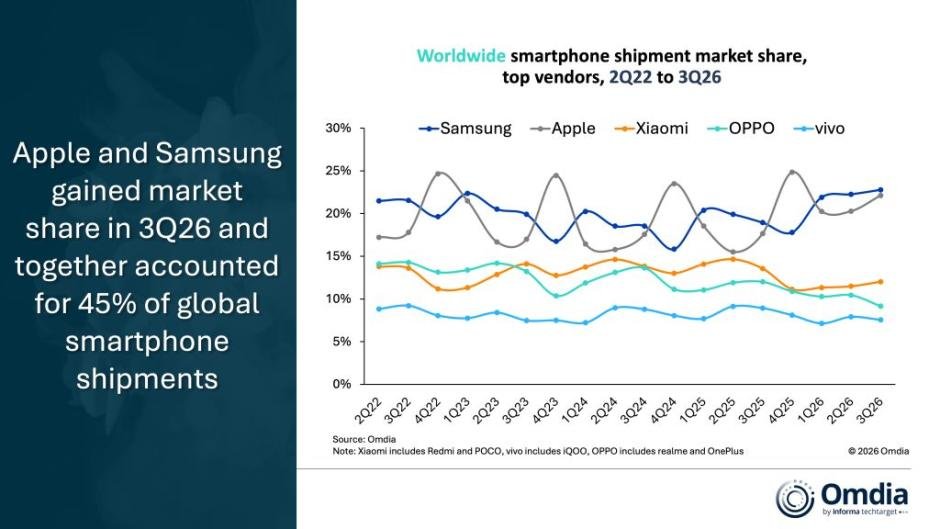
Omdia separately estimated a 20% decline, accelerating from a 6% fall in the previous quarter. Its assessment placed shipments at their lowest third-quarter level since 2013. Shipments also declined sequentially despite flagship launches and preparations for year-end shopping, Omdia’s Lucas Zhong in the report on the global smartphone market.
Although the research firms reported different estimates, both identified the same competitive shift: Samsung and Apple are gaining share as the market contracts.
Smartphone Market Share: Samsung Leads Apple by 500,000 Units
IDC’s figures show Samsung retaining first place with 57.8 million shipments, narrowly ahead of Apple’s 57.3 million. Their combined shipments reached 115.1 million units, accounting for approximately 45% of the global market, IDC’s Kiranjeet Kaur said in the report.
| Vendor | Q3 2026 shipments | Market share | Annual shipment change |
| Samsung | 57.8 million | 22.6% | −5.8% |
| Apple | 57.3 million | 22.4% | −4.0% |
| Xiaomi | 30.7 million | 12.0% | −29.2% |
| OPPO | 25.6 million | 10.0% | −34.5% |
| vivo | 19.1 million | 7.5% | −31.5% |
| Others | 64.8 million | 25.4% | −32.5% |
| Total | 255.3 million | 100% | −22.0% |
Source: IDC Quarterly Mobile Phone Tracker, October 14, 2026.
Samsung and Apple together held 36.9% market share a year earlier, IDC said. Their combined position therefore increased by approximately 8.1 percentage points, even though both shipped fewer smartphones.
Samsung Defends First Place as Market Share Reaches 22.6%
Samsung’s shipments declined 5.8% from 61.4 million units a year earlier. However, its market share increased from 18.7% to 22.6%, reflecting a substantially smaller shipment decline than the overall market.
Omdia attributed Samsung’s relative resilience to its broad product range and established global distribution network. The August launch of the Galaxy Z Fold8 and Flip8 series also supported its premium smartphone positioning.
Samsung’s performance illustrates how a vendor can gain market share during a downturn without increasing shipments. Maintaining that position will depend on balancing affordable models, premium devices and profitability as component costs remain elevated.
Apple Records the Smallest Decline Among the Top Five
Apple’s shipments fell 4%, the smallest decline among the five leading vendors, while its market share rose from 18.2% to 22.4%.
The gap between Apple and Samsung narrowed to just 500,000 units, compared with 1.7 million units in the corresponding quarter of 2025, based on IDC’s rounded shipment figures.
Omdia cited continued demand for the iPhone 17 family and the September introduction of the iPhone 18 Pro and Pro Max as supporting factors. It also highlighted the iPhone Duo as Apple’s entry into foldable smartphones.
However, Omdia cautioned that AI is not yet a major consumer purchase driver. Apple Intelligence’s longer-term contribution will depend on whether its features deliver useful improvements that encourage upgrades and strengthen customer retention.
Xiaomi, OPPO and vivo Face Steeper Shipment Losses
Xiaomi retained third position, but shipments dropped 29.2% to 30.7 million units. Its market share declined from 13.2% to 12%, showing that its shipment contraction exceeded the broader market decline.
OPPO recorded the largest decline among the top five vendors. Shipments fell 34.5% to 25.6 million units, while market share slipped from 11.9% to 10%.
vivo shipped 19.1 million smartphones, down 31.5%, with its share declining from 8.5% to 7.5%.
Together, Xiaomi, OPPO and vivo shipped 75.4 million units, compared with 110.4 million a year earlier. Their combined reduction of 35 million units represented nearly half of the global market’s 72 million-unit shipment loss.
Omdia’s separate estimates placed Xiaomi at 12%, OPPO—including realme and OnePlus—at 9%, and vivo at 8%. These figures should be read within Omdia’s dataset rather than combined with IDC’s shipment totals.
Memory Costs Rise Approximately 350%
IDC identified rapidly escalating memory costs as a central cause of the downturn. According to the research firm, memory costs increased approximately 350% from a year earlier, creating pressure on smartphone production costs and vendor margins.
Sequential memory inflation slowed to a low double-digit increase in Q3, compared with roughly 50%–100% increases in earlier quarters. Nevertheless, the accumulated cost increase remained substantial, while other critical components also stayed expensive.
The impact is particularly difficult for entry-level smartphones, where margins are already thin and buyers are sensitive to price increases. Vendors face a choice between absorbing higher costs, raising retail prices, adjusting specifications or reducing shipments.
Omdia said manufacturers are increasingly prioritising average selling prices and portfolio profitability. That strategy may protect margins, but reducing affordable-device shipments can also weaken distribution relationships and brand visibility in emerging markets.
Smartphone Market Outlook: Recovery Could Wait Until 2028
IDC expects smartphone market growth to remain constrained through 2027, with a possible recovery pushed to 2028 at the earliest.
Inventory is another concern. Some vendors increased production plans ahead of anticipated component supply tightening. If consumer demand remains weak, those decisions could leave excess stock entering 2027.
Omdia expects flagship launches, promotions and festive demand to provide limited relief in the fourth quarter. Device financing, trade-in programmes and telecom operator partnerships could help vendors support upgrades while managing discount costs.
For smartphone manufacturers, the next phase of competition will depend on more than shipment rankings. Securing components, maintaining affordable upgrade options and protecting profitability will determine whether current market-share gains translate into stronger financial performance.
BABURAJAN KIZHAKEDATH