Apple is expected to achieve record market share across smartphones, tablets, personal computers and smartwatches in 2026, according to Counterpoint Research. The gains come despite a difficult technology market shaped by surging memory prices, inventory corrections and weakening consumer demand.
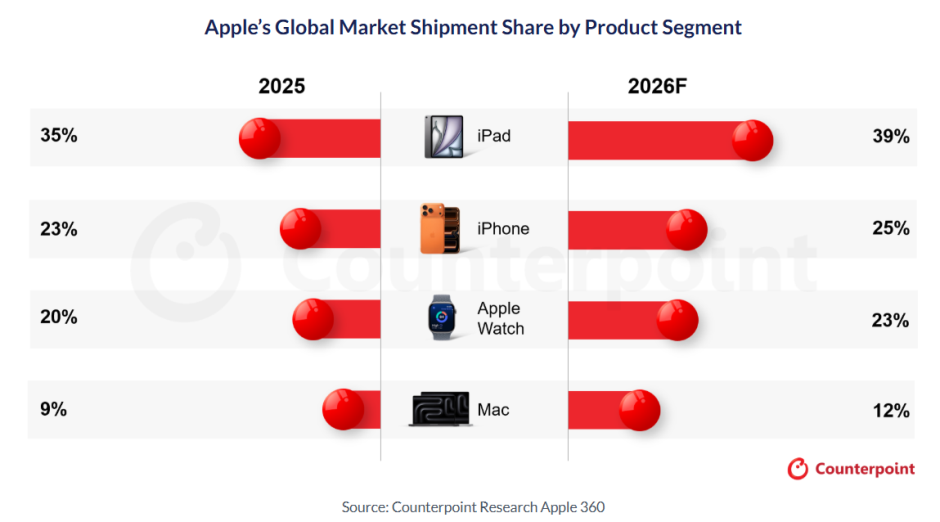
Counterpoint forecasts Apple will increase shipment share across all four major device categories in 2026. iPad share is projected to rise from 35 percent in 2025 to 39 percent in 2026, iPhone from 23 percent to 25 percent, Mac from 9 percent to 12 percent and Apple Watch from 20 percent to 23 percent.
The simultaneous gains underline the increasing strength of Apple’s integrated hardware, software, artificial intelligence and services ecosystem at a time when several competing smartphone and PC manufacturers face pressure from higher component costs.
iPhone Market Share to Reach Record 25 Percent
Apple’s global smartphone shipment share is forecast to reach an all-time high of 25 percent in 2026, up from 23 percent in 2025, even though overall iPhone shipments are expected to remain broadly flat.
The market-share expansion will reflect weakness among competitors, with most rival smartphone OEMs expected to suffer double-digit shipment declines during 2026.
iPhone 18 Pro lineup will outperform the iPhone 17 Pro series. Demand for the standard iPhone 17 is also expected to remain healthy because Apple is not anticipated to introduce a regular iPhone 18 model during 2026.
Apple is simultaneously widening access to its ecosystem through the iPhone 17e, expected to start at around US$599. The device brings Apple Intelligence to a lower price point and could help Apple attract consumers who previously considered its smartphones too expensive.
Rather than relying only on specifications, Apple continues to differentiate its products through integration between devices using AirDrop, Handoff, Continuity Camera, Universal Clipboard and Apple Intelligence.
Competition remains intense. Samsung is extending Galaxy AI across its flagship portfolio. Google is integrating Gemini across Pixel devices. Xiaomi, OPPO, vivo and HONOR are competing through larger batteries, faster charging and aggressive pricing. Apple is emphasizing long-term software support, privacy-focused on-device AI and integration across multiple products.
DRAM Prices Could Rise 13–18 Percent as Memory Crisis Hits Rivals
Apple’s market-share expansion is taking place against a challenging component-cost environment.
TrendForce expects conventional DRAM contract prices to rise between 13 percent and 18 percent quarter over quarter in the third quarter of 2026. Enterprise NAND Flash contract prices are forecast to increase another 10 percent to 15 percent, driven by strong AI server demand and constrained supply.
Higher DRAM and NAND prices are forcing smartphone and PC manufacturers either to raise device prices or absorb the additional costs through lower margins.
Apple is comparatively well positioned because of its purchasing scale, premium margins, supply-chain management and customer base, which tends to be less sensitive to price increases. Its long-standing relationships with TSMC, Foxconn and Qualcomm provide additional resilience during industry-wide component constraints.
Counterpoint Research Director Tarun Pathak said Apple’s performance in 2026 demonstrates its unusual resilience. Market-share gains across multiple device categories can reinforce one another by attracting new customers while increasing the cost and inconvenience of switching ecosystems for existing users.
iPad Share Forecast to Jump to 39 Percent
Apple is expected to strengthen its global tablet leadership despite an overall tablet-market contraction caused by inventory corrections and memory shortages.
iPad shipment market share will increase by 4 percentage points, from 35 percent in 2025 to 39 percent in 2026. Apple is expected to grow iPad shipments even while the wider tablet industry declines.
A product-refresh cycle is supporting the business. Apple introduced the M5-powered iPad Pro in late 2025, followed by an updated iPad Air earlier in 2026. Updated base iPad and iPad mini models are expected during the remainder of the year.
Growing demand in emerging markets could provide another source of expansion as Apple seeks to extend the iPad beyond its traditional premium-market customer base.
Mac Shipments to Surge 23 Percent as Laptop Market Drops 11 Percent
Apple’s PC performance is expected to be one of the strongest parts of its 2026 hardware story.
Mac shipments will grow 23 percent year over year in 2026, outperforming an overall laptop market expected to decline 11 percent.
Mac’s global shipment share is consequently projected to rise from 9 percent in 2025 to 12 percent in 2026, a gain of 3 percentage points and the largest percentage-point increase among leading PC vendors.
A key growth driver is the MacBook Neo, positioned as Apple’s most affordable notebook. The device starts at US$599 in the United States and INR 69,900 in India.
MacBook Neo features a 13-inch Liquid Retina display, A18 Pro processor, 8 GB of unified memory and 256 GB SSD, along with Apple Intelligence, Wi-Fi 6E and all-day battery life. Apple is targeting students, first-time Mac customers and buyers seeking a lower-priced AI-enabled PC.
Its US$599 starting price also gives Apple a significant entry-price advantage against many Windows AI PCs from Dell, HP, Lenovo, ASUS and Acer. Devices powered by Qualcomm Snapdragon X, Intel Core Ultra and AMD Ryzen AI processors generally start at approximately US$799 to US$1,200.
Windows AI PCs retain advantages in enterprise compatibility and hardware choice, while Apple is betting on tightly optimized hardware and software, battery efficiency and integration between Mac, iPhone and iPad.
Apple Watch Share to Rise to 23 Percent
Apple is also expected to outperform the broader smartwatch industry.
The global smartwatch market will grow 1 percent in 2026, but Apple Watch shipment share is expected to increase from 20 percent to 23 percent, representing a 3-percentage-point gain.
Growth will be supported by full-year availability of Apple Watch SE 3 and Apple Watch Ultra 3 following Apple’s first comprehensive smartwatch portfolio refresh since 2022.
The relatively affordable Apple Watch SE 3 also forms part of Apple’s strategy to reduce the cost of entering its ecosystem alongside the iPhone 17e and MacBook Neo.
Apple Intelligence Could Drive Multi-Device Upgrade Cycle
Artificial intelligence is central to Apple’s ecosystem strategy. At WWDC 2026, the company showcased enhanced Apple Intelligence capabilities, including a more personalized Siri designed to understand user context and operate across iPhone, iPad, Mac and Apple Watch.
Counterpoint Principal Analyst Varun Mishra believes Apple’s large number of connected-device touchpoints gives it an important AI advantage. Successful execution of personalized Apple Intelligence could become a major differentiator and potentially stimulate a new multi-device replacement cycle.
Apple faces aggressive AI competition. Samsung is scaling Galaxy AI, Google is extending Gemini across Android, and Microsoft is pushing Copilot+ PCs into consumer and enterprise markets.
Apple’s approach is to combine custom silicon, AI, premium hardware, operating systems and services within one tightly controlled ecosystem rather than compete solely on individual AI features.
Growing Installed Base Creates More Services Revenue Opportunities
Apple’s expected hardware gains have implications beyond device shipments. Every additional iPhone, Mac and iPad expands the addressable audience for recurring services including the App Store, Apple Music, Apple TV+, Apple Arcade, Apple Pay, AppleCare and iCloud+.
An expanding installed base can therefore generate additional high-margin recurring revenue while increasing customer retention and encouraging consumers to purchase multiple Apple products.
Apple’s 2026 forecasts illustrate the scale of that opportunity: iPhone share rising from 23 percent to 25 percent, iPad from 35 percent to 39 percent, Mac from 9 percent to 12 percent and Apple Watch from 20 percent to 23 percent.
FASNA SHABEER