
Wi-Fi 7 adoption is accelerating across the U.S. broadband market as consumers upgrade routers, smartphones, laptops and other connected devices, creating a new technology refresh cycle for internet service providers and home networking equipment suppliers.
Ookla Speedtest data shows Wi-Fi 7 accounted for 7.2 percent of Wi-Fi router generations among U.S. providers in Q1 2026, up from 1.8 percent in Q1 2025. That represents growth of 300 percent in one year and signals that Wi-Fi 7 is beginning to move beyond the early-adopter market.
Wi-Fi 7 products began arriving in early 2024, but adoption remained below 1 percent at the end of Q1 2024 and stayed in the low single digits a year later. The latest figures indicate a potentially much larger upgrade cycle as broadband providers combine Wi-Fi 7 gateways with faster fiber and cable networks, Ookla’s Kerry Baker said.
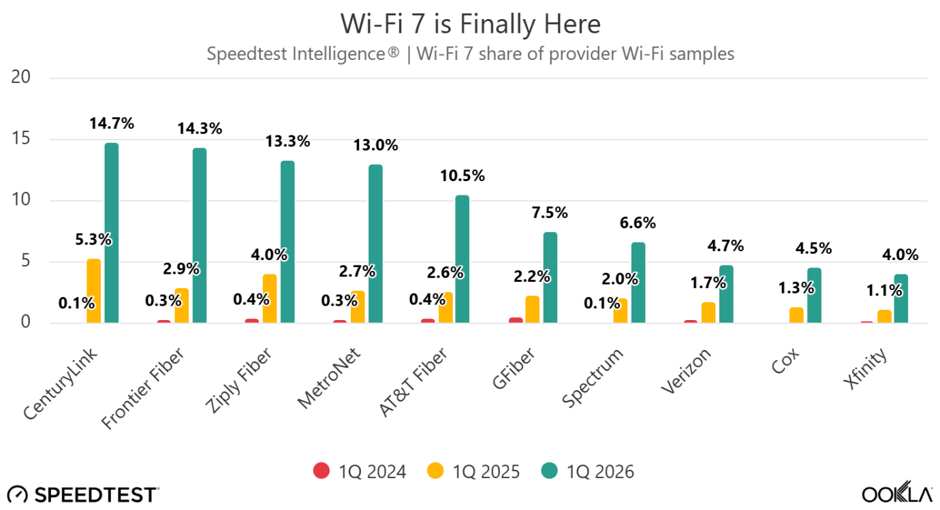
CenturyLink, Frontier and Ziply Lead Wi-Fi 7 Penetration
Fiber broadband providers are leading the U.S. market when Wi-Fi 7 adoption is measured as a percentage of their customer base.
CenturyLink recorded the highest penetration at 14.7 percent, followed closely by Frontier at 14.3 percent, Ziply Fiber at 13.3 percent and MetroNet at 13.0 percent.
All four were substantially ahead of the U.S. average of 7.2 percent.
Cable broadband providers recorded lower penetration levels. Spectrum reached 6.6 percent, Cox 4.5 percent and Xfinity 4.0 percent.
The figures reveal an important divide in the U.S. broadband market: fiber operators are ahead in Wi-Fi 7 penetration, but large cable companies can lead when adoption is measured by absolute scale.
Spectrum Becomes World’s Largest Wi-Fi 7 Provider by Speedtest Volume
Spectrum accounted for 24.9 percent of all U.S. Wi-Fi 7 Speedtest samples in Q1 2026, more than twice Xfinity’s 12.4 percent and ahead of Frontier’s 11.9 percent.
Spectrum was also the world’s largest Wi-Fi 7 provider by Speedtest sample volume, while five U.S. providers ranked among the world’s top 10 networks.
The results demonstrate how the large installed customer bases of U.S. cable operators can compensate for lower Wi-Fi 7 penetration.
Spectrum’s footprint could become even larger following Charter’s planned combination with Cox. However, Cox recorded Wi-Fi 7 penetration of only 4.5 percent, below Spectrum’s 6.6 percent, suggesting the combination could initially dilute Spectrum’s overall penetration rate.
China Telecom and China Unicom are also among the world’s major Wi-Fi 7 networks because of their huge subscriber bases. However, China has licensed the 6 GHz band for mobile telecommunications rather than public unlicensed Wi-Fi, limiting the role of 6 GHz spectrum in Chinese Wi-Fi 7 deployments.
GFiber Pushes Wi-Fi 7 Into 3 Gbps and 8 Gbps Homes
Wi-Fi 7 is increasingly becoming the wireless extension of multi-gigabit fiber broadband.
GFiber (formerly Google Fiber) introduced a custom-engineered Wi-Fi 7 router in February 2026 with its Home 3 Gig and Edge 8 Gig broadband products. The router includes a 10 Gig Ethernet port and supports Multi-Link Operation to improve wireless performance.
Home 3 Gig offers symmetrical speeds of 3 Gbps, while Edge 8 Gig delivers symmetrical speeds of 8 Gbps.
The deployment illustrates a major opportunity for broadband operators: multi-gigabit fiber connections become considerably more valuable to consumers when home Wi-Fi infrastructure is capable of taking advantage of the available capacity.
AT&T Fiber, Verizon, T-Mobile Home Internet and other major U.S. broadband providers are also important participants in the home broadband market. However, their Wi-Fi 7 penetration should not be directly compared with Ookla’s provider figures without equivalent Speedtest measurements.
6 GHz Wi-Fi Usage Surges 62 Percent
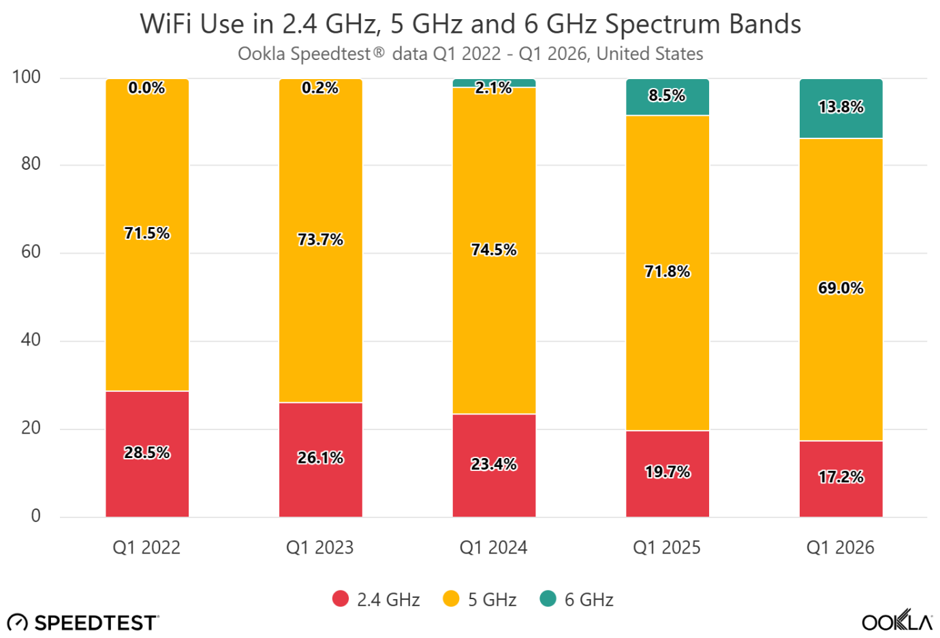
The rapid Wi-Fi 7 transition is being supported by greater utilization of the 6 GHz spectrum band, which provides 1,200 MHz of spectrum between 5.925 GHz and 7.125 GHz.
Ookla found that U.S. 6 GHz usage increased 62 percent between Q1 2025 and Q1 2026, reaching 13.8 percent of total U.S. Speedtest samples.
The increase reflects a growing installed base of compatible Wi-Fi routers as well as smartphones, laptops and tablets capable of using the additional spectrum.
Access to 6 GHz can provide more capacity for demanding applications while reducing congestion on traditional Wi-Fi bands, making it an important component of the Wi-Fi 7 value proposition.
U.S. Broadband Speed Reaches 316.34 Mbps
Wi-Fi 7 adoption is arriving at the same time that U.S. fixed broadband networks are becoming significantly faster.
Download speed across fixed providers reached 316.34 Mbps in Q1 2026, an increase of 76 percent compared with Q1 2022.
Upload speed reached 68.31 Mbps, approximately three times the Q1 2022 level.
Cable network upgrades involving mid-split and high-split architectures have played an important role in boosting upstream performance, while fiber networks generally offer stronger symmetrical download and upload capacity.
Xfinity illustrates the impact of these broadband upgrades.
Xfinity customers noted that its Wi-Fi 6E upload speed jumped from 41.74 Mbps in Q1 2025 to 99.43 Mbps in Q1 2026. Wi-Fi 7 upload performance surged from 41.45 Mbps to 108.76 Mbps during the same period.
The figures demonstrate that simply installing a Wi-Fi 7 router does not guarantee performance improvements. Customer experience ultimately depends on the broadband connection, gateway, compatible client devices, home network conditions and available network capacity.
Wi-Fi 7 Creates New Router and Broadband Equipment Opportunity
The transition is also creating a significant equipment refresh opportunity across the broadband customer-premises equipment market.
Ookla’s dataset covered more than 150 router vendor entities.
Chinese vendors, primarily TP-Link, represented 16 percent of sample volume across all Wi-Fi bands and generations combined, but accounted for almost no Wi-Fi 6E or Wi-Fi 7 routers in the dataset.
Many routers leased by U.S. internet service providers come from suppliers such as Sagemcom and CommScope, while Chinese-manufactured routers have traditionally had a stronger presence in retail channels.
The broadband CPE ecosystem also includes Vantiva, Sercomm, Arcadyan, Hitron and Askey, creating a diverse supplier base as operators replace older home gateways.
Vantiva’s recent performance provides another indication of the broadband equipment upgrade cycle. Its Broadband business generated €1.336 billion in revenue during 2025, up 9.1 percent from €1.224 billion in 2024.
The company said demand benefited from innovations including Wi-Fi 7 and DOCSIS 4.0, alongside new device generations. Its portfolio includes GPON Wi-Fi 7 equipment, a Wi-Fi 7 fiber gateway and a Wi-Fi 7 extender.
Wi-Fi 7 Could Become Critical for the AI-Ready Home
Wi-Fi 7’s opportunity extends beyond faster internet speed as artificial intelligence, cloud computing, augmented reality, high-resolution video and immersive applications increase demands on home networks.
Ookla identifies latency as particularly important for augmented reality and multimodal AI applications, which work best at latency levels below 20 milliseconds.
Fiber broadband is approximately 10 milliseconds quicker than cable, according to Ookla.
That makes improvements in upstream performance increasingly important. AI-generated content, cloud applications, real-time collaboration, video uploads and interactive experiences depend on upload capacity as well as download speed.
Wi-Fi 7 technologies such as wider channels, Multi-Link Operation and access to the 6 GHz band can improve how traffic moves across the home network. However, Wi-Fi performance will remain closely tied to the underlying fiber or cable broadband connection.
Wi-Fi 4 Still Accounts for 10 Percent of Speedtest Samples
Despite rapid growth in Wi-Fi 7, the U.S. market remains a multi-generation environment.
Wi-Fi 4’s share of Speedtest samples declined from 13 percent in Q1 2025 to 10 percent in Q1 2026, indicating that millions of older Wi-Fi devices and routers remain in operation.
This creates a long upgrade runway for broadband providers and equipment suppliers.
Not every customer necessarily requires Wi-Fi 7 immediately. Depending on broadband speed, connected devices and usage requirements, moving from older technology to Wi-Fi 6 or Wi-Fi 6E could still deliver a substantial improvement.
The transition is therefore likely to unfold gradually rather than through a single mass replacement cycle.
FCC Router Rules Could Reshape U.S. Equipment Supply
Regulatory developments could also influence the competitive landscape for broadband routers.
On March 23, 2026, the FCC added routers produced in foreign countries to its Covered List following a national security determination involving foreign-produced consumer routers.
Ookla’s analysis indicates the policy may have a limited immediate impact on Wi-Fi 7 deployment because Chinese vendors represented almost none of the Wi-Fi 6E and Wi-Fi 7 hardware identified in its dataset.
The regulatory change could instead create additional opportunities for compliant broadband equipment suppliers as U.S. internet providers accelerate gateway replacement programs.
Wi-Fi 8 Is Coming, But Wi-Fi 7 Has Only Reached 7.2 Percent
The networking industry is already preparing for the next technology cycle even as Wi-Fi 7 adoption is only beginning to gain meaningful scale.
Wi-Fi 8 prototypes are approaching and commercial products are expected in about two years, while industry discussions around Wi-Fi 9 standards have already started.
That creates an unusual market dynamic.
Wi-Fi 7 adoption in the U.S. reached only 7.2 percent in Q1 2026, despite expanding 300 percent from 1.8 percent in Q1 2025. The overwhelming majority of broadband customers therefore have yet to move to the latest generation.
For U.S. broadband operators, this represents a substantial opportunity.
The next stage of competition will increasingly involve more than advertising faster broadband speeds. Operators will need to combine multi-gigabit fiber or upgraded cable networks, Wi-Fi 7 gateways, 6 GHz spectrum, stronger upload performance and compatible consumer devices to deliver a faster whole-home experience.
Wi-Fi 8 and Wi-Fi 9 may already be on the technology industry’s roadmap, but Wi-Fi 7 is only now entering its most important commercial growth phase in the U.S. broadband market.
FASNA SHABEER