The telecom industry’s IoT strategy is moving beyond basic cellular connectivity toward satellite IoT, 5G RedCap, eSIM, AI-powered analytics, smart utilities, edge computing and global connectivity orchestration.
Below is a summary of recent IoT initiatives from seven major mobile operators.
China Mobile
China Mobile is positioning IoT as part of a move toward 5G-Advanced, AI, satellite-terrestrial connectivity and massive machine communications. Its opportunity is being reinforced by China’s new national IoT development programme, which aims to expand the country’s core IoT industry to more than RMB 3.5 trillion, or about US$505.8 billion, by 2028. China is targeting 10 billion IoT terminal connections and plans to formulate or revise more than 50 advanced IoT standards by 2028.
For China Mobile, this creates a major expansion opportunity spanning industrial IoT, connected vehicles, smart cities, utilities and satellite-enabled IoT. China is also promoting low-Earth-orbit satellite communications and direct satellite connectivity, which could ultimately allow operators such as China Mobile to extend IoT coverage beyond terrestrial cellular networks.
China Mobile remained the world’s largest cellular IoT connectivity provider, ending 2025 with 1.48 billion connections, an increase of 5 percent year-on-year.
China Telecom
China Telecom is expanding IoT as part of its cloud-network integration, industrial digitalization, 5G and satellite communications strategy. The operator is well placed in satellite-connected applications because of its established satellite communications capabilities, alongside its terrestrial mobile and cloud infrastructure.
China Telecom’s emerging IoT opportunity extends from conventional NB-IoT and 5G connections into industrial IoT, smart cities, connected transportation and integrated satellite-terrestrial IoT.
China Telecom ranked second with 746 million IoT connections, followed closely by China Unicom with 723 million.
Vodafone
Vodafone is taking its IoT strategy toward intelligent connectivity, 5G Standalone, network slicing, AI and satellite coverage. Vodafone IoT already connects more than 230 million devices globally, giving the business one of the largest cellular IoT footprints among international telecom operators.
Vodafone and Topcon Positioning Group are developing a mass-market positioning service capable of locating connected vehicles, machinery and IoT devices to within a few centimetres, compared with the few-metre accuracy available from standalone satellite navigation.
Vodafone is also looking beyond conventional IoT connectivity toward differentiated performance through 5G Standalone and network slicing, allowing customers to select different connectivity characteristics for applications ranging from asset tracking to critical infrastructure.
Vodafone remained the largest Western IoT connectivity provider with 234 million connections.
AT&T
AT&T has made AI-driven IoT network intelligence and edge computing central to its latest enterprise IoT push. AT&T IoT Network Intelligence, announced at the CES 2026, is designed to give businesses greater visibility into connected-device performance.
AT&T followed this by making Connected Spaces its first end-to-end IoT solution available through AWS Marketplace. Connected Spaces provides plug-and-play sensors and near-real-time monitoring of temperature, humidity, motion and energy consumption, targeting sectors including retail, hospitality, healthcare, warehouses and property management.
In March 2026, AT&T announced work with Cisco and NVIDIA on network-driven edge AI for enterprises. The architecture combines AT&T’s dedicated IoT core, Cisco Mobility Services Platform and NVIDIA AI infrastructure to enable AI inference closer to where IoT data is generated.
AT&T has 160 million IoT connections.
Bharti Airtel
Bharti Airtel is concentrating on smart utilities, smart metering and multi-network IoT connectivity in India. Its IoT connectivity portfolio now spans 5G, 4G, NB-IoT, LTE-M, 2G and satellite connectivity, with dual-profile eSIM capabilities designed to maintain device connectivity across networks.
Its Smart Meter Systems combine Head-End Systems, Meter Data Management, cloud applications and network analytics. Airtel says the solution can support millions of customers and deliver a 50 percent reduction in deployment, while supporting RF and cellular communications.
Airtel reached 69 million IoT connections and recorded the strongest annual growth among the leading operators.
Verizon
Verizon is building its IoT strategy around ThingSpace, eSIM, satellite IoT, 5G RedCap, AI analytics and global IoT orchestration. Its current IoT networking portfolio includes LTE Cat-M1, NB-IoT, 5G RedCap, satellite connectivity, Private 5G and Global IoT Orchestration, while ThingSpace Intelligence provides device and data insights that can feed AI models.
One of Verizon’s most significant recent expansions is Global IoT Orchestration. Through partnerships with Singtel, Bell Canada and Telenor IoT, Verizon customers can manage international device connectivity through ThingSpace. Verizon says its IoT customers can access wireless services across up to 200 territories using satellite, roaming and native eSIM connectivity. Skylo provides satellite IoT capabilities where conventional cellular coverage is unavailable or unreliable.
Adoption indicators are significant. Verizon reported 240 percent growth in the monthly average for eSIM connectivity on ThingSpace. Its IoT research found 72 percent of transportation respondents using IoT for fleet management, while 60 percent of energy and utility respondents use smart meters and 48 percent use smart grids.
Verizon has 62 million IoT connections.
Deutsche Telekom
Deutsche Telekom has announced the world’s first multi-orbit IoT roaming service that enables IoT devices to switch between terrestrial mobile networks and satellite connectivity.
Deutsche Telekom combines its NB-IoT and LTE-M network with satellite providers. Skylo provides GEO satellite coverage, while Sateliot and OQ Technology provide connectivity through LEO satellites.
Deutsche Telekom says Iridium NTN Direct is scheduled to become available to its business customers during the second half of 2026.
Deutsche Telekom has 69 million IoT connections.
Cellular IoT connections
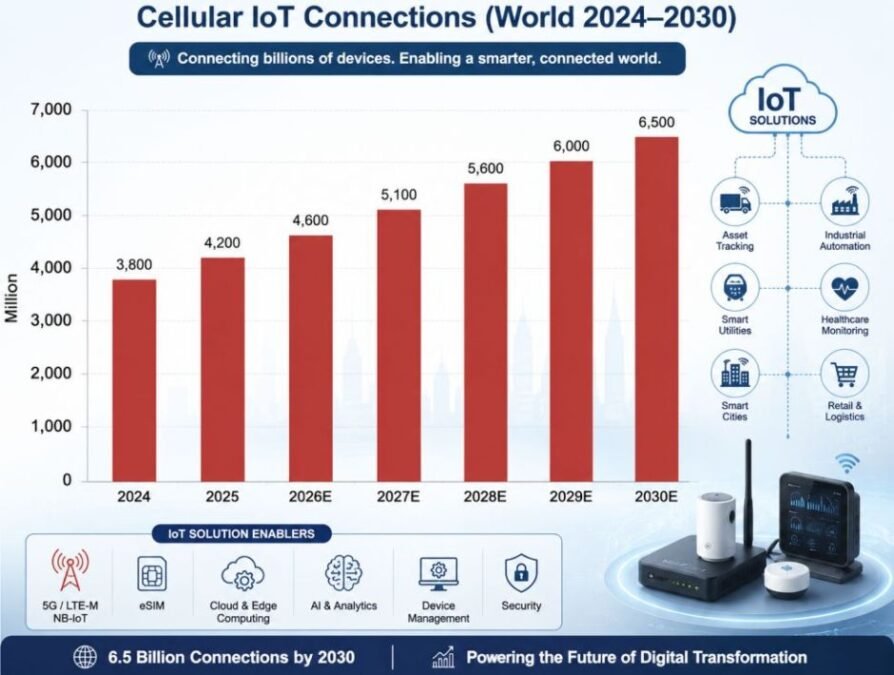
Global cellular IoT connections increased 11 percent to 4.2 billion at the end of 2025, according to Berg Insight, accounting for around 32 percent of all mobile subscriptions worldwide.
Berg Insight forecasts cellular IoT connections will increase from around 3.8 billion in 2024 to 4.2 billion in 2025, surpass 5 billion in 2027 and reach 6.5 billion by 2030, representing a 9.3 percent compound annual growth rate (CAGR).
Global cellular IoT connectivity revenue increased 5 percent in 2025 to €14.5 billion and is forecast to reach approximately €21.5 billion by 2030, reflecting an 8.1 percent CAGR.
Monthly IoT ARPU is projected to decline from €0.31 in 2025 to €0.28 in 2030. Monthly ARPU already fell 7 percent during 2025, highlighting the pricing pressure created by competition and rapid growth in low-bandwidth IoT connections.
China Accounts for Around 70 Percent of Global Cellular IoT Connections
China remained by far the world’s largest cellular IoT market at the end of 2025.
The country recorded approximately 2.9 billion cellular IoT connections, equivalent to around 70 percent of the global installed base, following annual growth of 5 percent.
North America had 321 million cellular IoT connections, while Western Europe recorded 313 million.
South Asia, Latin America and Central & Eastern Europe each had between 93 million and 142 million connections. The Middle East, Africa and Southeast Asia each recorded between 41 million and 53 million, while Australia & Oceania had approximately 22 million cellular IoT connections.
FASNA SHABEER