Samsung’s Q3 2026 earnings highlight strong memory demand, rising component costs for smartphones and a changing procurement environment for telecom operators.
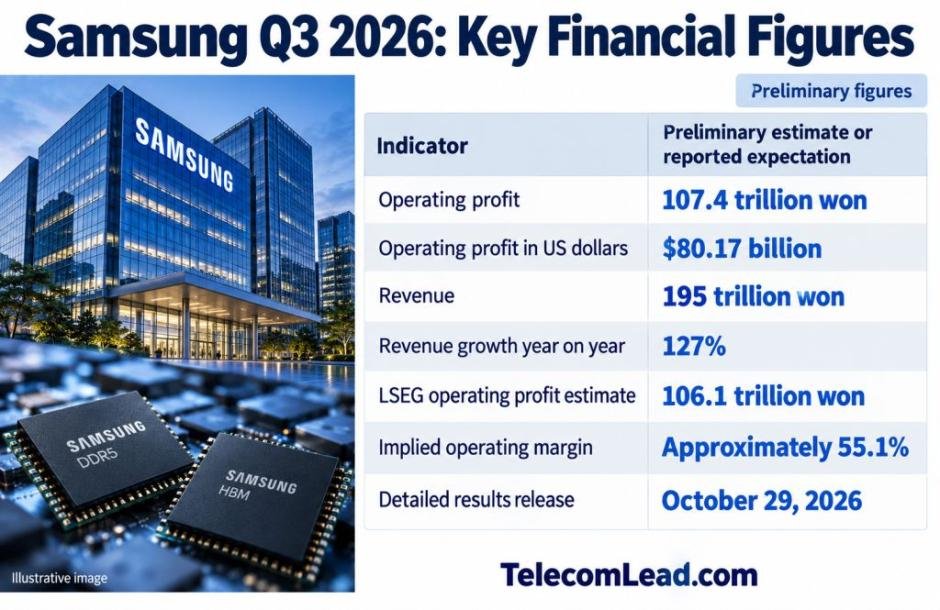
Samsung Electronics has forecast third-quarter 2026 operating profit of 107.4 trillion won ($80.17 billion), nearly nine times the year-earlier level, as spending on artificial intelligence infrastructure drives demand for memory chips.
Revenue for the July–September period is expected to increase 127 percent to 195 trillion won.
For telecom operators, the results raise a practical question: how will sustained demand for AI infrastructure affect the cost and availability of memory used in servers, storage systems and connected devices?
Samsung’s memory business is benefiting from higher prices and growing demand. However, its smartphone and consumer electronics businesses face pressure from the same component inflation. This uneven performance makes the forthcoming divisional results important for assessing the durability of the earnings surge.
The implied operating margin is calculated by dividing preliminary operating profit by estimated revenue. It represents Samsung’s consolidated performance, rather than the margin of its memory division.
The guidance marks Samsung’s fourth consecutive quarter of record operating profit. Detailed business performance will be available through Samsung’s earnings releases when the company publishes its full results.
AI Demand Supports HBM, DRAM and NAND Sales
Memory chips are expected to account for most of Samsung’s earnings improvement. Three product categories help explain the demand.
High-bandwidth memory, or HBM, supplies the bandwidth required by advanced AI accelerators. It supports the rapid movement of data needed for demanding AI workloads.
Conventional DRAM provides working memory in servers, computers and smartphones. AI infrastructure also requires substantial system memory beyond the HBM attached to accelerators.
NAND flash supports persistent storage, including solid-state drives used to hold data, applications and AI models.
These categories serve different functions, but all contribute to the infrastructure supporting AI services. Samsung’s performance therefore reflects a broader memory market opportunity than HBM alone.
Douglas Kim of Douglas Research Advisory estimated that Samsung’s HBM bit shipments increased by close to 50 percent quarter on quarter in Q3. That estimate points to rising shipment volume as Samsung seeks to strengthen its position against SK Hynix, Reuters news report said.
Shipment growth alone does not establish a corresponding gain in market share. Competitor shipments, product mix, selling prices and customer adoption are also needed to assess Samsung’s competitive progress.
Memory Prices Continue Rising at a Slower Pace
The earnings outlook depends on how long memory prices can continue increasing.
TrendForce expects conventional DRAM contract prices to rise 10–15 percent quarter on quarter in Q4, compared with an increase of roughly 60 percent in Q2.
The distinction matters: a moderation in price growth still means buyers face higher prices. It does not mean memory prices are falling.
For Samsung, slower increases could reduce the pace of earnings expansion. Analysts expect Q4 operating profit to grow 8.2 percent sequentially, compared with approximately 20 percent growth in Q3.
Samsung and Micron expect the demand–supply imbalance to persist into 2028. That outlook remains subject to changes in production capacity, Chinese competition and the pace of AI infrastructure spending.
The key question is whether shipment growth and a stronger product mix can sustain earnings as the contribution from sharp price increases moderates.
What Telecom Operators Should Watch
Telecom operators planning cloud infrastructure, edge computing, analytics platforms or AI services should examine memory costs within equipment proposals.
The impact will vary by workload. An AI accelerator platform, a virtualised network server and a storage expansion have different memory requirements. HBM pricing cannot be applied directly to every telecom infrastructure purchase.
Smartphone Business Faces Component Cost Pressure
Samsung’s memory gains are accompanied by pressure elsewhere in the group.
Analysts estimate that its mobile business recorded a Q3 loss exceeding $1 billion.
Higher memory costs create difficult choices for smartphone manufacturers. Vendors can absorb the increase, adjust specifications, change their product mix or raise selling prices. Each decision has implications for margins and customer demand.
Foundry Recovery Depends on Utilisation
Samsung’s contract chipmaking business faces a separate challenge.
Analysts expect the foundry division to remain loss-making because of high fixed costs and low utilisation rates. Manufacturing facilities require substantial spending even when production volumes are insufficient to spread those costs efficiently.
Utilisation is expected to improve over the coming quarters as demand for advanced manufacturing processes strengthens.
Samsung continues to seek a stronger position against TSMC. Assessing that progress requires evidence of customer commitments, manufacturing yields, production volumes and profitability.
Strong memory earnings should therefore be evaluated separately from foundry recovery. The two businesses have different demand drivers and operating constraints.
October 29 Results Will Test Earnings Sustainability
Samsung’s full results should provide a clearer picture of the balance between memory growth and pressure on its other businesses.
The disclosures will include memory divisional profitability, HBM sales contribution, capital expenditure, mobile margins and foundry utilisation. Management’s outlook for pricing and customer demand will also help determine whether earnings growth is becoming more dependent on shipment volume.
Samsung’s preliminary Q3 performance demonstrates the earnings power of strong memory demand. Its October 29 disclosures will show how effectively that strength translates into sustained profitability across the wider group.
BABURAJAN KIZHAKEDATH