
The global DRAM industry revenue climbed 81 percent quarter-on-quarter to reach $97 billion during the first quarter of 2026.
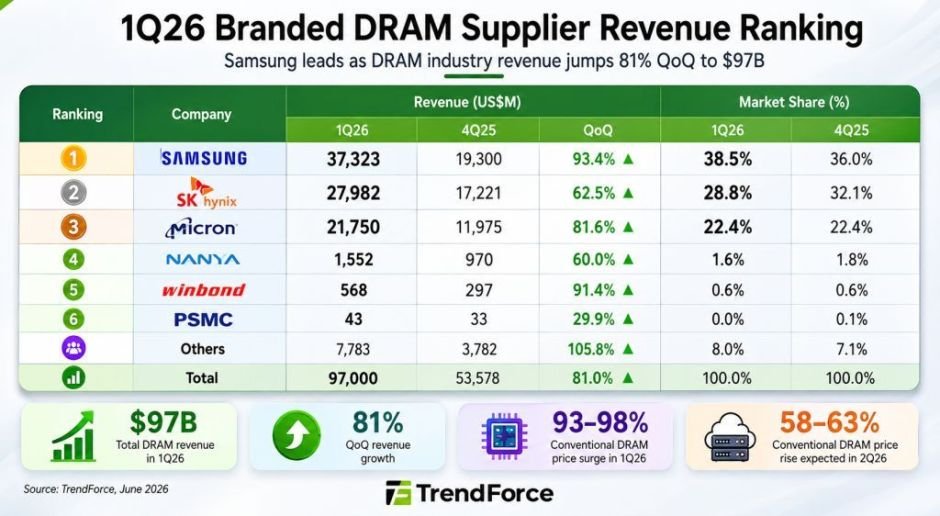
The growth in the DRAM business was fueled by an unprecedented rise in memory contract prices and strong demand from AI-driven data center deployments, according to TrendForce. Conventional DRAM contract prices increased approximately 93-98 percent.
The memory market is undergoing a significant transformation as artificial intelligence workloads evolve from large language model (LLM) training toward AI inference. Cloud service providers (CSPs) are increasingly shifting investments from dedicated AI servers to general-purpose servers capable of supporting a broader range of AI applications. This transition is expanding memory demand beyond high-bandwidth memory (HBM3e), LPDDR5X, and high-capacity RDIMMs to include a wider portfolio of RDIMM products.
Supply conditions remain exceptionally tight. TrendForce noted that DRAM manufacturers continue to prioritize production of high-capacity RDIMMs for AI servers, leaving limited supply available for PC manufacturers and smartphone vendors. With inventory levels at major DRAM suppliers remaining extremely low, conventional DRAM bit shipment growth is expected to stay constrained throughout the second quarter.
The pricing environment is also expected to remain favorable for memory suppliers. Major cloud operators have demonstrated a greater willingness to absorb higher memory costs to secure supply allocations, encouraging other customers to follow suit. As a result, TrendForce forecasts conventional DRAM contract prices will rise by another 58 percent to 63 percent during the second quarter of 2026.
Samsung Electronics strengthened its leadership position in the DRAM market during the first quarter. Supported by the strongest average selling price growth among the top three suppliers and robust server DRAM sales, Samsung generated $37.32 billion in revenue, representing a 93.4 percent increase from the previous quarter. The company expanded its market share to 38.5 percent.
SK Hynix maintained its position as the second-largest DRAM supplier, benefiting from the industry’s highest mix of HBM shipments. However, declining HBM contract prices in 2026 moderated overall pricing gains. The company reported revenue of $27.98 billion, up 62.5 percent quarter-on-quarter, capturing a 28.8 percent market share.
Micron Technology remained the third-largest supplier, posting revenue growth of 81.6 percent to $21.75 billion while maintaining a stable 22.4 percent market share.
The industry’s top three vendors continue to focus production on premium server memory products that offer higher margins. With new fabrication facilities requiring substantial investment and long construction timelines, suppliers are expected to rely mainly on process technology migrations and manufacturing optimization to increase bit output during 2026.
Taiwanese memory manufacturers are also benefiting from the current market dynamics. Nanya Technology reduced inventory levels significantly during the quarter and benefited from rising DDR4 and DDR3 prices, driving revenue up 60 percent to $1.55 billion.
Winbond recorded one of the strongest growth rates among smaller suppliers, with revenue rising 91.4 percent quarter-on-quarter to nearly $568 million due to higher shipments of DDR4 and LPDDR4 products.
Powerchip Semiconductor Manufacturing Corporation (PSMC) reported a 29.9 percent increase in revenue from its internally produced consumer DRAM products, reaching $43 million. Total company revenue, including foundry operations, increased 19.3 percent. Following its technology licensing agreement with Micron, PSMC is expected to accelerate capacity expansion and strengthen its position in the DRAM market.
Looking ahead, continued AI infrastructure investments, constrained supply growth, and strong demand for server memory are expected to keep DRAM pricing elevated throughout 2026, creating favorable conditions for memory manufacturers worldwide.
BABURAJAN KIZHAKEDATH