
TIM is executing a multi-pronged fiber strategy centered on expanding its FTTH footprint, integrating I-Systems, improving asset utilization, launching converged broadband services and increasing monetization of its fiber infrastructure.
The strategy is delivering strong financial and operational results, with fixed service revenue increasing 27.0 percent to R$416 million in the second quarter of 2026 and 24.9 percent to R$808 million during the first half of 2026.
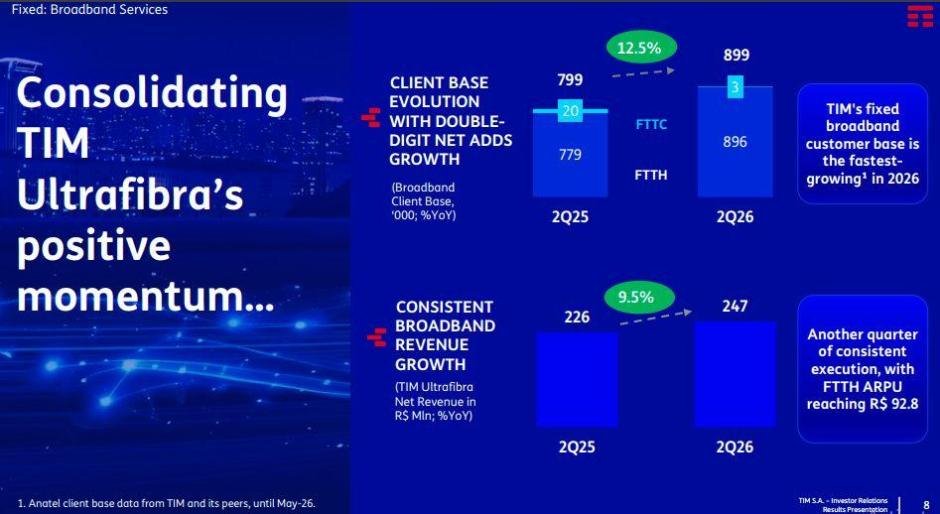
TIM Ultrafibra revenue grew 9.5 percent to R$247 million in the second quarter and 10.4 percent to R$490 million in the first six months of 2026, reflecting sustained demand for fiber broadband services. Overall service revenue increased 5.7 percent to R$6.79 billion in the quarter and 6.1 percent in the first half, with fiber broadband remaining one of the major growth contributors.
Customer expansion remains at the core of TIM’s fiber strategy. The broadband customer base rose 12.5 percent to 899,000 subscribers, adding more than 100,000 net customers since June 2025. The network is now almost entirely fiber, with 896,000 FTTH customers, representing 15.0 percent annual growth, while only 3,000 FTTC customers remain.
According to Anatel data through May 2026, TIM has become the fastest-growing fixed broadband provider in Brazil by customer additions. Broadband monetization also continued to improve, with FTTH ARPU reaching R$92.8, while TIM Ultrafibra ARPU stood at R$93.3, supporting another quarter of consistent broadband revenue growth.
“TIM Ultrafibra maintained a positive trajectory, with revenue growth for the third consecutive quarter and a 12.5 percent rise in the customer base, reflecting another consistent evolution of an operation that is today practically 100 percent FTTH,” TIM said.
Capex of TIM was R$935 million in Q2-2026. TIM does not reveal its specific investment in fiber related projects. TIM said the 6 percent increase in Capex was driven by investments in IT and other initiatives supporting the company’s technological and operational development, as well as the consolidation of fiber investments related to ISystems in the Network line.
The acquisition and integration of I-Systems represents the next phase of TIM’s fiber strategy. The company aims to extract operational efficiency by fully controlling I-Systems’ fiber infrastructure, increase asset monetization by raising broadband take-up within its existing footprint, optimize its broadband portfolio to better align with customer needs across covered markets, and strengthen commercial execution. TIM also expects I-Systems to support future network expansion while improving utilization of its owned fiber assets with spare capacity. The acquisition also contributed to higher investment during the quarter, with fiber investments consolidated within network Capex.
Convergence is another major pillar of TIM’s broadband strategy. The company introduced TIM Ultracombo, its first integrated Fiber + Mobile + Content proposition that combines broadband, mobile connectivity and entertainment services. The offering includes individual and family plans, regional offers, dedicated customer service, exclusive discounts, and one bill for all services, creating a simplified customer experience while increasing opportunities for cross-selling and customer retention. TIM is complementing its fiber strategy with broader digital transformation and network investments. The company plans to leverage its owned fiber assets to increase customer penetration, improve asset utilization and support converged services. Fiber expansion is also expected to benefit from ongoing AI-enabled operational improvements, network automation and digital customer engagement initiatives. Looking ahead, TIM views broadband as one of its primary growth engines and plans to continue expanding fiber adoption through I-Systems integration, convergence between mobile and fixed services, improved commercial effectiveness and higher monetization of its nationwide FTTH infrastructure.