TIM delivered another quarter of profitable growth in the second quarter of 2026, supported by higher mobile and fiber revenues, record mobile ARPU, expanding B2B digital services, disciplined capital investment and stronger cash generation.
The Brazilian telecom operator reported total net revenue of R$6.97 billion, up 5.5 percent, while first-half revenue increased 6.0 percent to R$13.77 billion.
Service revenue of TIM grew 5.7 percent to R$6.79 billion during the quarter, driven by mobile, broadband, fiber, IoT and enterprise digital services.
TIM’s mobile business improved monetization despite a slightly smaller subscriber base. Total mobile subscribers stood at 61.88 million, including 33.67 million postpaid customers, up 6.8 percent, while prepaid customers declined 8.0 percent to 28.21 million.
Mobile service revenue of TIM increased 4.6 percent to R$6.37 billion, helping mobile ARPU reach a record R$34.3, an increase of 5.0 percent. Postpaid ex-M2M ARPU improved to R$55.7, prepaid ARPU increased to R$14.4, while overall postpaid ARPU was R$43.8. Monthly churn remained well controlled at 3.0 percent, compared with 2.9 percent a year earlier, reflecting stable customer retention despite intense market competition.
TIM’s fiber broadband business remained one of its strongest growth engines. Fixed service revenue surged 27.0 percent to R$416 million, while TIM Ultrafibra revenue increased 9.5 percent to R$247 million. The broadband customer base expanded 12.5 percent to 899,000, including 896,000 FTTH customers, representing 15.0 percent annual growth.
FTTH ARPU reached R$92.8, while operational indicators reported TIM Ultrafibra ARPU at R$93.3. TIM launched TIM Ultracombo, integrating fiber broadband and mobile services into a converged offer designed to improve customer acquisition and retention. The acquisition of I-Systems strengthens the company’s FTTH expansion strategy and increases commercial opportunities across existing fiber coverage.
Enterprise connectivity, digital services and AI-enabled data monetization continued to diversify revenue. B2B service revenue excluding wholesale increased 16.6 percent over the last twelve months to R$1.746 billion, representing 6.6 percent of total service revenue. New enterprise contracts signed during the quarter reached a record R$192 million, supported by demand from logistics, utilities, agribusiness and smart city projects.
TIM Ads and Open Gateway recorded campaign growth of more than 50 percent, while the company expanded its API portfolio to seven commercially available APIs. TIM Insights and Audience Builder now utilize more than 1,300 data points combined with artificial intelligence to improve audience segmentation, campaign personalization and enterprise data monetization.
TIM expanded its digital ecosystem through partnerships across financial, insurance and healthcare services. Insurance penetration reached approximately 36 percent of device sales, the consortium partnership with KSK surpassed 1 million registered TIM customers, while the healthcare partnership with Cartão de Todos generated more than 1.6 million leads and over 288,000 cumulative subscriptions. The company also introduced a redesigned TIM Play platform and a more flexible TIM Controle portfolio to improve customer engagement and increase recurring digital revenue.
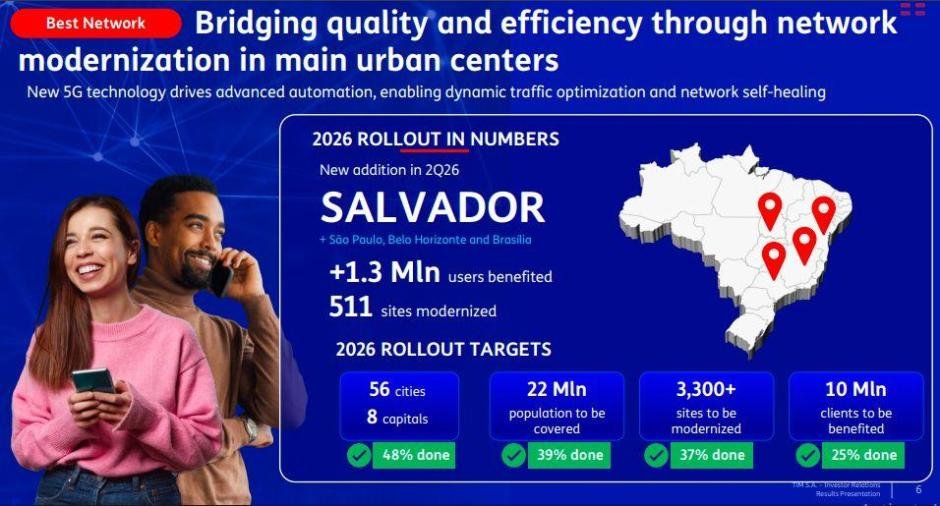
Capital investment remained focused on network modernization, IT infrastructure and fiber expansion. Capex increased 6.0 percent to R$935 million, equivalent to 13.4 percent of net revenue, while first-half Capex reached R$2.29 billion, up 3.0 percent.
TIM said network investments accounted for R$647 million, while IT and other investments totaled R$288 million. The higher investment reflected increased spending on IT modernization and consolidation of I-Systems’ fiber assets. Operating cash flow climbed 8.7 percent to R$1.87 billion, operating free cash flow rose 10.1 percent to R$1.24 billion, and cash holdings totaled R$4.53 billion at the end of June.
BABURAJAN KIZHAKEDATH